




In a triangle ABC, AD is a median and E is the midpoint of median AD. A line through B and E meets AC at point F. Prove that $AC = 3AF$
Answer
 Verified
595.8k+ views
Hint:For this question mid-point theorem is to be used.
Mid-point theorem: - It says a line segment joining the mid-points of two sides of a triangle is parallel to the third side and equal to half the length of the third side.
Example: -
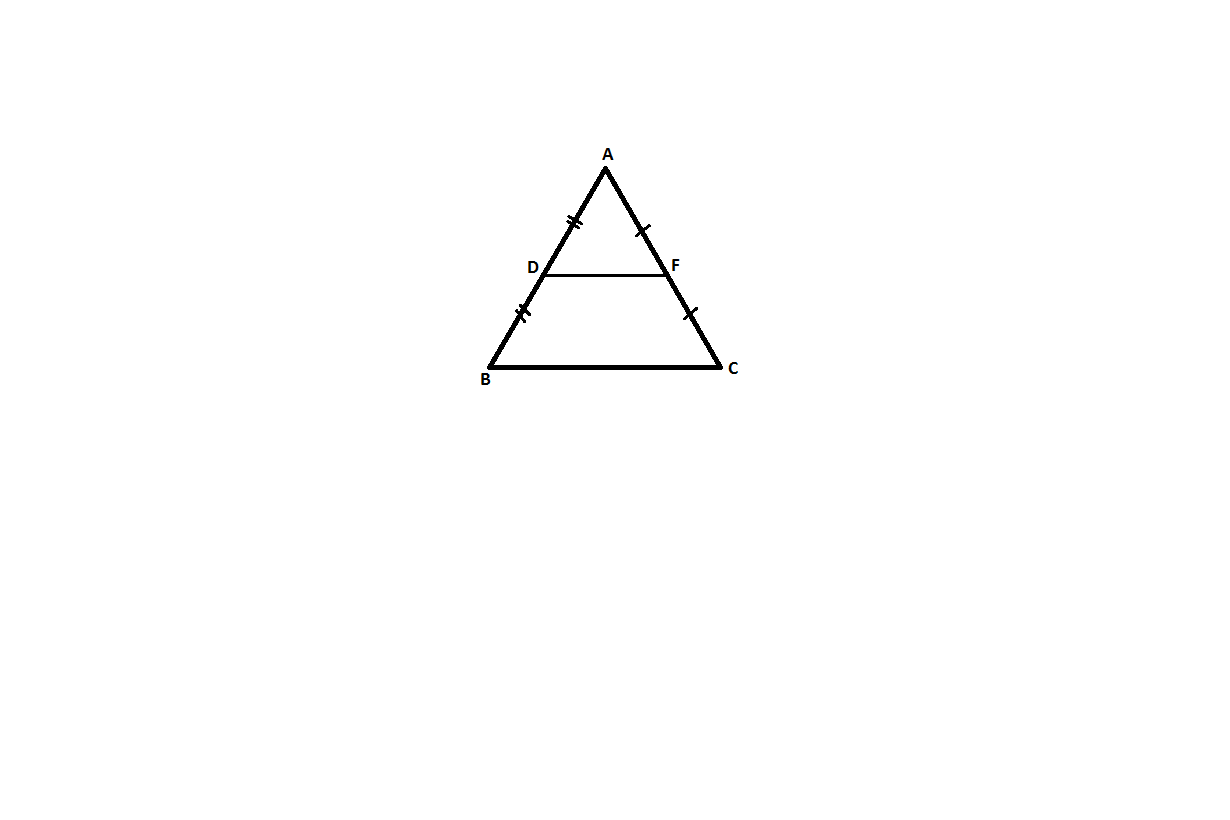
In triangle ABC, D is midpoint of AB and E is midpoint of AC.
$
\therefore DF//BC\\
\therefore DF = \dfrac{1}{2}BC $
So we can say that it bisects the line into two equal parts.
Complete step-by-step answer:
Construction: - Draw DG parallel to BF, which meets FC at G.
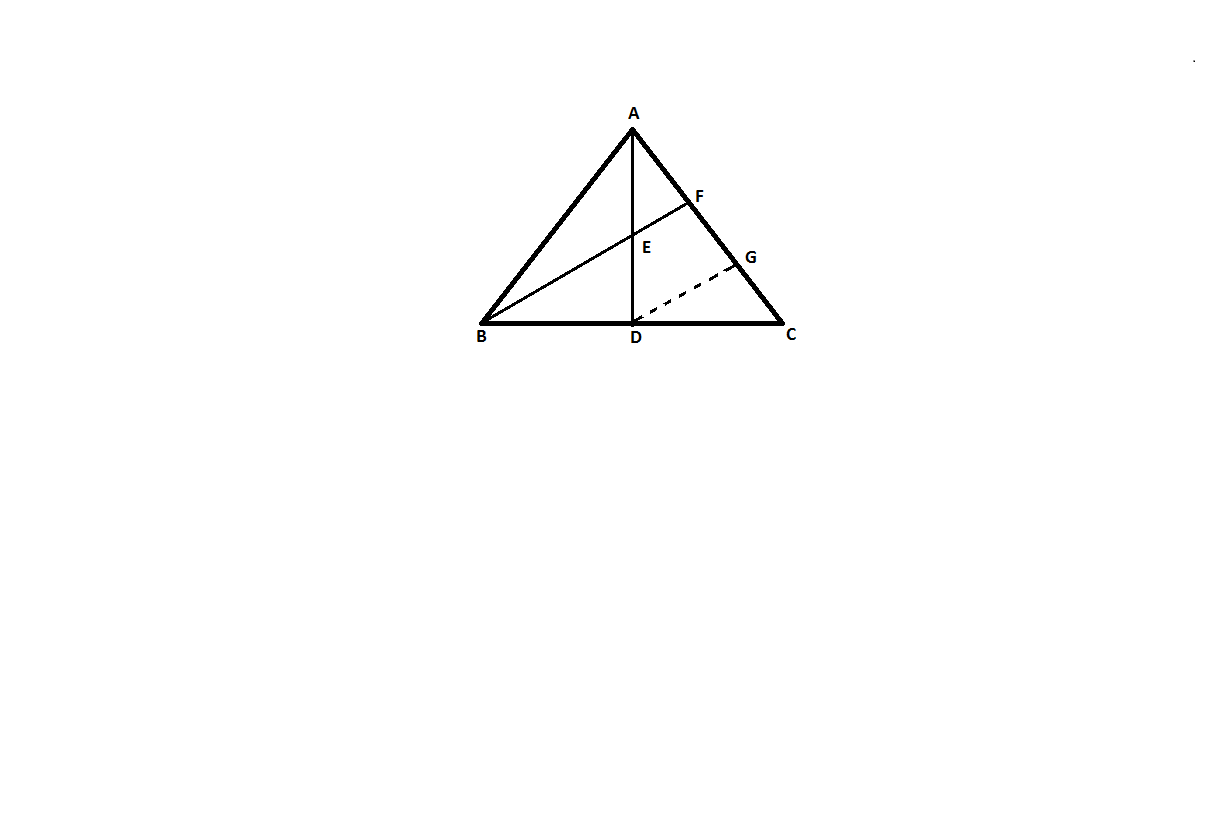
Proof: - In triangle ABC, AD is median and E is the midpoint of AD.
In and E is the midpoint of AD. Hence, F is midpoint of AG (midpoint theorem)
Or, $AF = FG$ ................equation(1)
In and D is the midpoint of BC.
$\therefore $ G is midpoint of CF (midpoint theorem)
Or, $FG = GC$ .................equation(2)
From equation (1) and (2)
$AF = FG = GC$
Since: - $AC = AF + FG + GC$
$AC = 3AF$
Hence proved.
Note: Carefully observe the hint which is given in the question and then proceed for the question. Here $DG\parallel BF$ gives a hint that the mid- point theorem is to be used. Similar questions can be framed with the use of a converse mid-point theorem.
Converse mid-point theorem: - It states that when a line is drawn through the midpoint of a side of a triangle which is parallel to the second side then it will bisect the third side.
Mid-point theorem: - It says a line segment joining the mid-points of two sides of a triangle is parallel to the third side and equal to half the length of the third side.
Example: -
In triangle ABC, D is midpoint of AB and E is midpoint of AC.
$
\therefore DF//BC\\
\therefore DF = \dfrac{1}{2}BC $
So we can say that it bisects the line into two equal parts.
Complete step-by-step answer:
Construction: - Draw DG parallel to BF, which meets FC at G.
Proof: - In triangle ABC, AD is median and E is the midpoint of AD.
In and E is the midpoint of AD. Hence, F is midpoint of AG (midpoint theorem)
Or, $AF = FG$ ................equation(1)
In and D is the midpoint of BC.
$\therefore $ G is midpoint of CF (midpoint theorem)
Or, $FG = GC$ .................equation(2)
From equation (1) and (2)
$AF = FG = GC$
Since: - $AC = AF + FG + GC$
$AC = 3AF$
Hence proved.
Note: Carefully observe the hint which is given in the question and then proceed for the question. Here $DG\parallel BF$ gives a hint that the mid- point theorem is to be used. Similar questions can be framed with the use of a converse mid-point theorem.
Converse mid-point theorem: - It states that when a line is drawn through the midpoint of a side of a triangle which is parallel to the second side then it will bisect the third side.
Recently Updated Pages
Master Class 10 Computer Science: Engaging Questions & Answers for Success

Master Class 10 General Knowledge: Engaging Questions & Answers for Success
Master Class 10 English: Engaging Questions & Answers for Success
Master Class 10 Social Science: Engaging Questions & Answers for Success
Master Class 10 Maths: Engaging Questions & Answers for Success
Master Class 10 Science: Engaging Questions & Answers for Success
Trending doubts
What is the median of the first 10 natural numbers class 10 maths CBSE
Which women's tennis player has 24 Grand Slam singles titles?
Who is the Brand Ambassador of Incredible India?
Why is there a time difference of about 5 hours between class 10 social science CBSE
Write a letter to the principal requesting him to grant class 10 english CBSE
A moving boat is observed from the top of a 150 m high class 10 maths CBSE