




In an isosceles triangle \[ABC\left( {AB = AC} \right)\], the altitude to the base and to the lateral side are equal to 10 cm and 12 cm respectively. The length of the base is
A. 12.5
B. 15
C. 16
D. 18
Answer
 Verified
593.7k+ views
Hint: In this question, we will be using the formula of half-angles in trigonometry and using the sides of the triangle we will obtain the unknown sides. Also, we will use the property of altitude to the base in case of isosceles triangle to get the required solution. So, use this concept to reach the solution of the given problem.
Complete step by step answer:
Given \[\Delta ABC\] is an isosceles triangle with \[AB = AC\]. Let \[AD\] be the altitude to the base and \[CE\] be the altitude to the lateral side whose length are equal to 10 cm and 12 cm respectively as shown in the below figure:
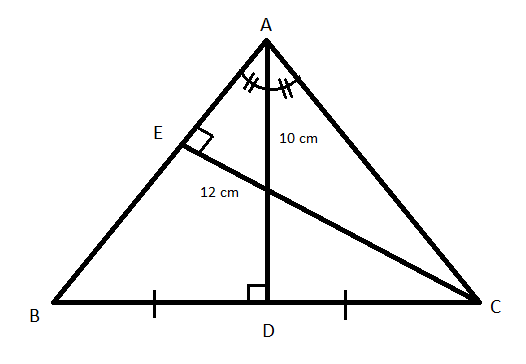
By applying \[\sin B\] in \[\Delta ABD\] and \[\Delta BCE\], we get
\[
\Rightarrow \sin B = \dfrac{{AD}}{{AB}} = \dfrac{{CE}}{{BC}} \\
\Rightarrow \sin B = \dfrac{{10}}{{AB}} = \dfrac{{12}}{{BC}} \\
\Rightarrow \dfrac{{10}}{{AB}} = \dfrac{{12}}{{BC}} \\
\Rightarrow BC = \dfrac{{12}}{{10}}AB \\
\therefore BC = 1.2AB \\
\]
We know that the altitude to the base divides the angle at where the two equal side lengths meet into two equal angles.
So, \[\angle BAC = \dfrac{1}{2}\angle BAD = \dfrac{1}{2}\angle DAC\]
We know that altitude to the base in an isosceles triangle divides the base in two equal parts.
So, we have \[BC = 2BD = 2DC\]
Now in \[\Delta ABD\] we have
\[
\Rightarrow \sin \dfrac{A}{2} = \dfrac{{BD}}{{AB}} = \dfrac{{\dfrac{{BC}}{2}}}{{AB}} = \dfrac{{\dfrac{{1.2AB}}{2}}}{{AB}} = 0.6{\text{ }}\left[ {\because BC = 1.2AB} \right] \\
\Rightarrow \cos \dfrac{A}{2}{\text{ = }}\sqrt {1 - {{\left( {0.6} \right)}^2}} = 0.8{\text{ }}\left[ {\because \cos \dfrac{A}{2} = \sqrt {1 - {{\sin }^2}\dfrac{A}{2}} } \right] \\
\Rightarrow \tan \dfrac{A}{2}{\text{ = }}\dfrac{{BD}}{{AD}} = \dfrac{{\sin \dfrac{A}{2}}}{{\cos \dfrac{A}{2}}} = \dfrac{{0.6}}{{0.8}} = \dfrac{3}{4} = 0.75 \\
\therefore \dfrac{{BD}}{{AD}} = 0.75 \Rightarrow BD = 10 \times 0.75 = 7.5{\text{ }}\left[ {\because AD = 10} \right] \\
\]
We know that altitude to the base in an isosceles triangle divides the base in two equal parts.
So, \[BC = 2 \times BD = 2 \times 7.5 = 15\]
Therefore, the length of the base is \[BC = 15{\text{cm}}\]
So, the correct answer is “Option B”.
Note: We have to use a trigonometric formula to solve this question. The formula used is \[\cos \dfrac{A}{2} = \sqrt {1 - {{\sin }^2}\dfrac{A}{2}} \]. Also, we have to use \[\sin A = \dfrac{{{\text{opp side}}}}{{{\text{hypotenuse}}}}\] and \[\tan \dfrac{A}{2} = \dfrac{{\sin \dfrac{A}{2}}}{{\cos \dfrac{A}{2}}}\]. Also, we should remember the property of the isosceles triangle that opposite sides are always equal and opposite angles are also equal.
Complete step by step answer:
Given \[\Delta ABC\] is an isosceles triangle with \[AB = AC\]. Let \[AD\] be the altitude to the base and \[CE\] be the altitude to the lateral side whose length are equal to 10 cm and 12 cm respectively as shown in the below figure:
By applying \[\sin B\] in \[\Delta ABD\] and \[\Delta BCE\], we get
\[
\Rightarrow \sin B = \dfrac{{AD}}{{AB}} = \dfrac{{CE}}{{BC}} \\
\Rightarrow \sin B = \dfrac{{10}}{{AB}} = \dfrac{{12}}{{BC}} \\
\Rightarrow \dfrac{{10}}{{AB}} = \dfrac{{12}}{{BC}} \\
\Rightarrow BC = \dfrac{{12}}{{10}}AB \\
\therefore BC = 1.2AB \\
\]
We know that the altitude to the base divides the angle at where the two equal side lengths meet into two equal angles.
So, \[\angle BAC = \dfrac{1}{2}\angle BAD = \dfrac{1}{2}\angle DAC\]
We know that altitude to the base in an isosceles triangle divides the base in two equal parts.
So, we have \[BC = 2BD = 2DC\]
Now in \[\Delta ABD\] we have
\[
\Rightarrow \sin \dfrac{A}{2} = \dfrac{{BD}}{{AB}} = \dfrac{{\dfrac{{BC}}{2}}}{{AB}} = \dfrac{{\dfrac{{1.2AB}}{2}}}{{AB}} = 0.6{\text{ }}\left[ {\because BC = 1.2AB} \right] \\
\Rightarrow \cos \dfrac{A}{2}{\text{ = }}\sqrt {1 - {{\left( {0.6} \right)}^2}} = 0.8{\text{ }}\left[ {\because \cos \dfrac{A}{2} = \sqrt {1 - {{\sin }^2}\dfrac{A}{2}} } \right] \\
\Rightarrow \tan \dfrac{A}{2}{\text{ = }}\dfrac{{BD}}{{AD}} = \dfrac{{\sin \dfrac{A}{2}}}{{\cos \dfrac{A}{2}}} = \dfrac{{0.6}}{{0.8}} = \dfrac{3}{4} = 0.75 \\
\therefore \dfrac{{BD}}{{AD}} = 0.75 \Rightarrow BD = 10 \times 0.75 = 7.5{\text{ }}\left[ {\because AD = 10} \right] \\
\]
We know that altitude to the base in an isosceles triangle divides the base in two equal parts.
So, \[BC = 2 \times BD = 2 \times 7.5 = 15\]
Therefore, the length of the base is \[BC = 15{\text{cm}}\]
So, the correct answer is “Option B”.
Note: We have to use a trigonometric formula to solve this question. The formula used is \[\cos \dfrac{A}{2} = \sqrt {1 - {{\sin }^2}\dfrac{A}{2}} \]. Also, we have to use \[\sin A = \dfrac{{{\text{opp side}}}}{{{\text{hypotenuse}}}}\] and \[\tan \dfrac{A}{2} = \dfrac{{\sin \dfrac{A}{2}}}{{\cos \dfrac{A}{2}}}\]. Also, we should remember the property of the isosceles triangle that opposite sides are always equal and opposite angles are also equal.
Recently Updated Pages
Master Class 11 Computer Science: Engaging Questions & Answers for Success

Master Class 11 Business Studies: Engaging Questions & Answers for Success
Master Class 11 Economics: Engaging Questions & Answers for Success
Master Class 11 English: Engaging Questions & Answers for Success
Master Class 11 Maths: Engaging Questions & Answers for Success
Master Class 11 Biology: Engaging Questions & Answers for Success
Trending doubts
One Metric ton is equal to kg A 10000 B 1000 C 100 class 11 physics CBSE
There are 720 permutations of the digits 1 2 3 4 5 class 11 maths CBSE
Discuss the various forms of bacteria class 11 biology CBSE
Draw a diagram of a plant cell and label at least eight class 11 biology CBSE
State the laws of reflection of light
Explain zero factorial class 11 maths CBSE