




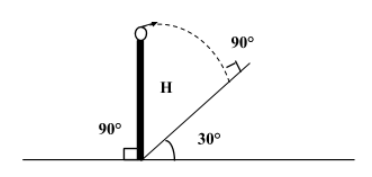
In fig. The angle of inclination of the inclined plane is 30°. Find the horizontal velocity ${V}_{0}$ so that the particle hits the inclined plane perpendicularly.
A.$V= \sqrt {\dfrac {2gH}{5}}$
B.$V= \sqrt {\dfrac {2gH}{7}}$
C.$V= \sqrt {\dfrac {gH}{5}}$
D.$V= \sqrt {\dfrac {gH}{7}}$
Answer
 Verified
582.6k+ views
Hint: To solve this problem, first find the velocity of the particle along the Y axis using the Kinematic equation of motion showing relation between velocity and time. Substitute the values and find the value of time t. Then, use the kinematic equation of motion which gives the relation between displacement and time. Substitute the values in the kinematic equation and find the velocity. This will be the horizontal velocity of the particle that hits the inclined plane perpendicularly.
Complete answer:
Consider, X-axis is perpendicular to the plane and the Y-axis is parallel to the plane. So, when the particle hits the plane perpendicularly, its velocity becomes 0 along the X-axis.
Velocity of the particle along the Y-axis at time t will be,
$v= u +at$
Substituting the values in above equation we get,
$0 = {V}_{0}\cos {30°} + (-g\sin {30°}) t$
$\Rightarrow g\sin {30°} t= {V}_{0}\cos {30°}$
$\Rightarrow g \times \dfrac{1}{2} \times t = {V}_{0}\dfrac {\sqrt {3}}{2}$
$\Rightarrow t = \dfrac {\sqrt {3} {V}_{0}}{g}$ …(1)
Displacement along the direction perpendicular to the plane is given by,
$s = ut+ \dfrac {1}{2}a {t}^{2}$
Substituting the values in above equation we get,
$H\cos{30°}= {V}_{0}\sin {30°} \times \dfrac {\sqrt {3} {V}_{0}}{g} + \dfrac {1}{2} g \cos {30°} {\dfrac {\sqrt {3} {V}_{0}}{g}}^{2}$
$\Rightarrow \dfrac {\sqrt {3}H}{2}= \dfrac {{V}_{0}}{2} \times \dfrac {\sqrt {3} {V}_{0}}{g} + \dfrac {1}{2}g\times \dfrac {\sqrt {3}}{2}\times \dfrac {3 {V}_{0}}{{g}^{2}}$
$\Rightarrow \dfrac {\sqrt {3}H}{2}= \dfrac {\sqrt {3}{V}_{0}}{2g} + \dfrac {3\sqrt {3}{{V}_{0}}^{2}}{4g}$
$\Rightarrow \dfrac {H}{2} = \dfrac {{{V}_{0}}^{2}}{2g} + \dfrac {3{{V}_{0}}^{2}}{4g}$
$\Rightarrow \dfrac {H}{2} = \dfrac {2{{V}_{0}}^{2}}{4g} + \dfrac {3{{V}_{0}}^{2}}{4g}$
$\Rightarrow H = \dfrac {5{V}_{0}^{2}}{2g}$
$\Rightarrow {{V}_{0}}^{2} =\dfrac {2gH}{5}$
$\Rightarrow {V}_{0} = \sqrt {\dfrac {2gH}{5}}$
Hence, the horizontal velocity of the particle when it hits the inclined plane perpendicularly is $\sqrt {\dfrac {2gH}{5}}$.
Note:
To solve these types of problems, students should know all the equations of motions. They should also know the proper application of these equations. To choose the correct equation for the specified problem, check which parameters are given and which you are asked to find. If you want to find the displacement at a given time then use the equation, $s= ut + \dfrac {1}{2}a{t}^{2}$
If you have to find the displacement at given velocity, then use the relation, ${v}^{2} ={u}^{2} + 2as$.
If you have to find the velocity at a given time then use the relation, $v = u +at$.
Complete answer:
Consider, X-axis is perpendicular to the plane and the Y-axis is parallel to the plane. So, when the particle hits the plane perpendicularly, its velocity becomes 0 along the X-axis.
Velocity of the particle along the Y-axis at time t will be,
$v= u +at$
Substituting the values in above equation we get,
$0 = {V}_{0}\cos {30°} + (-g\sin {30°}) t$
$\Rightarrow g\sin {30°} t= {V}_{0}\cos {30°}$
$\Rightarrow g \times \dfrac{1}{2} \times t = {V}_{0}\dfrac {\sqrt {3}}{2}$
$\Rightarrow t = \dfrac {\sqrt {3} {V}_{0}}{g}$ …(1)
Displacement along the direction perpendicular to the plane is given by,
$s = ut+ \dfrac {1}{2}a {t}^{2}$
Substituting the values in above equation we get,
$H\cos{30°}= {V}_{0}\sin {30°} \times \dfrac {\sqrt {3} {V}_{0}}{g} + \dfrac {1}{2} g \cos {30°} {\dfrac {\sqrt {3} {V}_{0}}{g}}^{2}$
$\Rightarrow \dfrac {\sqrt {3}H}{2}= \dfrac {{V}_{0}}{2} \times \dfrac {\sqrt {3} {V}_{0}}{g} + \dfrac {1}{2}g\times \dfrac {\sqrt {3}}{2}\times \dfrac {3 {V}_{0}}{{g}^{2}}$
$\Rightarrow \dfrac {\sqrt {3}H}{2}= \dfrac {\sqrt {3}{V}_{0}}{2g} + \dfrac {3\sqrt {3}{{V}_{0}}^{2}}{4g}$
$\Rightarrow \dfrac {H}{2} = \dfrac {{{V}_{0}}^{2}}{2g} + \dfrac {3{{V}_{0}}^{2}}{4g}$
$\Rightarrow \dfrac {H}{2} = \dfrac {2{{V}_{0}}^{2}}{4g} + \dfrac {3{{V}_{0}}^{2}}{4g}$
$\Rightarrow H = \dfrac {5{V}_{0}^{2}}{2g}$
$\Rightarrow {{V}_{0}}^{2} =\dfrac {2gH}{5}$
$\Rightarrow {V}_{0} = \sqrt {\dfrac {2gH}{5}}$
Hence, the horizontal velocity of the particle when it hits the inclined plane perpendicularly is $\sqrt {\dfrac {2gH}{5}}$.
Note:
To solve these types of problems, students should know all the equations of motions. They should also know the proper application of these equations. To choose the correct equation for the specified problem, check which parameters are given and which you are asked to find. If you want to find the displacement at a given time then use the equation, $s= ut + \dfrac {1}{2}a{t}^{2}$
If you have to find the displacement at given velocity, then use the relation, ${v}^{2} ={u}^{2} + 2as$.
If you have to find the velocity at a given time then use the relation, $v = u +at$.
Recently Updated Pages
Master Class 11 Computer Science: Engaging Questions & Answers for Success

Master Class 11 Business Studies: Engaging Questions & Answers for Success
Master Class 11 Economics: Engaging Questions & Answers for Success
Master Class 11 English: Engaging Questions & Answers for Success
Master Class 11 Maths: Engaging Questions & Answers for Success
Master Class 11 Biology: Engaging Questions & Answers for Success
Trending doubts
One Metric ton is equal to kg A 10000 B 1000 C 100 class 11 physics CBSE
There are 720 permutations of the digits 1 2 3 4 5 class 11 maths CBSE
Discuss the various forms of bacteria class 11 biology CBSE
Draw a diagram of a plant cell and label at least eight class 11 biology CBSE
State the laws of reflection of light
Explain zero factorial class 11 maths CBSE