




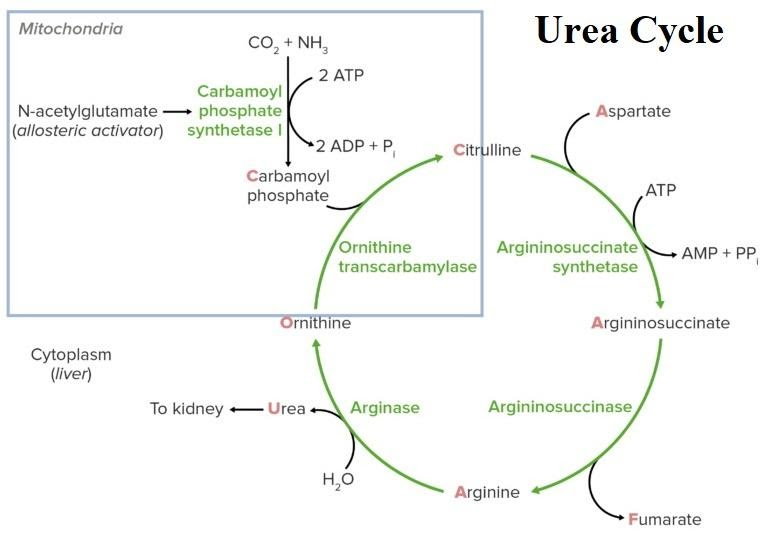
In Ornithine cycle, number of ATP molecules spent to convert toxic ammonia to a molecular urea is-
A. Four
B. Two
C. Three
D. One
Answer
 Verified
512.4k+ views
Hint: The ornithine cycle is another name for the urea cycle. It is a biochemical reaction that produces urea from ammonia. As we know organisms are classified on the basis of excreting waste materials. The organisms which excrete urea are called ureotelic animals. The urea cycle or ornithine cycle occurs in the liver and to a lesser extent the kidneys.
Complete Explanation:
Option A Four- urea cycle is required by the body to eliminate excess toxic chemicals that are ammonia to urea. So, the ATP molecules required are not four.
Option A is not correct.
Option B Two- the ornithine cycle is carried out in the liver of certain organisms. Which is responsible for converting ammonia to urea.
Option B is not correct.
Option C Three- one urea cycle required three ATP molecules to convert the toxic ammonia to molecular urea. It also requires one molecule of carbon-monoxide and one molecule of aspartic acid.
Option C is correct.
Option D One- in one cycle three ATP molecules are required. Hence one can not be the adequate option. In every cycle three ATP molecules are being used.
Option D is not correct.
Hence, Option C is the correct answer.
Note:
As we discussed in one urea cycle, ammonia is getting eliminated and molecular urea is getting recycled. Amino acid catabolism results in waste ammonia. Urea is being produced by the liver. If the urea is not being diluted or converted into a less toxic form from ammonia it can be detrimental to animals. Especially birds and insects. The animals excrete uric acid in a solid form. Which later converted to urea or urate salt.
Complete Explanation:
Option A Four- urea cycle is required by the body to eliminate excess toxic chemicals that are ammonia to urea. So, the ATP molecules required are not four.
Option A is not correct.
Option B Two- the ornithine cycle is carried out in the liver of certain organisms. Which is responsible for converting ammonia to urea.
Option B is not correct.
Option C Three- one urea cycle required three ATP molecules to convert the toxic ammonia to molecular urea. It also requires one molecule of carbon-monoxide and one molecule of aspartic acid.
Option C is correct.
Option D One- in one cycle three ATP molecules are required. Hence one can not be the adequate option. In every cycle three ATP molecules are being used.
Option D is not correct.
Hence, Option C is the correct answer.
Note:
As we discussed in one urea cycle, ammonia is getting eliminated and molecular urea is getting recycled. Amino acid catabolism results in waste ammonia. Urea is being produced by the liver. If the urea is not being diluted or converted into a less toxic form from ammonia it can be detrimental to animals. Especially birds and insects. The animals excrete uric acid in a solid form. Which later converted to urea or urate salt.
Recently Updated Pages
Master Class 11 Computer Science: Engaging Questions & Answers for Success

Master Class 11 Business Studies: Engaging Questions & Answers for Success
Master Class 11 Economics: Engaging Questions & Answers for Success
Master Class 11 English: Engaging Questions & Answers for Success
Master Class 11 Maths: Engaging Questions & Answers for Success
Master Class 11 Biology: Engaging Questions & Answers for Success
Trending doubts
One Metric ton is equal to kg A 10000 B 1000 C 100 class 11 physics CBSE
There are 720 permutations of the digits 1 2 3 4 5 class 11 maths CBSE
Discuss the various forms of bacteria class 11 biology CBSE
Draw a diagram of a plant cell and label at least eight class 11 biology CBSE
State the laws of reflection of light
Explain zero factorial class 11 maths CBSE