




In square $ABCD$;$A = (3,4)$, $B = ( - 2,4)$, and $C = ( - 2, - 1)$ By plotting these points on a graph paper, find the area of the square.
Answer
 Verified
582.6k+ views
Hint: First we have to plot the given points into a graph. Because we must know the distance between all the four pairs of points. Then we will start with the use of the distance formula to find the distance between all the four pairs of the points. After calculating the vertex of the point $D$ then we will find the area of the square $ABCD$.
Formula used: Distance between points formula $D = \sqrt {{{({x_2} - {x_1})}^2} + {{({y_2} - {y_1})}^2}} $
Where $\left( {{x_1},{x_2}} \right)$ and $\left( {{y_1},{y_2}} \right)$ be the two points.
Area of the square $ = $ $side \times side$ unit sq.
Complete step-by-step answer:
Given points are $A = (3,4)$, $B = ( - 2,4)$, and $C = ( - 2, - 1)$
By plotting the points into graph we get,
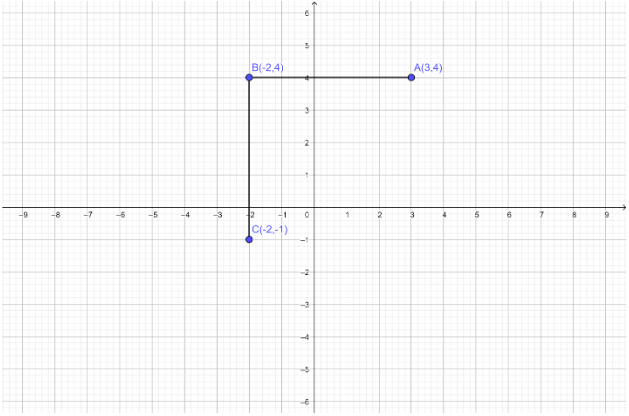
First we have to find the fourth vertex $D$ and the area of the given square $ABCD$.
In the square $ABCD$, we know all the sides are equal thus, the distance of each of the vertices are same
Hence we can write,
$AB = BC = CD = DA$
The points plotted on the graph below.
From the graph, the coordinates of point $D$ are $(3, - 1)$
Hence,
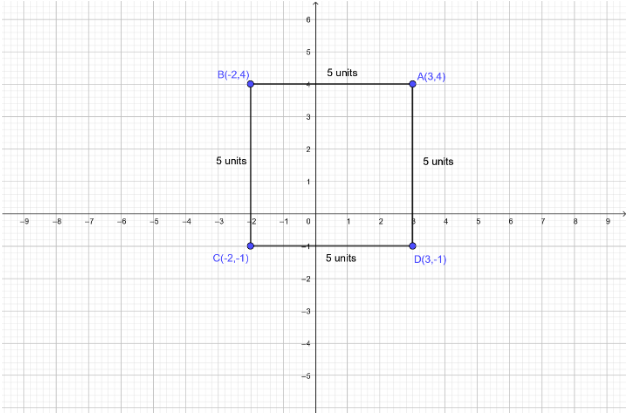
Now using the distance formula $D = \sqrt {{{({x_2} - {x_1})}^2} + {{({y_2} - {y_1})}^2}} ......(1)$
Using equation $(1)$ we can find out the side $AB$, so it will be
Here, $A = (3,4)$ where ${x_1} = 3,{y_1} = 4$ and $B = ( - 2,4)$ where ${x_2} = - 2,{y_2} = 4$
$\Rightarrow$$AB = \sqrt {{{( - 2 - 3)}^2} + {{(4 - 4)}^2}} $ $ = \sqrt {{{( - 5)}^2} + {0^2}} $$ = \sqrt {( - 5)( - 5) + 0} $$ = \sqrt {25} $$ = 5$ Units
Here,
$B = ( - 2,4)$ where ${x_1} = - 2$, ${y_1} = 4$ and
$C = ( - 2, - 1)$ where ${x_2} = - 2,{y_2} = - 1$
$\Rightarrow$$BC = \sqrt {{{( - 2 - ( - 2))}^2} + {{( - 1 - 4)}^2}} $$ = \sqrt {0 + {{( - 5)}^2}} = \sqrt {25} = 5$ Units
Now,
$C = ( - 2, - 1)$ where ${x_1} = - 2,{y_1} = - 1$ and
$D = (3, - 1)$ where ${x_2} = 3,{y_2} = - 1$
$\Rightarrow$$CD = \sqrt {{{(3 - ( - 2))}^2} + {{( - 1 - ( - 1))}^2}} = \sqrt {{5^2} + {0^2}} $$ = \sqrt {25} = 5$ Units
Now,
$D = (3, - 1)$where ${x_1} = 3,{y_1} = - 1$ and
$A = (3,4)$where ${x_2} = 3,{y_2} = 4$
$\Rightarrow$$DA = \sqrt {{{(3 - 3)}^2} + {{( - 1 - 4)}^2}} = \sqrt {{0^2} + {{( - 5)}^2}} = \sqrt {25} = 5$ Units
$D$ are $(3, - 1)$
Here we got the side $AB = 5$ unit sq.
Area of the square $ = $ side ×side
Area of the square $ABCD = AB \times AB$
Substituting the side value,
$ \Rightarrow 5 \times 5$
Multiplying both the numbers, we get
Hence,
Area of the square \[ABCD = 25\] Unit sq.
$\therefore $ The area of the square is $25$ unit sq.
Note: Whenever we face such types of problems the key behind the solution lies in the diagrammatic representation of the data provided then awareness about the basic formula can help in getting to the right track to reach the answer.
Formula used: Distance between points formula $D = \sqrt {{{({x_2} - {x_1})}^2} + {{({y_2} - {y_1})}^2}} $
Where $\left( {{x_1},{x_2}} \right)$ and $\left( {{y_1},{y_2}} \right)$ be the two points.
Area of the square $ = $ $side \times side$ unit sq.
Complete step-by-step answer:
Given points are $A = (3,4)$, $B = ( - 2,4)$, and $C = ( - 2, - 1)$
By plotting the points into graph we get,
First we have to find the fourth vertex $D$ and the area of the given square $ABCD$.
In the square $ABCD$, we know all the sides are equal thus, the distance of each of the vertices are same
Hence we can write,
$AB = BC = CD = DA$
The points plotted on the graph below.
From the graph, the coordinates of point $D$ are $(3, - 1)$
Hence,
Now using the distance formula $D = \sqrt {{{({x_2} - {x_1})}^2} + {{({y_2} - {y_1})}^2}} ......(1)$
Using equation $(1)$ we can find out the side $AB$, so it will be
Here, $A = (3,4)$ where ${x_1} = 3,{y_1} = 4$ and $B = ( - 2,4)$ where ${x_2} = - 2,{y_2} = 4$
$\Rightarrow$$AB = \sqrt {{{( - 2 - 3)}^2} + {{(4 - 4)}^2}} $ $ = \sqrt {{{( - 5)}^2} + {0^2}} $$ = \sqrt {( - 5)( - 5) + 0} $$ = \sqrt {25} $$ = 5$ Units
Here,
$B = ( - 2,4)$ where ${x_1} = - 2$, ${y_1} = 4$ and
$C = ( - 2, - 1)$ where ${x_2} = - 2,{y_2} = - 1$
$\Rightarrow$$BC = \sqrt {{{( - 2 - ( - 2))}^2} + {{( - 1 - 4)}^2}} $$ = \sqrt {0 + {{( - 5)}^2}} = \sqrt {25} = 5$ Units
Now,
$C = ( - 2, - 1)$ where ${x_1} = - 2,{y_1} = - 1$ and
$D = (3, - 1)$ where ${x_2} = 3,{y_2} = - 1$
$\Rightarrow$$CD = \sqrt {{{(3 - ( - 2))}^2} + {{( - 1 - ( - 1))}^2}} = \sqrt {{5^2} + {0^2}} $$ = \sqrt {25} = 5$ Units
Now,
$D = (3, - 1)$where ${x_1} = 3,{y_1} = - 1$ and
$A = (3,4)$where ${x_2} = 3,{y_2} = 4$
$\Rightarrow$$DA = \sqrt {{{(3 - 3)}^2} + {{( - 1 - 4)}^2}} = \sqrt {{0^2} + {{( - 5)}^2}} = \sqrt {25} = 5$ Units
$D$ are $(3, - 1)$
Here we got the side $AB = 5$ unit sq.
Area of the square $ = $ side ×side
Area of the square $ABCD = AB \times AB$
Substituting the side value,
$ \Rightarrow 5 \times 5$
Multiplying both the numbers, we get
Hence,
Area of the square \[ABCD = 25\] Unit sq.
$\therefore $ The area of the square is $25$ unit sq.
Note: Whenever we face such types of problems the key behind the solution lies in the diagrammatic representation of the data provided then awareness about the basic formula can help in getting to the right track to reach the answer.
Recently Updated Pages
Master Class 10 Computer Science: Engaging Questions & Answers for Success

Master Class 10 General Knowledge: Engaging Questions & Answers for Success
Master Class 10 English: Engaging Questions & Answers for Success
Master Class 10 Social Science: Engaging Questions & Answers for Success
Master Class 10 Maths: Engaging Questions & Answers for Success
Master Class 10 Science: Engaging Questions & Answers for Success
Trending doubts
What is the median of the first 10 natural numbers class 10 maths CBSE
The draft of the Preamble of the Indian Constitution class 10 social science CBSE
Which women's tennis player has 24 Grand Slam singles titles?
Who gave "Inqilab Zindabad" slogan?
Why is there a time difference of about 5 hours between class 10 social science CBSE
Who is the Brand Ambassador of Incredible India?