




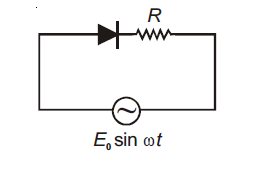
In the circuit shown, the average power dissipated in the resistor is (assume diode to be ideal).
$ A)\;\dfrac{{{E^2}_0}}{{2R}} $
$ B)\;\dfrac{{{E^2}_0}}{{4R}} $
$ C)\;\dfrac{{{E^2}_0}}{R} $
$ D)\;Zero $
Answer
 Verified
539.1k+ views
Hint: The power dissipated is that process by which an electronic or electrical device that produces heat as an unpleasant derivative of their primary. If resistance is increased then the current will be decreased and the power dissipation of the resistor’s be decreased.
Complete step by step solution:
If the electric current flows through a given element in the circuit, the loose the voltage in that process, then the dissipation power of that circuit element is the product of the electric current and their voltage.
The expression is used:
Power = Current $ \times$ Voltage
$ \Rightarrow P = I \times V$
It is important to be aware of that effect of power dissipation in components, the greater the power, the more heat be dissipated by that component. This usually means that the components dissipate a large amount of the power to get hot.
The maximum power transfer theorem states that the maximum amount of the power will be dissipated by the load resistance if it is equal to the Thevenin or Norton resistance of the supply network power. The maximum efficiency not satisfied by the maximum power of the transform theorem.
Hence, the power dissipated with diode =$\dfrac{1}{2} \times $ (Power dissipated without diode)
$ = \dfrac{1}{2} \times \left( {\dfrac{{{{\left( {\dfrac{{{E_0}}}{{\sqrt 2 }}} \right)}^2}}}{R}} \right) = \dfrac{1}{2} \times \dfrac{{{E_0}^2}}{{2R}} $
$ = \dfrac{{{E_0}^2}}{{4R}}$
So, the correct answer is “Option B”.
Note: The power consumption is not a good term to use for power, but likely refers to the power input to that device under the thought. The power dissipated likely refers to the association lost with the device that is generally dissipated as the heat. The calculation of loss as the term input power is subtracted by the output power. The Negative power dissipation is applicable as well as the positive power dissipation is applicable.
Complete step by step solution:
If the electric current flows through a given element in the circuit, the loose the voltage in that process, then the dissipation power of that circuit element is the product of the electric current and their voltage.
The expression is used:
Power = Current $ \times$ Voltage
$ \Rightarrow P = I \times V$
It is important to be aware of that effect of power dissipation in components, the greater the power, the more heat be dissipated by that component. This usually means that the components dissipate a large amount of the power to get hot.
The maximum power transfer theorem states that the maximum amount of the power will be dissipated by the load resistance if it is equal to the Thevenin or Norton resistance of the supply network power. The maximum efficiency not satisfied by the maximum power of the transform theorem.
Hence, the power dissipated with diode =$\dfrac{1}{2} \times $ (Power dissipated without diode)
$ = \dfrac{1}{2} \times \left( {\dfrac{{{{\left( {\dfrac{{{E_0}}}{{\sqrt 2 }}} \right)}^2}}}{R}} \right) = \dfrac{1}{2} \times \dfrac{{{E_0}^2}}{{2R}} $
$ = \dfrac{{{E_0}^2}}{{4R}}$
So, the correct answer is “Option B”.
Note: The power consumption is not a good term to use for power, but likely refers to the power input to that device under the thought. The power dissipated likely refers to the association lost with the device that is generally dissipated as the heat. The calculation of loss as the term input power is subtracted by the output power. The Negative power dissipation is applicable as well as the positive power dissipation is applicable.
Recently Updated Pages
Master Class 11 Computer Science: Engaging Questions & Answers for Success

Master Class 11 Business Studies: Engaging Questions & Answers for Success
Master Class 11 Economics: Engaging Questions & Answers for Success
Master Class 11 English: Engaging Questions & Answers for Success
Master Class 11 Maths: Engaging Questions & Answers for Success
Master Class 11 Biology: Engaging Questions & Answers for Success
Trending doubts
One Metric ton is equal to kg A 10000 B 1000 C 100 class 11 physics CBSE
There are 720 permutations of the digits 1 2 3 4 5 class 11 maths CBSE
Discuss the various forms of bacteria class 11 biology CBSE
Draw a diagram of a plant cell and label at least eight class 11 biology CBSE
State the laws of reflection of light
Explain zero factorial class 11 maths CBSE