




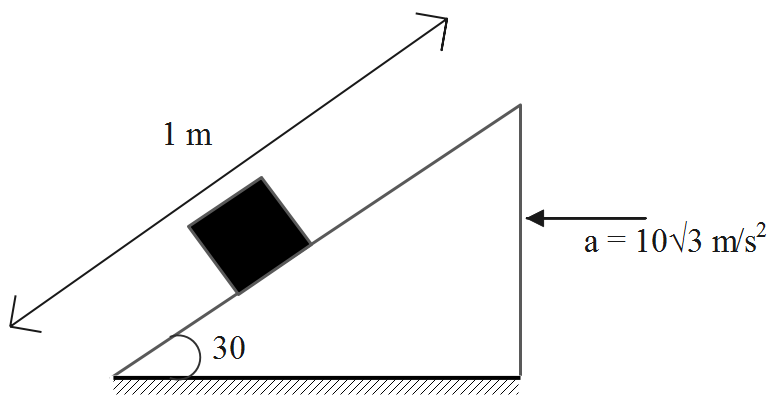
In the figure, the wedge is pushed with an acceleration of \[10\sqrt{3}{m}/{{{s}^{2}}}\;\]. It is seen that the block starts climbing up on the smooth inclined face of the wedge. What will be the time taken by the block to reach the top?
Answer
 Verified
516.9k+ views
Hint: The acceleration of a body equals the force applied on the body by the mass of that body. The acceleration of the body inclined along the plane equals the ratio of the difference of the product of mass, acceleration and the cosine of angle the product of mass, acceleration due to gravity and the sine of angle and the mass.
Formula used:
\[\begin{align}
& {{a}_{eff}}=\dfrac{F}{m} \\
& {{a}_{eff}}=\dfrac{ma\cos \theta -mg\sin \theta }{m} \\
\end{align}\]
Complete step by step answer:
From the given information, we have the data as follows.
The wedge is pushed with an acceleration of \[10\sqrt{3}{m}/{{{s}^{2}}}\;\]. The block starts climbing up on the smooth inclined face of the wedge.
As the block starts climbing up on the smooth inclined face of the wedge, thus, there will be no frictional force acting on the block.
The acceleration equals the force by the mass.
\[{{a}_{eff}}=\dfrac{F}{m}\]
Here, the force equals the ratio of the difference of the product of mass, acceleration and the cosine of angle, the product of mass, acceleration due to gravity and the sine of angle and the mass.
\[{{a}_{eff}}=\dfrac{ma\cos \theta -mg\sin \theta }{m}\]
Substitute the values of the mass, acceleration, the acceleration due to gravity and the angle in the above equation to compute the effective acceleration.
\[\begin{align}
& {{a}_{eff}}=\dfrac{ma\cos \theta -mg\sin \theta }{m} \\
& \Rightarrow {{a}_{eff}}=a\cos \theta -g\sin \theta \\
& \therefore {{a}_{eff}}=10\sqrt{3}\cos 30{}^\circ -10\sin 30{}^\circ \\
\end{align}\]
Continue further computation.
\[\begin{align}
& {{a}_{eff}}=10\sqrt{3}\cos 30{}^\circ -10\sin 30{}^\circ \\
& \Rightarrow {{a}_{eff}}=10\sqrt{3}\times \dfrac{\sqrt{3}}{2}-10\times \dfrac{1}{2} \\
& \Rightarrow {{a}_{eff}}=15-5 \\
& \therefore {{a}_{eff}}=10{m}/{{{s}^{2}}}\; \\
\end{align}\]
The time taken is,
\[t=\sqrt{\dfrac{2s}{{{a}_{eff}}}}\]
Substitute the values in the above formula.
\[t=\sqrt{\dfrac{2\times 1}{10}}\]
Therefore, the value of the time is,
\[t=\dfrac{1}{\sqrt{5}}s\]
\[\therefore \] The time taken by the block to reach the top is,\[\dfrac{1}{\sqrt{5}}s\].
Note: The units of the parameters should be taken care of. Many times, the values of the parameters will be given in the statements of the question, whereas, in this case, the values of the parameters, such as, the distance is given in the diagram.
Formula used:
\[\begin{align}
& {{a}_{eff}}=\dfrac{F}{m} \\
& {{a}_{eff}}=\dfrac{ma\cos \theta -mg\sin \theta }{m} \\
\end{align}\]
Complete step by step answer:
From the given information, we have the data as follows.
The wedge is pushed with an acceleration of \[10\sqrt{3}{m}/{{{s}^{2}}}\;\]. The block starts climbing up on the smooth inclined face of the wedge.
As the block starts climbing up on the smooth inclined face of the wedge, thus, there will be no frictional force acting on the block.
The acceleration equals the force by the mass.
\[{{a}_{eff}}=\dfrac{F}{m}\]
Here, the force equals the ratio of the difference of the product of mass, acceleration and the cosine of angle, the product of mass, acceleration due to gravity and the sine of angle and the mass.
\[{{a}_{eff}}=\dfrac{ma\cos \theta -mg\sin \theta }{m}\]
Substitute the values of the mass, acceleration, the acceleration due to gravity and the angle in the above equation to compute the effective acceleration.
\[\begin{align}
& {{a}_{eff}}=\dfrac{ma\cos \theta -mg\sin \theta }{m} \\
& \Rightarrow {{a}_{eff}}=a\cos \theta -g\sin \theta \\
& \therefore {{a}_{eff}}=10\sqrt{3}\cos 30{}^\circ -10\sin 30{}^\circ \\
\end{align}\]
Continue further computation.
\[\begin{align}
& {{a}_{eff}}=10\sqrt{3}\cos 30{}^\circ -10\sin 30{}^\circ \\
& \Rightarrow {{a}_{eff}}=10\sqrt{3}\times \dfrac{\sqrt{3}}{2}-10\times \dfrac{1}{2} \\
& \Rightarrow {{a}_{eff}}=15-5 \\
& \therefore {{a}_{eff}}=10{m}/{{{s}^{2}}}\; \\
\end{align}\]
The time taken is,
\[t=\sqrt{\dfrac{2s}{{{a}_{eff}}}}\]
Substitute the values in the above formula.
\[t=\sqrt{\dfrac{2\times 1}{10}}\]
Therefore, the value of the time is,
\[t=\dfrac{1}{\sqrt{5}}s\]
\[\therefore \] The time taken by the block to reach the top is,\[\dfrac{1}{\sqrt{5}}s\].
Note: The units of the parameters should be taken care of. Many times, the values of the parameters will be given in the statements of the question, whereas, in this case, the values of the parameters, such as, the distance is given in the diagram.
Recently Updated Pages
Master Class 11 Computer Science: Engaging Questions & Answers for Success

Master Class 11 Business Studies: Engaging Questions & Answers for Success
Master Class 11 Economics: Engaging Questions & Answers for Success
Master Class 11 English: Engaging Questions & Answers for Success
Master Class 11 Maths: Engaging Questions & Answers for Success
Master Class 11 Biology: Engaging Questions & Answers for Success
Trending doubts
One Metric ton is equal to kg A 10000 B 1000 C 100 class 11 physics CBSE
There are 720 permutations of the digits 1 2 3 4 5 class 11 maths CBSE
Discuss the various forms of bacteria class 11 biology CBSE
Draw a diagram of a plant cell and label at least eight class 11 biology CBSE
State the laws of reflection of light
Explain zero factorial class 11 maths CBSE