




In the given figure, PQ is the diameter. \[\angle SQP\] is equal to
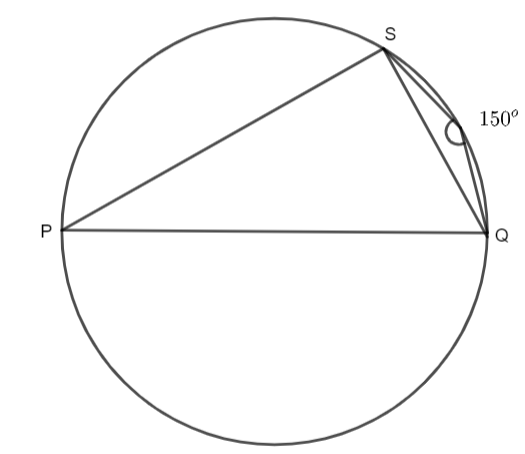
\[\left( a \right){{40}^{\circ }}\]
\[\left( b \right){{30}^{\circ }}\]
\[\left( c \right){{60}^{\circ }}\]
\[\left( d \right){{50}^{\circ }}\]
Answer
 Verified
585.9k+ views
Hint: To solve this question, we will first use a theorem stated as, “If A, B and C are distinct points on a circle where the line AC is a diameter, then the angle \[\angle ABC={{90}^{\circ }}.\] Using this, we will calculate \[\angle PSQ\] and then use the fact that the opposite angles of a cyclic quadrilateral add up to \[{{180}^{\circ }}\] to get the measure of \[\angle SQP.\]
Complete step by step answer:
We are given the circle. Let us define R in it as below.
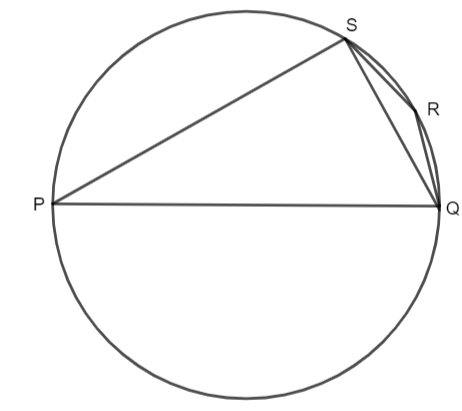
PQ is the diameter and \[\angle SRQ={{150}^{\circ }}\] is given.
Consider triangle PSQ first. We have a theorem that states, “If A, B and C are distinct points on a circle where the line AC is a diameter, then the angle \[\angle ABC={{90}^{\circ }}.\] Using this, we will calculate \[\angle PSQ.\] This means in the circle, AC is the diameter, then \[\angle ABC={{90}^{\circ }}.\]
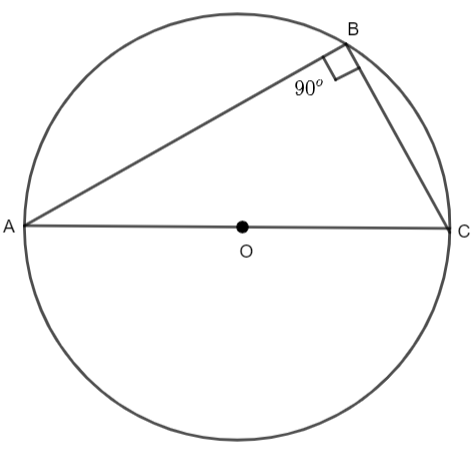
Using this theory in our triangle and circle, we have, \[\angle PSQ={{90}^{\circ }}\] as PQ is the diameter of the circle and P, S and Q lie on the circle. We have now,
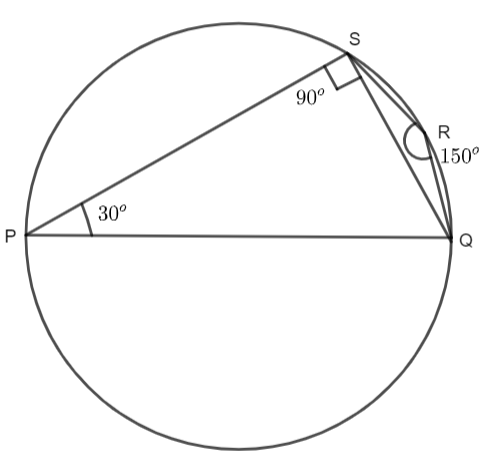
Now, considering the cyclic quadrilateral PSRQ, given \[\angle SRQ={{150}^{\circ }}.\] Then as the sum of the opposite angles of a cyclic quadrilateral is \[{{180}^{\circ }}.\]
\[\Rightarrow \angle SPQ+\angle SRQ={{180}^{\circ }}\]
\[\Rightarrow \angle SPQ+{{150}^{\circ }}={{180}^{\circ }}\]
\[\Rightarrow \angle SPQ={{180}^{\circ }}-{{150}^{\circ }}\]
\[\Rightarrow \angle SPQ={{30}^{\circ }}\]
Therefore, \[\angle SPQ={{30}^{\circ }}.\]
Now, finally considering triangle PSQ, the angle sum property of a triangle says that the sum of all the angles of a triangle is \[{{180}^{\circ }}.\] So, in triangle PSQ,
\[\Rightarrow \angle P+\angle S+\angle Q={{180}^{\circ }}\]
\[\Rightarrow {{30}^{\circ }}+{{90}^{\circ }}+\angle Q={{180}^{\circ }}\]
\[\Rightarrow \angle Q={{180}^{\circ }}-{{30}^{\circ }}-{{90}^{\circ }}\]
\[\Rightarrow \angle SQP={{180}^{\circ }}-{{120}^{\circ }}\]
\[\Rightarrow \angle SQP={{60}^{\circ }}\]
So the measure of \[\angle SQP={{60}^{\circ }}\] which is the required result.
Note: Cyclic quadrilaterals are those whose all sides lie on the circumference of a circle. Here in our question, the quadrilateral PSRQ is cyclic as all sides lie on the circumference of the circle. A key point to note here is that the measure of \[\angle PSQ={{90}^{\circ }}\] and not angle \[\angle QSR.\] Therefore, we cannot use triangle SRQ to calculate our angle Q.
Complete step by step answer:
We are given the circle. Let us define R in it as below.
PQ is the diameter and \[\angle SRQ={{150}^{\circ }}\] is given.
Consider triangle PSQ first. We have a theorem that states, “If A, B and C are distinct points on a circle where the line AC is a diameter, then the angle \[\angle ABC={{90}^{\circ }}.\] Using this, we will calculate \[\angle PSQ.\] This means in the circle, AC is the diameter, then \[\angle ABC={{90}^{\circ }}.\]
Using this theory in our triangle and circle, we have, \[\angle PSQ={{90}^{\circ }}\] as PQ is the diameter of the circle and P, S and Q lie on the circle. We have now,
Now, considering the cyclic quadrilateral PSRQ, given \[\angle SRQ={{150}^{\circ }}.\] Then as the sum of the opposite angles of a cyclic quadrilateral is \[{{180}^{\circ }}.\]
\[\Rightarrow \angle SPQ+\angle SRQ={{180}^{\circ }}\]
\[\Rightarrow \angle SPQ+{{150}^{\circ }}={{180}^{\circ }}\]
\[\Rightarrow \angle SPQ={{180}^{\circ }}-{{150}^{\circ }}\]
\[\Rightarrow \angle SPQ={{30}^{\circ }}\]
Therefore, \[\angle SPQ={{30}^{\circ }}.\]
Now, finally considering triangle PSQ, the angle sum property of a triangle says that the sum of all the angles of a triangle is \[{{180}^{\circ }}.\] So, in triangle PSQ,
\[\Rightarrow \angle P+\angle S+\angle Q={{180}^{\circ }}\]
\[\Rightarrow {{30}^{\circ }}+{{90}^{\circ }}+\angle Q={{180}^{\circ }}\]
\[\Rightarrow \angle Q={{180}^{\circ }}-{{30}^{\circ }}-{{90}^{\circ }}\]
\[\Rightarrow \angle SQP={{180}^{\circ }}-{{120}^{\circ }}\]
\[\Rightarrow \angle SQP={{60}^{\circ }}\]
So the measure of \[\angle SQP={{60}^{\circ }}\] which is the required result.
Note: Cyclic quadrilaterals are those whose all sides lie on the circumference of a circle. Here in our question, the quadrilateral PSRQ is cyclic as all sides lie on the circumference of the circle. A key point to note here is that the measure of \[\angle PSQ={{90}^{\circ }}\] and not angle \[\angle QSR.\] Therefore, we cannot use triangle SRQ to calculate our angle Q.
Recently Updated Pages
Master Class 10 Computer Science: Engaging Questions & Answers for Success

Master Class 10 General Knowledge: Engaging Questions & Answers for Success
Master Class 10 English: Engaging Questions & Answers for Success
Master Class 10 Social Science: Engaging Questions & Answers for Success
Master Class 10 Maths: Engaging Questions & Answers for Success
Master Class 10 Science: Engaging Questions & Answers for Success
Trending doubts
What is the median of the first 10 natural numbers class 10 maths CBSE
Which women's tennis player has 24 Grand Slam singles titles?
Who is the Brand Ambassador of Incredible India?
Why is there a time difference of about 5 hours between class 10 social science CBSE
Write a letter to the principal requesting him to grant class 10 english CBSE
A moving boat is observed from the top of a 150 m high class 10 maths CBSE