




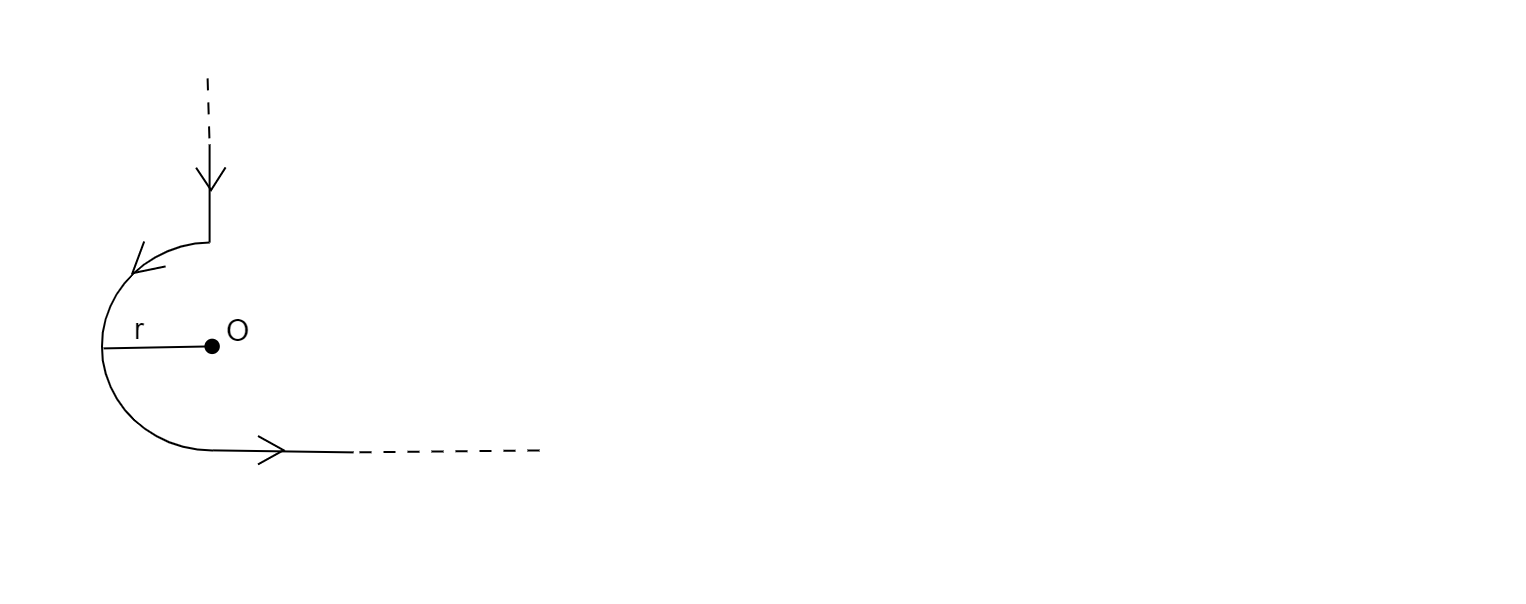
In the given figure, what is the magnetic field at the point $'O'$?
A.$\dfrac{{{\mu }_{0}}I}{4\pi r}+\dfrac{{{\mu }_{0}}I}{2\pi r}$
B.$\dfrac{{{\mu }_{0}}I}{4\pi r}$
C.$\dfrac{{{\mu }_{0}}I}{4r}+\dfrac{{{\mu }_{0}}I}{4\pi r}$
D.$\dfrac{{{\mu }_{0}}I}{4r}-\dfrac{{{\mu }_{0}}I}{4\pi r}$
Answer
 Verified
536.1k+ views
Hint: The simplest way to solve this question would be to divide the wire in three parts and then calculate the magnetic field due to each part separately and finally add them up. The three parts in which we have divided the wire are: semi-circular parts and the two straight parts.
Complete answer:
First let us find the magnetic field at point $O$ due to the semi-circular portion. Magnetic field at the center of a complete circle of radius $r$ and current $I$ is given by:
${{B}_{circ}}=\dfrac{{{\mu }_{0}}I}{2r}$
For semi-circle, the magnetic field will be:
$\begin{align}
& {{B}_{semi-circ}}=\dfrac{\dfrac{{{\mu }_{0}}I}{2r}}{2} \\
& \Rightarrow {{B}_{semi-circ}}=\dfrac{{{\mu }_{0}}I}{4r} \\
\end{align}$
By right hand thumb rule, we can conclude that the direction of the magnetic field is outward to the plane of the figure.
Now, let us calculate the magnetic field for the straight wires:
The magnetic field due to the vertical wire will be zero, while for the horizontal wire it will be:
${{B}_{hori}}=\dfrac{{{\mu }_{0}}I}{4\pi r}$
By right hand thumb rule, we can conclude that the direction of the magnetic field is outward to the plane of the figure.
Since the direction of magnetic field of both the semi-circular wire and the horizontal wire is the same, i.e., outwards to the plane of the figure, hence they will get added up to find the total magnetic field.
Hence the total magnetic field at point $O$ will be:
$\begin{align}
& {{B}_{total}}={{B}_{semi-circ}}+{{B}_{hori}} \\
& \therefore {{B}_{total}}=\dfrac{{{\mu }_{0}}I}{4r}+\dfrac{{{\mu }_{0}}I}{4\pi r} \\
\end{align}$
So,Option C is the correct answer.
Note:
Finding the direction of the magnetic field of each part is really important otherwise we would get wrong results. Here, the direction of the magnetic field in both the semi-circular and horizontal wires was the same, therefore we added them up, if it was different then the answer would have been different.
Complete answer:
First let us find the magnetic field at point $O$ due to the semi-circular portion. Magnetic field at the center of a complete circle of radius $r$ and current $I$ is given by:
${{B}_{circ}}=\dfrac{{{\mu }_{0}}I}{2r}$
For semi-circle, the magnetic field will be:
$\begin{align}
& {{B}_{semi-circ}}=\dfrac{\dfrac{{{\mu }_{0}}I}{2r}}{2} \\
& \Rightarrow {{B}_{semi-circ}}=\dfrac{{{\mu }_{0}}I}{4r} \\
\end{align}$
By right hand thumb rule, we can conclude that the direction of the magnetic field is outward to the plane of the figure.
Now, let us calculate the magnetic field for the straight wires:
The magnetic field due to the vertical wire will be zero, while for the horizontal wire it will be:
${{B}_{hori}}=\dfrac{{{\mu }_{0}}I}{4\pi r}$
By right hand thumb rule, we can conclude that the direction of the magnetic field is outward to the plane of the figure.
Since the direction of magnetic field of both the semi-circular wire and the horizontal wire is the same, i.e., outwards to the plane of the figure, hence they will get added up to find the total magnetic field.
Hence the total magnetic field at point $O$ will be:
$\begin{align}
& {{B}_{total}}={{B}_{semi-circ}}+{{B}_{hori}} \\
& \therefore {{B}_{total}}=\dfrac{{{\mu }_{0}}I}{4r}+\dfrac{{{\mu }_{0}}I}{4\pi r} \\
\end{align}$
So,Option C is the correct answer.
Note:
Finding the direction of the magnetic field of each part is really important otherwise we would get wrong results. Here, the direction of the magnetic field in both the semi-circular and horizontal wires was the same, therefore we added them up, if it was different then the answer would have been different.
Recently Updated Pages
Master Class 11 Computer Science: Engaging Questions & Answers for Success

Master Class 11 Business Studies: Engaging Questions & Answers for Success
Master Class 11 Economics: Engaging Questions & Answers for Success
Master Class 11 English: Engaging Questions & Answers for Success
Master Class 11 Maths: Engaging Questions & Answers for Success
Master Class 11 Biology: Engaging Questions & Answers for Success
Trending doubts
One Metric ton is equal to kg A 10000 B 1000 C 100 class 11 physics CBSE
There are 720 permutations of the digits 1 2 3 4 5 class 11 maths CBSE
Discuss the various forms of bacteria class 11 biology CBSE
Draw a diagram of a plant cell and label at least eight class 11 biology CBSE
State the laws of reflection of light
Explain zero factorial class 11 maths CBSE