




In which part of the digestive system is water absorbed?
Answer
 Verified
523.2k+ views
Hint: The absorption of water is passive and takes place along with other solutes only and is absorbed in the longest part of the digestive system.
Complete answer:
Among all the food that we ingest, 80 percent of the electrolytes present in them, and 90 percent of water are absorbed in the small intestine. Although the entire small intestine is involved in the absorption of water and lipids, water reabsorption is the main function of the large intestine. It can absorb up to 300 ml of water in a day. By the time the food enters the large intestine, approximately 80% of this fluid has already been absorbed by the small intestine. The large intestine is much broader than the small intestine and takes a much straighter path than the small intestine. The main purpose of the large intestine is to absorb water and salts from the material that has not been absorbed by the small intestine. It also helps to get rid of any waste products left after reabsorption. The absorbed fluid from the epithelium then goes into the lymphatic system via the lacteals.
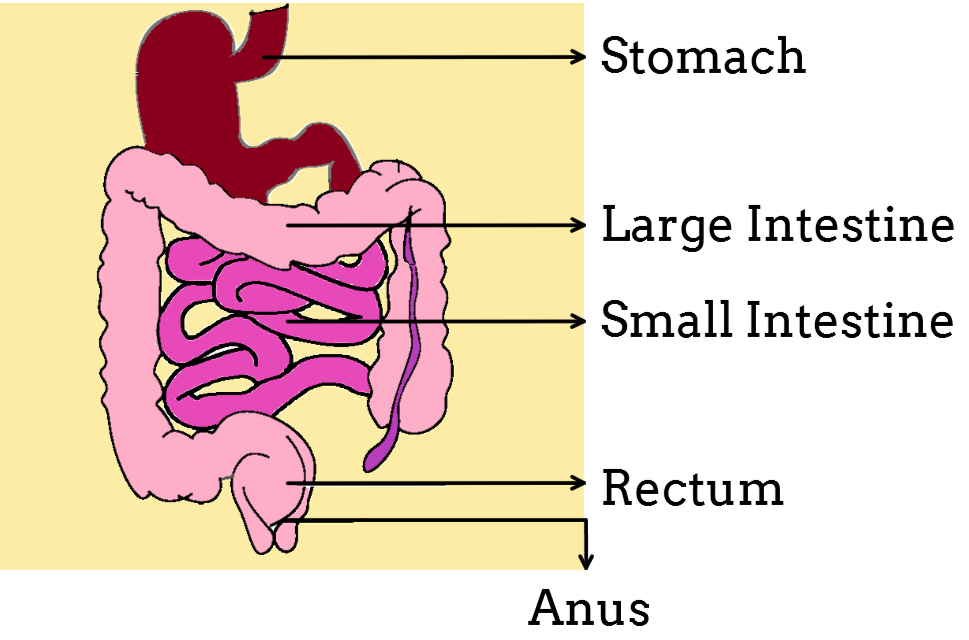
Note: -Sodium ions present in the water are absorbed by either diffusion or active transport using ATP against a chemical gradient. It also facilitates the movement of other molecules like chlorine ions, glucose, amino acids, etc. to move along with it into the cell.
-Vitamins are not digested but are only absorbed in the gastrointestinal tract.
-Fat-soluble vitamins are absorbed along with the dietary fat while water-soluble vitamins are absorbed by passive diffusion.
Complete answer:
Among all the food that we ingest, 80 percent of the electrolytes present in them, and 90 percent of water are absorbed in the small intestine. Although the entire small intestine is involved in the absorption of water and lipids, water reabsorption is the main function of the large intestine. It can absorb up to 300 ml of water in a day. By the time the food enters the large intestine, approximately 80% of this fluid has already been absorbed by the small intestine. The large intestine is much broader than the small intestine and takes a much straighter path than the small intestine. The main purpose of the large intestine is to absorb water and salts from the material that has not been absorbed by the small intestine. It also helps to get rid of any waste products left after reabsorption. The absorbed fluid from the epithelium then goes into the lymphatic system via the lacteals.
Note: -Sodium ions present in the water are absorbed by either diffusion or active transport using ATP against a chemical gradient. It also facilitates the movement of other molecules like chlorine ions, glucose, amino acids, etc. to move along with it into the cell.
-Vitamins are not digested but are only absorbed in the gastrointestinal tract.
-Fat-soluble vitamins are absorbed along with the dietary fat while water-soluble vitamins are absorbed by passive diffusion.
Recently Updated Pages
Master Class 11 Computer Science: Engaging Questions & Answers for Success

Master Class 11 Business Studies: Engaging Questions & Answers for Success
Master Class 11 Economics: Engaging Questions & Answers for Success
Master Class 11 English: Engaging Questions & Answers for Success
Master Class 11 Maths: Engaging Questions & Answers for Success
Master Class 11 Biology: Engaging Questions & Answers for Success
Trending doubts
One Metric ton is equal to kg A 10000 B 1000 C 100 class 11 physics CBSE
There are 720 permutations of the digits 1 2 3 4 5 class 11 maths CBSE
Discuss the various forms of bacteria class 11 biology CBSE
Draw a diagram of a plant cell and label at least eight class 11 biology CBSE
State the laws of reflection of light
Explain zero factorial class 11 maths CBSE