




Is a ball and socket joint a uniaxial joint because motion is limited to rotation in a single plane?
Answer
 Verified
489.9k+ views
Hint: The most frequent form of joint in the body is the synovial joint. The existence of a joint cavity is a significant structural feature of a synovial joint that is absent from fibrous or cartilaginous joints. The articulating surfaces of the bones come into contact with each other in this fluid-filled region. Smooth articular cartilage covers the articular surfaces of bones in synovial joints. This allows the synovial joint's bones to glide smoothly against one another, providing for enhanced joint mobility.
Complete answer:
Although a hinge joint is considered uni-axial, a ball and socket joint does not fall into this category. Due to the fact that ball and socket joints can move in multiple directions. As a result, these are multiaxial joints.
The forms of the articulating surfaces of the bones that make up each joint are used to divide synovial joints. Pivot, hinge, condyloid, saddle, plane, and ball-and-socket joints are the six types of synovial joints.
Hinge joint:
The convex end of one bone articulates with the concave end of the adjoining bone in a hinge joint. Hinge joints are functionally characterised as uniaxial joints since they only allow bending and straightening motions along a single axis. The elbow joint, with its articulation between the trochlea of the humerus and the trochlear notch of the ulna, is a good example. The knee, ankle, and interphalangeal joints between the phalanges of the fingers and toes are examples of other body hinge joints.
Ball and socket joint:
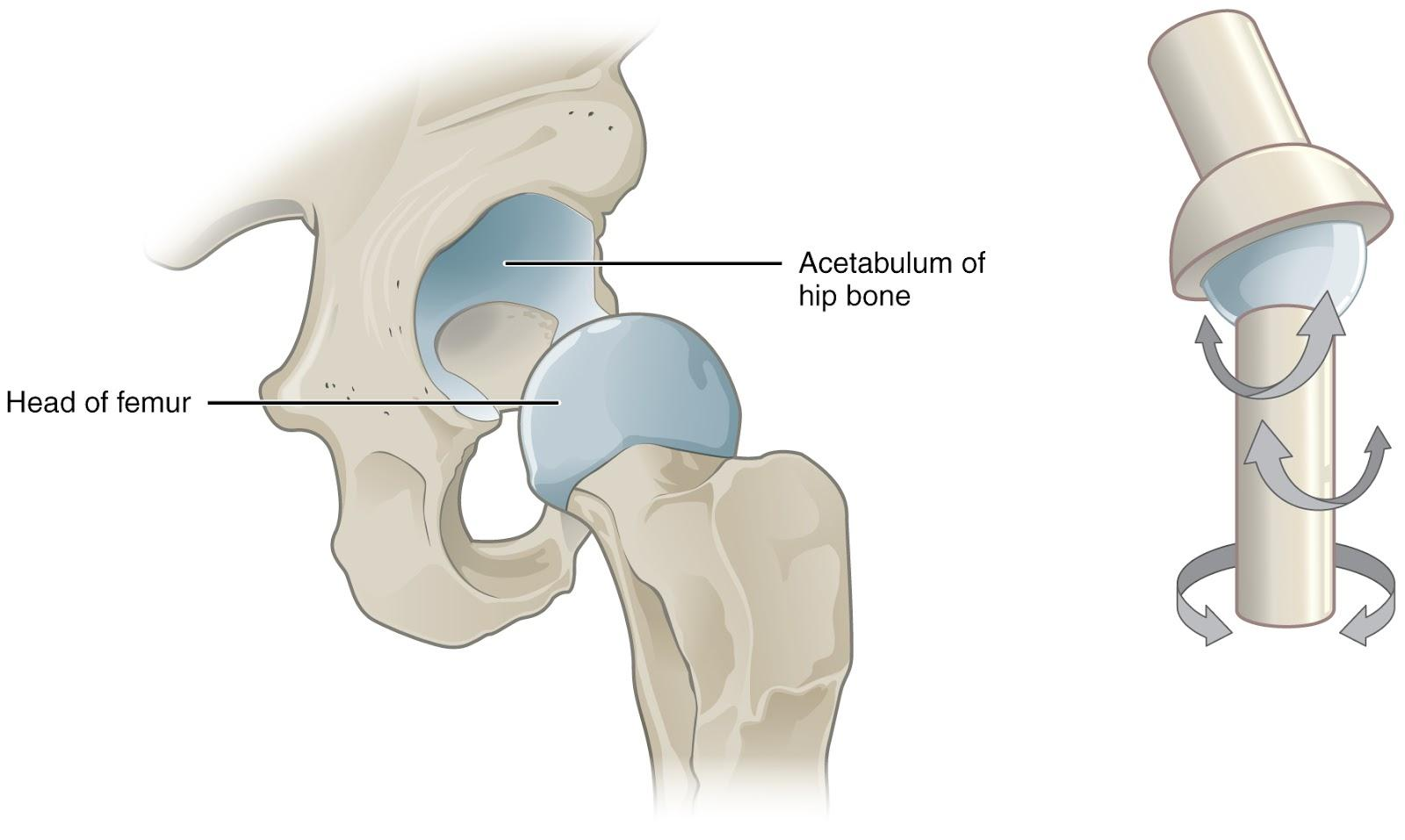
The ball-and-socket joint has the most range of motion of any joint. The concave articulation (the socket) of one bone fits into the rounded head (the ball) of the adjacent bone at these joints. The only ball-and-socket joints in the body are the hip and glenohumeral (shoulder) joints. The head of the femur articulates with the acetabulum of the hip bone at the hip joint, and the head of the humerus with the glenoid cavity of the scapula at the shoulder joint.
Multiaxial joints are the functional classification for ball-and-socket joints. The femur and humerus can move in two directions: anterior-posterior and medial-lateral, as well as rotate along their long axis. The glenoid cavity's shallow socket provides the shoulder joint with a wide range of motion. The deep socket of the acetabulum and the strong supporting ligaments of the hip joint, on the other hand, serve to restrain femur motions, reflecting the need for hip stability and weight-bearing ability.
Note:-
Arthritis is a common synovial joint condition characterised by joint inflammation. This frequently causes severe joint pain, as well as edoema, stiffness, and decreased joint movement. Arthritis comes in over a hundred various kinds. Arthritis can be caused by a variety of factors, including ageing, articular cartilage loss, autoimmune illnesses, bacterial or viral infections, or undiscovered (most likely hereditary) reasons. Osteoarthritis is the most common type of arthritis, which is linked to ageing and articular cartilage "wear and tear".
Complete answer:
Although a hinge joint is considered uni-axial, a ball and socket joint does not fall into this category. Due to the fact that ball and socket joints can move in multiple directions. As a result, these are multiaxial joints.
The forms of the articulating surfaces of the bones that make up each joint are used to divide synovial joints. Pivot, hinge, condyloid, saddle, plane, and ball-and-socket joints are the six types of synovial joints.
Hinge joint:
The convex end of one bone articulates with the concave end of the adjoining bone in a hinge joint. Hinge joints are functionally characterised as uniaxial joints since they only allow bending and straightening motions along a single axis. The elbow joint, with its articulation between the trochlea of the humerus and the trochlear notch of the ulna, is a good example. The knee, ankle, and interphalangeal joints between the phalanges of the fingers and toes are examples of other body hinge joints.
Ball and socket joint:
The ball-and-socket joint has the most range of motion of any joint. The concave articulation (the socket) of one bone fits into the rounded head (the ball) of the adjacent bone at these joints. The only ball-and-socket joints in the body are the hip and glenohumeral (shoulder) joints. The head of the femur articulates with the acetabulum of the hip bone at the hip joint, and the head of the humerus with the glenoid cavity of the scapula at the shoulder joint.
Multiaxial joints are the functional classification for ball-and-socket joints. The femur and humerus can move in two directions: anterior-posterior and medial-lateral, as well as rotate along their long axis. The glenoid cavity's shallow socket provides the shoulder joint with a wide range of motion. The deep socket of the acetabulum and the strong supporting ligaments of the hip joint, on the other hand, serve to restrain femur motions, reflecting the need for hip stability and weight-bearing ability.
Note:-
Arthritis is a common synovial joint condition characterised by joint inflammation. This frequently causes severe joint pain, as well as edoema, stiffness, and decreased joint movement. Arthritis comes in over a hundred various kinds. Arthritis can be caused by a variety of factors, including ageing, articular cartilage loss, autoimmune illnesses, bacterial or viral infections, or undiscovered (most likely hereditary) reasons. Osteoarthritis is the most common type of arthritis, which is linked to ageing and articular cartilage "wear and tear".
Recently Updated Pages
Master Class 11 Computer Science: Engaging Questions & Answers for Success

Master Class 11 Business Studies: Engaging Questions & Answers for Success
Master Class 11 Economics: Engaging Questions & Answers for Success
Master Class 11 English: Engaging Questions & Answers for Success
Master Class 11 Maths: Engaging Questions & Answers for Success
Master Class 11 Biology: Engaging Questions & Answers for Success
Trending doubts
There are 720 permutations of the digits 1 2 3 4 5 class 11 maths CBSE
Discuss the various forms of bacteria class 11 biology CBSE
Explain zero factorial class 11 maths CBSE
What organs are located on the left side of your body class 11 biology CBSE
Draw a diagram of nephron and explain its structur class 11 biology CBSE
How do I convert ms to kmh Give an example class 11 physics CBSE