




How do you know which method to use to solve triangles?
Answer
 Verified
553.8k+ views
Hint: To solve a triangle means, finding the length of its sides and measure of its angle. We can solve the triangle by using either Law of Sines which states that \[\dfrac{\sin A}{a}=\dfrac{\sin B}{b}=\dfrac{\sin C}{c}\]. Or Law of Cosine which states that \[{{a}^{2}}={{b}^{2}}+{{c}^{2}}-2(bc)\cos A\], here \[A,B\And C\]are the angles of the triangle and \[a,b\And c\] are the length of sides opposite to them respectively.
Complete step by step answer:
To solve a triangle, we can use the Sine rule or Cosine rule. It depends on the given components of the triangle that is the number of sides or number of angles we know, which rule should be used.
We will now see the condition for which the Sine rule should be used to solve a triangle, see the following figure,
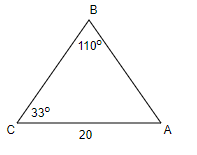
As we can see from the above \[\Delta ABC\], \[\angle C={{33}^{\circ }},\angle B={{110}^{\circ }}\And b=20\]. We know the measure of 2 angles and the length of 1 side of the triangle. We know that the sum of all angles of a triangle equals to \[{{180}^{\circ }}\]. Using this we can find the measure of the third angle as,
\[\begin{align}
& \Rightarrow \angle A={{180}^{\circ }}-\angle C-\angle B \\
& \Rightarrow \angle A={{180}^{\circ }}-{{33}^{\circ }}-{{110}^{\circ }} \\
& \Rightarrow \angle A={{37}^{\circ }} \\
\end{align}\]
Now, from the figure we have the measure of \[\angle B\] and length of side \[b\]. We can find the value of \[\dfrac{\sin B}{b}\] and use it in the Sine rule \[\dfrac{\sin A}{a}=\dfrac{\sin B}{b}=\dfrac{\sin C}{c}\]. The remaining components can be found using this relation.
We will see the condition for which the Cosine rule should be used to solve a triangle, see the figure given below,
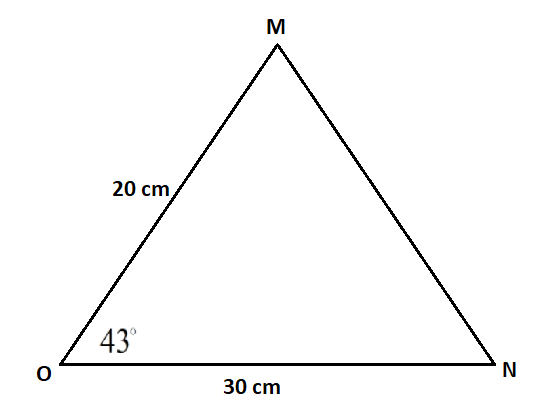
From the above figure, we can say that \[\angle O={{43}^{\circ }},m=30cm\And n=20cm\]. We know the measure of an angle and the length of sides opposite to the other two angles. Thus, we can easily use the Cosine rule for this triangle to find the other components.
Note:
There can be other conditions also where a particular rule should be used other than these two. If one of the angles is a right angle then the Cosine rule becomes \[{{a}^{2}}={{b}^{2}}+{{c}^{2}}\] which is called the Pythagoras theorem.
Complete step by step answer:
To solve a triangle, we can use the Sine rule or Cosine rule. It depends on the given components of the triangle that is the number of sides or number of angles we know, which rule should be used.
We will now see the condition for which the Sine rule should be used to solve a triangle, see the following figure,
As we can see from the above \[\Delta ABC\], \[\angle C={{33}^{\circ }},\angle B={{110}^{\circ }}\And b=20\]. We know the measure of 2 angles and the length of 1 side of the triangle. We know that the sum of all angles of a triangle equals to \[{{180}^{\circ }}\]. Using this we can find the measure of the third angle as,
\[\begin{align}
& \Rightarrow \angle A={{180}^{\circ }}-\angle C-\angle B \\
& \Rightarrow \angle A={{180}^{\circ }}-{{33}^{\circ }}-{{110}^{\circ }} \\
& \Rightarrow \angle A={{37}^{\circ }} \\
\end{align}\]
Now, from the figure we have the measure of \[\angle B\] and length of side \[b\]. We can find the value of \[\dfrac{\sin B}{b}\] and use it in the Sine rule \[\dfrac{\sin A}{a}=\dfrac{\sin B}{b}=\dfrac{\sin C}{c}\]. The remaining components can be found using this relation.
We will see the condition for which the Cosine rule should be used to solve a triangle, see the figure given below,
From the above figure, we can say that \[\angle O={{43}^{\circ }},m=30cm\And n=20cm\]. We know the measure of an angle and the length of sides opposite to the other two angles. Thus, we can easily use the Cosine rule for this triangle to find the other components.
Note:
There can be other conditions also where a particular rule should be used other than these two. If one of the angles is a right angle then the Cosine rule becomes \[{{a}^{2}}={{b}^{2}}+{{c}^{2}}\] which is called the Pythagoras theorem.
Recently Updated Pages
Master Class 11 Computer Science: Engaging Questions & Answers for Success

Master Class 11 Business Studies: Engaging Questions & Answers for Success
Master Class 11 Economics: Engaging Questions & Answers for Success
Master Class 11 English: Engaging Questions & Answers for Success
Master Class 11 Maths: Engaging Questions & Answers for Success
Master Class 11 Biology: Engaging Questions & Answers for Success
Trending doubts
One Metric ton is equal to kg A 10000 B 1000 C 100 class 11 physics CBSE
There are 720 permutations of the digits 1 2 3 4 5 class 11 maths CBSE
Discuss the various forms of bacteria class 11 biology CBSE
Draw a diagram of a plant cell and label at least eight class 11 biology CBSE
State the laws of reflection of light
Explain zero factorial class 11 maths CBSE