




Lamprey (Petromyzon) belongs to
(a)Chondrichthyes
(b)Osteichthyes
(c)Agnatha
(d)Amphibia
Answer
 Verified
574.8k+ views
Hint: Recent studies in molecular and morphological phylogenetics place lampreys and hagfish in the superclass, meaning jawless animals. They are not part of the category in which frogs are placed instead where the jawless fishes are found.
Complete answer:
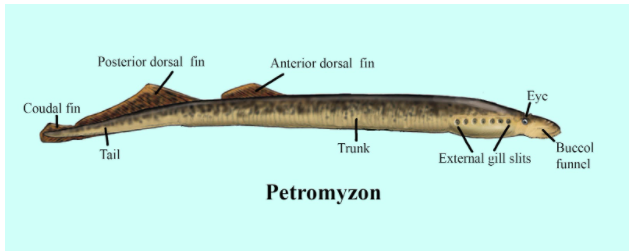
Lamprey (Petromyzon) belongs to the Cyclostomata branch of the Agnatha superclass.
Agnatha is a paraphyletic superclass of jawless fish and consists of two groups, Cyclostomata and Ostracoderm, which are extinct.
One of the jawless fishes of the order Petromyzontiformes is the Lampreys. The scientific name of the sea lamprey is Petromyzon. The existence of Notochord characterizes Chordates. Cyclostomata is a type of chordate that includes lampreys and hagfishes, living jawless fishes. The snake-like organism is long and slender. This organism is not referred to as a natural fish. The paired fins are absent from the organism. There are well defined dorsal and ventral fin folds of the organism. In swimming and locomotion, these fin folds assist. A toothed, funnel-like sucking mouth characterizes the adult process.
Additional Information: The Chondrichthyes Class falls under the Pisces Superclass. Most of the fish are marine and the tropical rivers are home to a few.
The Osteichthyes class falls under the Pisces superclass and includes lungfish, lobed finned fish, and ray-finned fish.
The species that occupy both land and water form Class Amphibia.
So, the correct answer is, ‘Agnatha’.
Note: The common name "lamprey" is possibly derived from the Latin lampetra, which, though the etymology is unclear, may mean "stone licker". Often, the plural form lamprey is used.
The Agnatha superclass consists of living and extinct forms. Lampreys share many similarities with jawed vertebrates (gnathostomes), such as the ability to monitor the body's ion concentration, pulse nervous regulation, and lateral eyes that are well-formed. The extinct agnathans seem to be more advanced than either hagfish or lampreys, and they have characteristics that suggest a relatively similar association with gnathostomes.
Complete answer:
Lamprey (Petromyzon) belongs to the Cyclostomata branch of the Agnatha superclass.
Agnatha is a paraphyletic superclass of jawless fish and consists of two groups, Cyclostomata and Ostracoderm, which are extinct.
One of the jawless fishes of the order Petromyzontiformes is the Lampreys. The scientific name of the sea lamprey is Petromyzon. The existence of Notochord characterizes Chordates. Cyclostomata is a type of chordate that includes lampreys and hagfishes, living jawless fishes. The snake-like organism is long and slender. This organism is not referred to as a natural fish. The paired fins are absent from the organism. There are well defined dorsal and ventral fin folds of the organism. In swimming and locomotion, these fin folds assist. A toothed, funnel-like sucking mouth characterizes the adult process.
Additional Information: The Chondrichthyes Class falls under the Pisces Superclass. Most of the fish are marine and the tropical rivers are home to a few.
The Osteichthyes class falls under the Pisces superclass and includes lungfish, lobed finned fish, and ray-finned fish.
The species that occupy both land and water form Class Amphibia.
So, the correct answer is, ‘Agnatha’.
Note: The common name "lamprey" is possibly derived from the Latin lampetra, which, though the etymology is unclear, may mean "stone licker". Often, the plural form lamprey is used.
The Agnatha superclass consists of living and extinct forms. Lampreys share many similarities with jawed vertebrates (gnathostomes), such as the ability to monitor the body's ion concentration, pulse nervous regulation, and lateral eyes that are well-formed. The extinct agnathans seem to be more advanced than either hagfish or lampreys, and they have characteristics that suggest a relatively similar association with gnathostomes.
Recently Updated Pages
Master Class 11 Computer Science: Engaging Questions & Answers for Success

Master Class 11 Business Studies: Engaging Questions & Answers for Success
Master Class 11 Economics: Engaging Questions & Answers for Success
Master Class 11 English: Engaging Questions & Answers for Success
Master Class 11 Maths: Engaging Questions & Answers for Success
Master Class 11 Biology: Engaging Questions & Answers for Success
Trending doubts
One Metric ton is equal to kg A 10000 B 1000 C 100 class 11 physics CBSE
There are 720 permutations of the digits 1 2 3 4 5 class 11 maths CBSE
Discuss the various forms of bacteria class 11 biology CBSE
Draw a diagram of a plant cell and label at least eight class 11 biology CBSE
State the laws of reflection of light
10 examples of friction in our daily life