




Meristematic tissue occurs in
a) Stems
b) Roots
c) All growing tips
d) Both A and B
Answer
 Verified
597.9k+ views
Hint: Tissues that are present in various plant parts which help in the growth and development of other tissues and organs of the plants.
Complete answer
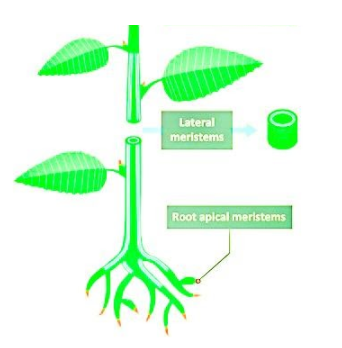
Meristematic tissue is actively dividing undifferentiated cells that undergo cell division. These tissues help in developing various organs of the plants. They are mostly present in the apices of the root and shoot.
Additional information
-The basic structure of the plant body is formed due to the differentiation of meristematic tissues.
-The meristematic cells have a thin cell wall and no intercellular space.
-The cells are small filled with protoplasm and no vacuole present, and the plastids are rudimentary in the form of proplastids.
-Meristematic tissues are of three types:
-Apical meristematic tissue (present at the tips)
-Intercalary meristematic tissue (present in the middle)
-Lateral meristematic tissue (present at the sides)
-A central zone is present in the centre of meristematic tissue having stem cells and helps in the maintenance of meristem.
-The shoot apical meristem develops the above-ground organs while root apical meristem develops the below-ground organs and tissues.
So, the correct answer is ‘Both A and B'.
Note: The term meristem was first used by Carl Wilhelm von Nageli I’m 1858 in his book “Contributors of Scientific Botany “. The term is derived from the Greek word merizein meaning ‘to divide’. The term introduced in considering its function. The opposite of the meristematic tissue is the permanent tissues which are non-dividing cells. They are originated from the meristematic tissues and performs specific functions of the plants. They are mainly of three types: parenchyma (stores food), collenchyma (gives mechanical strength to plants), and sclerenchyma (gives rigidity to the plants).
Complete answer
Meristematic tissue is actively dividing undifferentiated cells that undergo cell division. These tissues help in developing various organs of the plants. They are mostly present in the apices of the root and shoot.
Additional information
-The basic structure of the plant body is formed due to the differentiation of meristematic tissues.
-The meristematic cells have a thin cell wall and no intercellular space.
-The cells are small filled with protoplasm and no vacuole present, and the plastids are rudimentary in the form of proplastids.
-Meristematic tissues are of three types:
-Apical meristematic tissue (present at the tips)
-Intercalary meristematic tissue (present in the middle)
-Lateral meristematic tissue (present at the sides)
-A central zone is present in the centre of meristematic tissue having stem cells and helps in the maintenance of meristem.
-The shoot apical meristem develops the above-ground organs while root apical meristem develops the below-ground organs and tissues.
So, the correct answer is ‘Both A and B'.
Note: The term meristem was first used by Carl Wilhelm von Nageli I’m 1858 in his book “Contributors of Scientific Botany “. The term is derived from the Greek word merizein meaning ‘to divide’. The term introduced in considering its function. The opposite of the meristematic tissue is the permanent tissues which are non-dividing cells. They are originated from the meristematic tissues and performs specific functions of the plants. They are mainly of three types: parenchyma (stores food), collenchyma (gives mechanical strength to plants), and sclerenchyma (gives rigidity to the plants).
Recently Updated Pages
Master Class 11 Computer Science: Engaging Questions & Answers for Success

Master Class 11 Business Studies: Engaging Questions & Answers for Success
Master Class 11 Economics: Engaging Questions & Answers for Success
Master Class 11 English: Engaging Questions & Answers for Success
Master Class 11 Maths: Engaging Questions & Answers for Success
Master Class 11 Biology: Engaging Questions & Answers for Success
Trending doubts
One Metric ton is equal to kg A 10000 B 1000 C 100 class 11 physics CBSE
There are 720 permutations of the digits 1 2 3 4 5 class 11 maths CBSE
Discuss the various forms of bacteria class 11 biology CBSE
Draw a diagram of a plant cell and label at least eight class 11 biology CBSE
State the laws of reflection of light
Explain zero factorial class 11 maths CBSE