




Name the three important blood proteins are seen in the plasma. Add a note, on their functions.
Answer
 Verified
590.7k+ views
Hint: Plasma is that the clear, straw-coloured liquid portion of blood that remains after red blood cells, white blood cells, platelets and other cellular components are removed. It's the only largest component of human blood, comprising about 55 per cent, and contains water, salts, enzymes, antibodies and other proteins.
Complete answer:
The three important blood proteins that are seen in plasma are fibrinogen, globulins and albumins.
Fibrinogen- It is made in the liver. It is one of the 13 coagulation factors that help in normal blood clotting. When blood clotting is activated.the fibrinogen circulating in the blood is converted to fibrin. The fibrin helps to form the stable clot at the site of bleeding.
-Globulins- The globulins are of 3 types alpha, beta and gamma. Alpha and beta globulins are transport proteins which transport lipid and fat-soluble vitamins. The gamma globulins are antibodies that function in immunity.
-Albumins- Albumins maintain the osmotic pressure of blood.
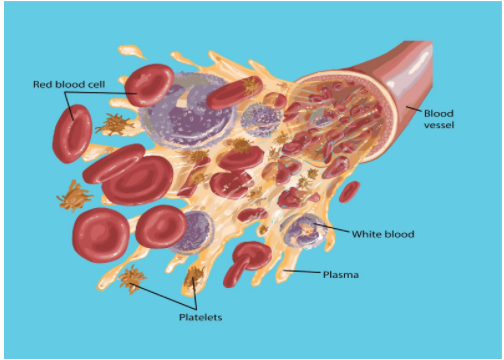
Additional Information: Plasma, also known as blood plasma, the liquid portion of blood. Plasma is a transport medium for delivering nutrients to the cells of the varied organs of the body and for transporting waste products derived from cellular metabolism to the kidneys, liver, and lungs for excretion. It's also a transport system for blood cells, and it plays a critical role in maintaining normal vital signs. Plasma helps to distribute heat throughout the body and to take care of homeostasis, or biological stability, including acid-base equilibrium within the blood and body.
Note: Plasma comes when all the blood cells that are the red blood cells (erythrocytes), white blood cells (leukocytes), and platelets (thrombocytes) are separated from the blood. Plasma contains 6–8 per cent proteins. One critical group is that the coagulation proteins and their inhibitors, synthesized primarily within the liver. When clotting is activated, fibrinogen circulating within the blood is converted to fibrin, which successively helps to make a stable blood clot at the location of vascular disruption.
Complete answer:
The three important blood proteins that are seen in plasma are fibrinogen, globulins and albumins.
Fibrinogen- It is made in the liver. It is one of the 13 coagulation factors that help in normal blood clotting. When blood clotting is activated.the fibrinogen circulating in the blood is converted to fibrin. The fibrin helps to form the stable clot at the site of bleeding.
-Globulins- The globulins are of 3 types alpha, beta and gamma. Alpha and beta globulins are transport proteins which transport lipid and fat-soluble vitamins. The gamma globulins are antibodies that function in immunity.
-Albumins- Albumins maintain the osmotic pressure of blood.
Additional Information: Plasma, also known as blood plasma, the liquid portion of blood. Plasma is a transport medium for delivering nutrients to the cells of the varied organs of the body and for transporting waste products derived from cellular metabolism to the kidneys, liver, and lungs for excretion. It's also a transport system for blood cells, and it plays a critical role in maintaining normal vital signs. Plasma helps to distribute heat throughout the body and to take care of homeostasis, or biological stability, including acid-base equilibrium within the blood and body.
Note: Plasma comes when all the blood cells that are the red blood cells (erythrocytes), white blood cells (leukocytes), and platelets (thrombocytes) are separated from the blood. Plasma contains 6–8 per cent proteins. One critical group is that the coagulation proteins and their inhibitors, synthesized primarily within the liver. When clotting is activated, fibrinogen circulating within the blood is converted to fibrin, which successively helps to make a stable blood clot at the location of vascular disruption.
Recently Updated Pages
Master Class 11 Computer Science: Engaging Questions & Answers for Success

Master Class 11 Business Studies: Engaging Questions & Answers for Success
Master Class 11 Economics: Engaging Questions & Answers for Success
Master Class 11 English: Engaging Questions & Answers for Success
Master Class 11 Maths: Engaging Questions & Answers for Success
Master Class 11 Biology: Engaging Questions & Answers for Success
Trending doubts
One Metric ton is equal to kg A 10000 B 1000 C 100 class 11 physics CBSE
There are 720 permutations of the digits 1 2 3 4 5 class 11 maths CBSE
Discuss the various forms of bacteria class 11 biology CBSE
Draw a diagram of a plant cell and label at least eight class 11 biology CBSE
State the laws of reflection of light
Explain zero factorial class 11 maths CBSE