




Name the types of cell division that occurs during the following cellular activity.
a. Growth of a shoot.
b. Formation of pollen grains.
Answer
 Verified
569.4k+ views
Hint: Cell division can be defined as the division of a parent cell in two or more daughter cells. It is of two types: mitosis (equational division) and meiosis (reductional division).
Complete answer:
During the growth of the shoot, the type of cell division that occurs is known as mitosis. As mitosis is also known as equational division, during the growth of the shoot there is an increase in the length and width of the shoot. This process requires cells with an equal number of chromosomes as that of the parent cell (i.e., 2n), hence, mitosis takes place during this type of cellular activity.
During the formation of pollen grains, the type of cell division that occurs is known as meiosis. Pollen grains are formed from the pollen mother cell having half the number of chromosomes from the pollen mother cell. This reduction in the number of chromosomes is caused by the meiotic cell division where the pollen mother cell having a ‘2n’ number of chromosomes are divided to form pollen grains having half the number of chromosomes i.e., ‘n’.
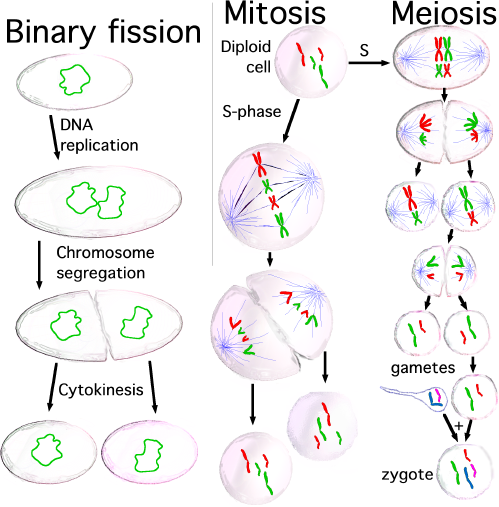
Additional information: A cell divides in two ways either mitotically or meiotically which depends on whether the cell wants to grow or reproduce respectively. The major purpose of mitosis is for the growth of the cells or the replacement of worn-out cells and to carry out asexual reproduction. Meiosis, on the other hand, is known for the production of haploid gametes to carry out sexual reproduction and produce genetically different offspring.
Note: Growth of shoot involves the enlargement and development of the individual cells present within the shoot. This process of enlargement and development of the cells is carried out by the mitotic cell division.
Pollen grains are the haploid male gametes that are produced inside the anther of the flower by meiotic cell division.
Complete answer:
During the growth of the shoot, the type of cell division that occurs is known as mitosis. As mitosis is also known as equational division, during the growth of the shoot there is an increase in the length and width of the shoot. This process requires cells with an equal number of chromosomes as that of the parent cell (i.e., 2n), hence, mitosis takes place during this type of cellular activity.
During the formation of pollen grains, the type of cell division that occurs is known as meiosis. Pollen grains are formed from the pollen mother cell having half the number of chromosomes from the pollen mother cell. This reduction in the number of chromosomes is caused by the meiotic cell division where the pollen mother cell having a ‘2n’ number of chromosomes are divided to form pollen grains having half the number of chromosomes i.e., ‘n’.
Additional information: A cell divides in two ways either mitotically or meiotically which depends on whether the cell wants to grow or reproduce respectively. The major purpose of mitosis is for the growth of the cells or the replacement of worn-out cells and to carry out asexual reproduction. Meiosis, on the other hand, is known for the production of haploid gametes to carry out sexual reproduction and produce genetically different offspring.
Note: Growth of shoot involves the enlargement and development of the individual cells present within the shoot. This process of enlargement and development of the cells is carried out by the mitotic cell division.
Pollen grains are the haploid male gametes that are produced inside the anther of the flower by meiotic cell division.
Recently Updated Pages
Master Class 11 Computer Science: Engaging Questions & Answers for Success

Master Class 11 Business Studies: Engaging Questions & Answers for Success
Master Class 11 Economics: Engaging Questions & Answers for Success
Master Class 11 English: Engaging Questions & Answers for Success
Master Class 11 Maths: Engaging Questions & Answers for Success
Master Class 11 Biology: Engaging Questions & Answers for Success
Trending doubts
One Metric ton is equal to kg A 10000 B 1000 C 100 class 11 physics CBSE
There are 720 permutations of the digits 1 2 3 4 5 class 11 maths CBSE
Discuss the various forms of bacteria class 11 biology CBSE
Draw a diagram of a plant cell and label at least eight class 11 biology CBSE
State the laws of reflection of light
Explain zero factorial class 11 maths CBSE