




On squared paper draw the triangle with vertices at (1,1), (5,3), (3,5). Find the area of the triangle.
Answer
 Verified
587.7k+ views
Hint: For this question, we need to draw the given points of vertices of a triangle and find out the area of the triangle. Use the formula of the area of a triangle as given below.
Formula used: Area of Triangle $ = \dfrac{1}{2}\left| {\left. {\left( {\begin{array}{*{20}{c}}
{({x_1} - {x_2}}&{{x_1} - {x_3}} \\
{{y_1} - {y_2}}&{{y_1} - {y_3}}
\end{array}} \right)} \right|} \right|$ --(1)
where, these vertical lines in equation 1 will represent determinants, and $({x_1},{y_1})$,\[({x_2},{y_2})\],$({x_3},{y_3})$ will represent the coordinates for the vertices of a triangle and more specifically ${x_1},{x_2},{x_3}$ be the x-axis coordinates and ${y_1},{y_2},{y_3}$be the y-axis coordinates.
Now to solve the determinants please use the concept given by equation (2)
\[ = \;\;\left| {\left( {\begin{array}{*{20}{c}}
a&b \\
c&d
\end{array}} \right)} \right| = ad - bc\] --(2)
A solution of equation 2 we will get by simple cross-multiplication of opposite diagonal elements and separate them with a negative sign.
Complete step-by-step answer:
(Step 1) Here we will write down the given coordinates and assign it as A=$(1,1), $B=$(3,5), $C= $(5,3)$
(Step 2) Now we will simply plot the coordinates on the x and y-axis with.
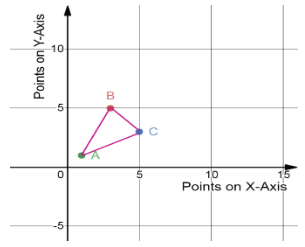
(Step 3) Now simply substitute all the points A, B, and C in equation 1, as discussed in the hint section above.
$ \Rightarrow Area = \dfrac{1}{2}\left| {\left( {\begin{array}{*{20}{c}}
{(1 - 5)}&{(1 - 3)} \\
{(1 - 3)}&{(1 - 5)}
\end{array}} \right)} \right|$
(Step 4) Solve the given question with valid points.
$ \Rightarrow Area = \dfrac{1}{2}\left| {\left( {\begin{array}{*{20}{c}}
{ - 4}&{ - 2} \\
{ - 2}&{ - 4}
\end{array}} \right)} \right|$
$ \Rightarrow Area = \dfrac{1}{2}\left| {( - 4)( - 4) - ( - 2)( - 2)} \right|$
$
\Rightarrow Area = \dfrac{1}{2}\left| {16 - 4} \right| \\
\Rightarrow Area = \dfrac{1}{2}\left| {12} \right| \\
\therefore Area = 6unit{s^2} \\
$
The area of a triangle found from the given coordinates of vertices is \[6\]${(units)^2}$. Remember area is measured in square units but as no dimensions, for now, is mentioned in the question so we have simply represented it as $unit{s^2}$.
Area of the triangle is \[6\]${(units)^2}$
Note: Another approach to solving this question is to make use of the graphical analysis as done on the plotted figure above. Area of any quantity cannot be negative.
Formula used: Area of Triangle $ = \dfrac{1}{2}\left| {\left. {\left( {\begin{array}{*{20}{c}}
{({x_1} - {x_2}}&{{x_1} - {x_3}} \\
{{y_1} - {y_2}}&{{y_1} - {y_3}}
\end{array}} \right)} \right|} \right|$ --(1)
where, these vertical lines in equation 1 will represent determinants, and $({x_1},{y_1})$,\[({x_2},{y_2})\],$({x_3},{y_3})$ will represent the coordinates for the vertices of a triangle and more specifically ${x_1},{x_2},{x_3}$ be the x-axis coordinates and ${y_1},{y_2},{y_3}$be the y-axis coordinates.
Now to solve the determinants please use the concept given by equation (2)
\[ = \;\;\left| {\left( {\begin{array}{*{20}{c}}
a&b \\
c&d
\end{array}} \right)} \right| = ad - bc\] --(2)
A solution of equation 2 we will get by simple cross-multiplication of opposite diagonal elements and separate them with a negative sign.
Complete step-by-step answer:
(Step 1) Here we will write down the given coordinates and assign it as A=$(1,1), $B=$(3,5), $C= $(5,3)$
(Step 2) Now we will simply plot the coordinates on the x and y-axis with.
(Step 3) Now simply substitute all the points A, B, and C in equation 1, as discussed in the hint section above.
$ \Rightarrow Area = \dfrac{1}{2}\left| {\left( {\begin{array}{*{20}{c}}
{(1 - 5)}&{(1 - 3)} \\
{(1 - 3)}&{(1 - 5)}
\end{array}} \right)} \right|$
(Step 4) Solve the given question with valid points.
$ \Rightarrow Area = \dfrac{1}{2}\left| {\left( {\begin{array}{*{20}{c}}
{ - 4}&{ - 2} \\
{ - 2}&{ - 4}
\end{array}} \right)} \right|$
$ \Rightarrow Area = \dfrac{1}{2}\left| {( - 4)( - 4) - ( - 2)( - 2)} \right|$
$
\Rightarrow Area = \dfrac{1}{2}\left| {16 - 4} \right| \\
\Rightarrow Area = \dfrac{1}{2}\left| {12} \right| \\
\therefore Area = 6unit{s^2} \\
$
The area of a triangle found from the given coordinates of vertices is \[6\]${(units)^2}$. Remember area is measured in square units but as no dimensions, for now, is mentioned in the question so we have simply represented it as $unit{s^2}$.
Area of the triangle is \[6\]${(units)^2}$
Note: Another approach to solving this question is to make use of the graphical analysis as done on the plotted figure above. Area of any quantity cannot be negative.
Recently Updated Pages
Master Class 8 Social Science: Engaging Questions & Answers for Success

Master Class 8 English: Engaging Questions & Answers for Success
Class 8 Question and Answer - Your Ultimate Solutions Guide
Master Class 8 Maths: Engaging Questions & Answers for Success
Master Class 8 Science: Engaging Questions & Answers for Success
Master Class 9 General Knowledge: Engaging Questions & Answers for Success
Trending doubts
What is BLO What is the full form of BLO class 8 social science CBSE
Citizens of India can vote at the age of A 18 years class 8 social science CBSE
Full form of STD, ISD and PCO
Advantages and disadvantages of science
Right to vote is a AFundamental Right BFundamental class 8 social science CBSE
What are the 12 elements of nature class 8 chemistry CBSE