




One of the plants using foliar adventitious buds as a method for vegetative propagation is
(a)Banana
(b)Ginger
(c)Bryophyllum
(d)Colocasia
Answer
 Verified
579k+ views
Hint: Vegetative propagation is an asexual method of plant reproduction that happens in its leaves, roots, and stems. This will occur through fragmentation and regeneration of specific vegetative parts of plants.
Complete answer:
Bryophyllum proliferates by vegetative reproduction. It has vegetatively grown small plantlets on the fringes of the leaves. These eventually drop off and root. These plantlets arise from mitosis of meristematic type tissue in notches in the leaves which divides incessantly to form a new plant.
Additional Information:
-In non-vascular plants such as mosses and liverworts, vegetative reproductive structures include gemmae and spores. In vascular plants, vegetative reproductive structures include roots, stems, and leaves.
-Vegetative propagation is formed possible by meristem tissue, commonly found within stems and leaves also because of the tips of roots, that contain undifferentiated cells. These cells actively divide by mitosis to permit widespread and rapid primary plant growth. Specialized, permanent plant tissue systems also originate from meristem tissue. It is the power of meristem tissue to repeatedly divide that permits for plant regeneration required by vegetative propagation.
So, the correct answer is, “Bryophyllum”.
Note: -Vegetative propagation can occur both naturally and artificially. Artificial vegetative propagation occurs with the help of man while the other is done naturally by the plant with the help of vegetative propagules.
-Natural vegetative propagation occurs when an axillary bud grows into a lateral shoot and it develops into roots (also known as adventitious roots). Plant structures allowing natural vegetative propagation are called Vegetative propagules and they include bulbs, rhizomes, stolons, and tubers.
-In artificial vegetative propagation, The various methods are involved like taking a piece of one parent plant and causing it to regenerate itself into a new plant.
The growth of tissues or cells under Common artificial methods include cuttings, grafting and budding, and tissue culture.
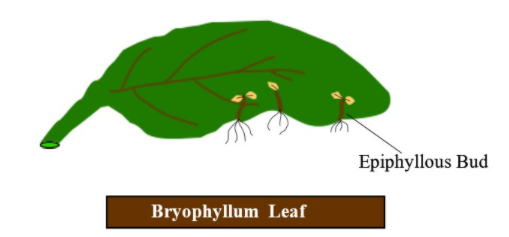
Complete answer:
Bryophyllum proliferates by vegetative reproduction. It has vegetatively grown small plantlets on the fringes of the leaves. These eventually drop off and root. These plantlets arise from mitosis of meristematic type tissue in notches in the leaves which divides incessantly to form a new plant.
Additional Information:
| Advantages of vegetative propagation | Disadvantages of vegetative propagation |
| -Quicker and more certain. | -Does not produce a new variety. |
| -Produces identical quality as the parent. | -This leads to overcrowding around the parent plant. |
| -Plants that do not have viable seed, can be reproduced. | -The very little possibility of dispersal. |
| -Flowers produced are of superior quality. | -No evolution and thus no variation. |
| -The desirable character of fruit can be maintained. | -The disease may affect all the individuals in a population. |
-In non-vascular plants such as mosses and liverworts, vegetative reproductive structures include gemmae and spores. In vascular plants, vegetative reproductive structures include roots, stems, and leaves.
-Vegetative propagation is formed possible by meristem tissue, commonly found within stems and leaves also because of the tips of roots, that contain undifferentiated cells. These cells actively divide by mitosis to permit widespread and rapid primary plant growth. Specialized, permanent plant tissue systems also originate from meristem tissue. It is the power of meristem tissue to repeatedly divide that permits for plant regeneration required by vegetative propagation.
So, the correct answer is, “Bryophyllum”.
Note: -Vegetative propagation can occur both naturally and artificially. Artificial vegetative propagation occurs with the help of man while the other is done naturally by the plant with the help of vegetative propagules.
-Natural vegetative propagation occurs when an axillary bud grows into a lateral shoot and it develops into roots (also known as adventitious roots). Plant structures allowing natural vegetative propagation are called Vegetative propagules and they include bulbs, rhizomes, stolons, and tubers.
-In artificial vegetative propagation, The various methods are involved like taking a piece of one parent plant and causing it to regenerate itself into a new plant.
The growth of tissues or cells under Common artificial methods include cuttings, grafting and budding, and tissue culture.
Recently Updated Pages
Master Class 11 Computer Science: Engaging Questions & Answers for Success

Master Class 11 Business Studies: Engaging Questions & Answers for Success
Master Class 11 Economics: Engaging Questions & Answers for Success
Master Class 11 English: Engaging Questions & Answers for Success
Master Class 11 Maths: Engaging Questions & Answers for Success
Master Class 11 Biology: Engaging Questions & Answers for Success
Trending doubts
One Metric ton is equal to kg A 10000 B 1000 C 100 class 11 physics CBSE
There are 720 permutations of the digits 1 2 3 4 5 class 11 maths CBSE
Discuss the various forms of bacteria class 11 biology CBSE
Draw a diagram of a plant cell and label at least eight class 11 biology CBSE
State the laws of reflection of light
Explain zero factorial class 11 maths CBSE