




Pacemaker is situated in the heart
A. In the wall of the right atrium
B. On interauricular septum
C. On interventricular septum
D. In the wall of the left atrium
Answer
 Verified
585.3k+ views
Hint: Electrical impulses from the heart's nodal tissues cause your heart to beat (contract). This electrical signal begins within the sinoatrial (SA) node, located at the highest of the heart's upper-right chamber (the right atrium). The SAN is usually called the heart's natural pacemaker.
Complete answer: The heart has four different types of nodal tissues, among which the cardiac pacemaker cells are mostly found within the sinoatrial (SA) node, located within the upper part of the wall of the right auricle (or atrium).
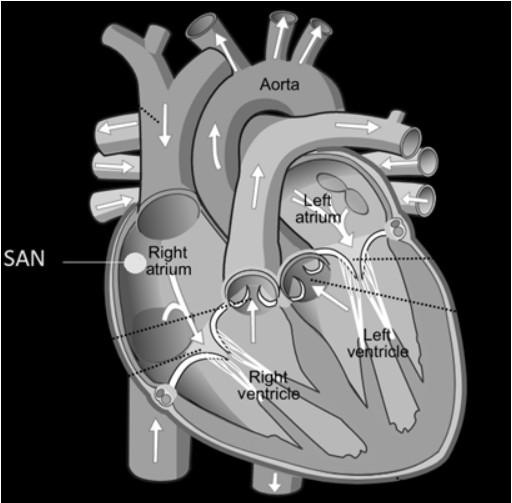
These cells have natural automaticity, meaning they will generate impulses themselves.
It is a small mass of specialized cells within the top of the proper atrium (upper chamber of the heart).
It is responsible for generating the main threshold electrical impulses that cause the contraction and relaxation of the heart muscles, which we commonly know as heartbeats.
It allows the pacemaker to fireside when the heartbeat is just too slow.
So, the correct answer is “Option A”.
Note: It is important to note that the sinus node continuously generates electrical impulses, thereby setting the traditional rhythm and rate during a healthy heart. Hence, the pacemaker is mentioned because of the natural pacemaker of the guts. These cells form the cardiac muscle (or AV node), which is located between the left atrium of the heart, and the ventricle within the atrial septum, and it has the ability to take over the pacemaker responsibility.
Complete answer: The heart has four different types of nodal tissues, among which the cardiac pacemaker cells are mostly found within the sinoatrial (SA) node, located within the upper part of the wall of the right auricle (or atrium).
These cells have natural automaticity, meaning they will generate impulses themselves.
It is a small mass of specialized cells within the top of the proper atrium (upper chamber of the heart).
It is responsible for generating the main threshold electrical impulses that cause the contraction and relaxation of the heart muscles, which we commonly know as heartbeats.
It allows the pacemaker to fireside when the heartbeat is just too slow.
So, the correct answer is “Option A”.
Note: It is important to note that the sinus node continuously generates electrical impulses, thereby setting the traditional rhythm and rate during a healthy heart. Hence, the pacemaker is mentioned because of the natural pacemaker of the guts. These cells form the cardiac muscle (or AV node), which is located between the left atrium of the heart, and the ventricle within the atrial septum, and it has the ability to take over the pacemaker responsibility.
Recently Updated Pages
Master Class 10 Computer Science: Engaging Questions & Answers for Success

Master Class 10 General Knowledge: Engaging Questions & Answers for Success
Master Class 10 English: Engaging Questions & Answers for Success
Master Class 10 Social Science: Engaging Questions & Answers for Success
Master Class 10 Maths: Engaging Questions & Answers for Success
Master Class 10 Science: Engaging Questions & Answers for Success
Trending doubts
What is the median of the first 10 natural numbers class 10 maths CBSE
Which women's tennis player has 24 Grand Slam singles titles?
Who is the Brand Ambassador of Incredible India?
Why is there a time difference of about 5 hours between class 10 social science CBSE
Write a letter to the principal requesting him to grant class 10 english CBSE
State and prove converse of BPT Basic Proportionality class 10 maths CBSE