




Pentose and hexose are the most common
(a) Oligosaccharide
(b) Disaccharide
(c) Monosaccharide
(d) Polysaccharide
Answer
 Verified
580.2k+ views
Hint: The molecular formula of pentose and hexose are ${ C }_{ 5 }{ H }_{ 10 }{ O }_{ 5 }$ and ${ C }_{ 6 }{ H }_{ 12 }{ O }_{ 6 }$ respectively. They are similar to the basic formula of monosaccharide.
Complete step by step answer:
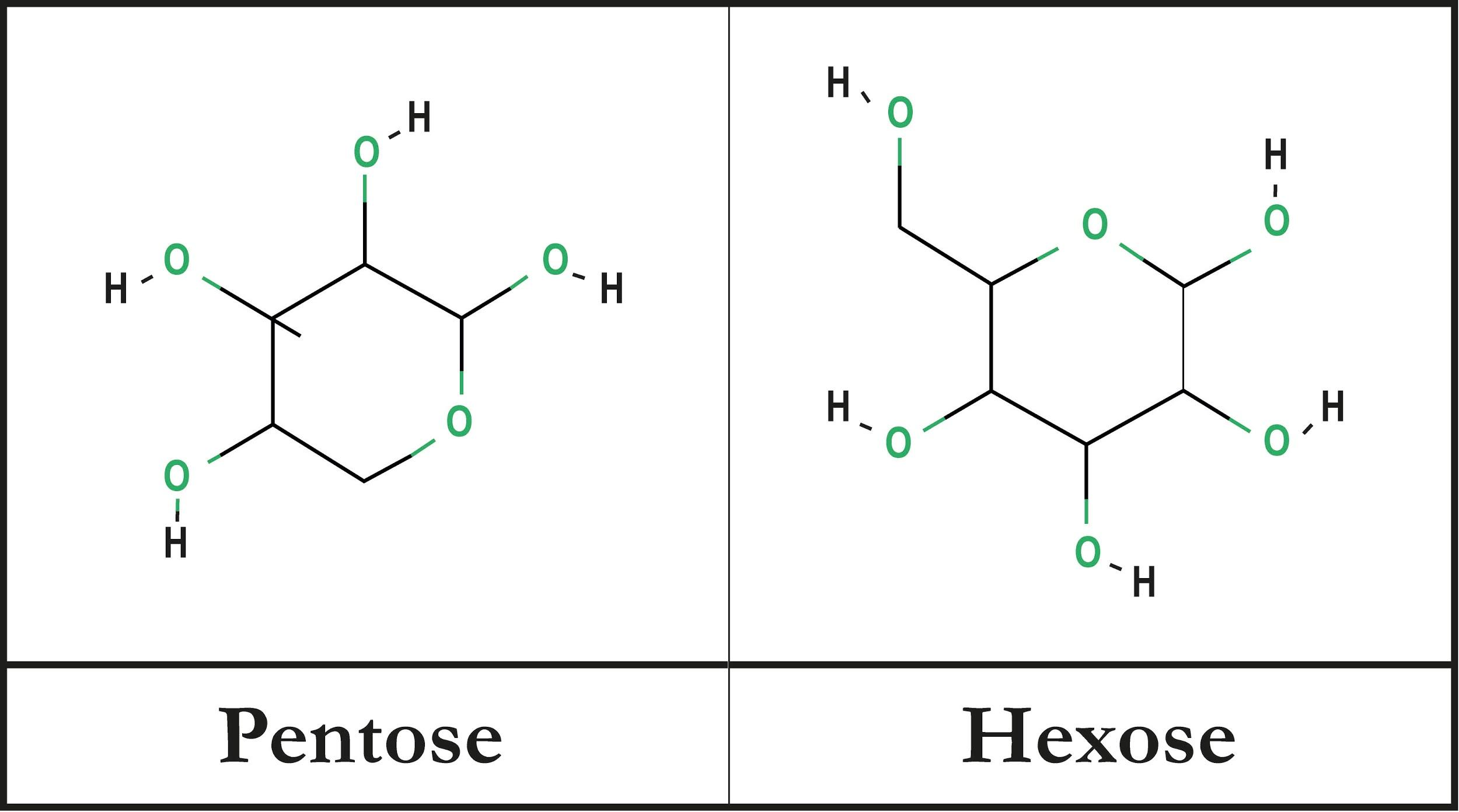
Pentose and hexose are common types of monosaccharides. Pentose is a five-carbon monosaccharide, whereas hexose contains six carbon atoms. The chemical formula of both pentose and hexose is similar to the basic formula of monosaccharide, i.e. ${ C }_{ n }{ H }_{ 2n }{ O }_{ n }$.
So, the correct answer is, ‘(c) Monosaccharide’.
Additional Information: Pentose is a five-carbon molecule with molecular formula ${ C }_{ 5 }{ H }_{ 10 }{ O }_{ 5 }$. Whereas, a hexose is a six-carbon compound whose molecular formula is ${ C }_{ 6 }{ H }_{ 12 }{ O }_{ 6 }$. Both pentose and hexose are monosaccharides. Monosaccharides are the simplest form of sugar with the basic formula as ${ C }_{ n }{ H }_{ 2n }{ O }_{ n }$. Glucose is a common example of hexose and the most common pentose are ribose, fructose, etc. The structures of pentose and hexose are given below,
Now, let us know more about the other three sugars in the question.
Oligosaccharide: These are the chains of small monosaccharides (usually 2-9).
Disaccharide: Disaccharides are formed by a combination of two monosaccharides. Some examples of disaccharides are- sucrose, maltose, etc.
Polysaccharide: These are complex carbohydrates. These consist of a polymer of large numbers of monomers. Glycogen, starch, cellulose, etc. are examples of polysaccharides.
Note: The molecular formula and structures of pentose and hexose are similar to monosaccharides. They don’t show any noticeable similarity with oligosaccharide, disaccharide, or polysaccharide.
Complete step by step answer:
Pentose and hexose are common types of monosaccharides. Pentose is a five-carbon monosaccharide, whereas hexose contains six carbon atoms. The chemical formula of both pentose and hexose is similar to the basic formula of monosaccharide, i.e. ${ C }_{ n }{ H }_{ 2n }{ O }_{ n }$.
So, the correct answer is, ‘(c) Monosaccharide’.
Additional Information: Pentose is a five-carbon molecule with molecular formula ${ C }_{ 5 }{ H }_{ 10 }{ O }_{ 5 }$. Whereas, a hexose is a six-carbon compound whose molecular formula is ${ C }_{ 6 }{ H }_{ 12 }{ O }_{ 6 }$. Both pentose and hexose are monosaccharides. Monosaccharides are the simplest form of sugar with the basic formula as ${ C }_{ n }{ H }_{ 2n }{ O }_{ n }$. Glucose is a common example of hexose and the most common pentose are ribose, fructose, etc. The structures of pentose and hexose are given below,
Now, let us know more about the other three sugars in the question.
Oligosaccharide: These are the chains of small monosaccharides (usually 2-9).
Disaccharide: Disaccharides are formed by a combination of two monosaccharides. Some examples of disaccharides are- sucrose, maltose, etc.
Polysaccharide: These are complex carbohydrates. These consist of a polymer of large numbers of monomers. Glycogen, starch, cellulose, etc. are examples of polysaccharides.
Note: The molecular formula and structures of pentose and hexose are similar to monosaccharides. They don’t show any noticeable similarity with oligosaccharide, disaccharide, or polysaccharide.
Recently Updated Pages
Master Class 11 Computer Science: Engaging Questions & Answers for Success

Master Class 11 Business Studies: Engaging Questions & Answers for Success
Master Class 11 Economics: Engaging Questions & Answers for Success
Master Class 11 English: Engaging Questions & Answers for Success
Master Class 11 Maths: Engaging Questions & Answers for Success
Master Class 11 Biology: Engaging Questions & Answers for Success
Trending doubts
One Metric ton is equal to kg A 10000 B 1000 C 100 class 11 physics CBSE
There are 720 permutations of the digits 1 2 3 4 5 class 11 maths CBSE
Discuss the various forms of bacteria class 11 biology CBSE
Draw a diagram of a plant cell and label at least eight class 11 biology CBSE
State the laws of reflection of light
Explain zero factorial class 11 maths CBSE