




Photorespiration is favoured by A. Low light and high $O_2$
B. Low $O_2$ and high $CO_2$
C. Low temperature and high $CO_2$
D. High $O_2$ and low $CO_2$
Answer
 Verified
566.7k+ views
Hint: In this process oxidation of RuBisCo enzyme takes place and oxygenates into RuBP, here some of the energy is wasted which was produced during photosynthesis. That is why it is known as a wasteful pathway.
Complete answer:
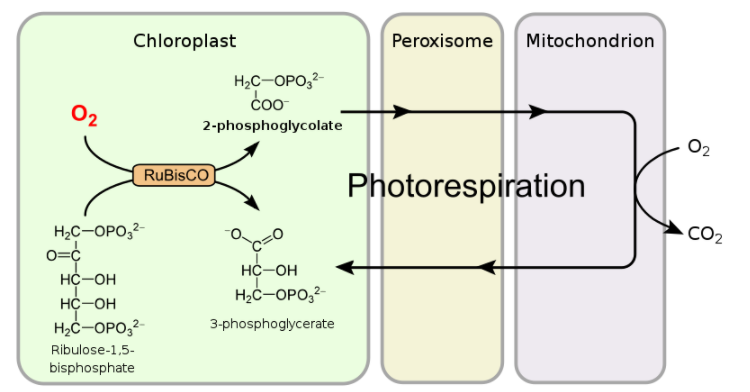
Photorespiration is favoured by the high oxygen and low carbon dioxide conditions. During the Calvin cycle, the enzyme RuBisCo attaches to carbon dioxide and starts producing sugar through different stages of the Calvin cycle. But sometimes when the concentration of oxygen is higher than carbon dioxide then the RuBisCo attaches to the oxygen instead of carbon dioxide. This causes the beginning of photorespiration. During the process of photorespiration carbon dioxide is released and also energy is utilized. So we can say photorespiration wastes energy and decreases the synthesis of sugar as it releases carbon dioxide utilized for the sugar production. It is also known as the C$_2$cycle. It is initiated in chloroplast but it occurs in peroxisomes.
Rate of photorespiration is increased by: -When stomata are closed to prevent water loss, the amount of oxygen gas increases and carbon dioxide decreases. -An increase in temperature causes the inability to recognize oxygen or carbon dioxide by RuBisCo and also reduces the solubility of carbon dioxide that results in decreased carbon dioxide concentration.
Hence, the correct answer is option (D).
Note: Rubisco makes up 30% or more of the soluble protein in a typical plant leaf ribulose-1, 5-bisphosphate (RuBP). Photorespiration is also known as C$_2$cycle. It begins in chloroplast but occurs in peroxisomes. Photorespiration increases with an increase in temperature. Photorespiration does not produce any ATP and leads to a net loss of carbon and nitrogen as a result of plant growth.
Complete answer:
Photorespiration is favoured by the high oxygen and low carbon dioxide conditions. During the Calvin cycle, the enzyme RuBisCo attaches to carbon dioxide and starts producing sugar through different stages of the Calvin cycle. But sometimes when the concentration of oxygen is higher than carbon dioxide then the RuBisCo attaches to the oxygen instead of carbon dioxide. This causes the beginning of photorespiration. During the process of photorespiration carbon dioxide is released and also energy is utilized. So we can say photorespiration wastes energy and decreases the synthesis of sugar as it releases carbon dioxide utilized for the sugar production. It is also known as the C$_2$cycle. It is initiated in chloroplast but it occurs in peroxisomes.
Rate of photorespiration is increased by: -When stomata are closed to prevent water loss, the amount of oxygen gas increases and carbon dioxide decreases. -An increase in temperature causes the inability to recognize oxygen or carbon dioxide by RuBisCo and also reduces the solubility of carbon dioxide that results in decreased carbon dioxide concentration.
Hence, the correct answer is option (D).
Note: Rubisco makes up 30% or more of the soluble protein in a typical plant leaf ribulose-1, 5-bisphosphate (RuBP). Photorespiration is also known as C$_2$cycle. It begins in chloroplast but occurs in peroxisomes. Photorespiration increases with an increase in temperature. Photorespiration does not produce any ATP and leads to a net loss of carbon and nitrogen as a result of plant growth.
Recently Updated Pages
Master Class 11 Computer Science: Engaging Questions & Answers for Success

Master Class 11 Business Studies: Engaging Questions & Answers for Success
Master Class 11 Economics: Engaging Questions & Answers for Success
Master Class 11 English: Engaging Questions & Answers for Success
Master Class 11 Maths: Engaging Questions & Answers for Success
Master Class 11 Biology: Engaging Questions & Answers for Success
Trending doubts
One Metric ton is equal to kg A 10000 B 1000 C 100 class 11 physics CBSE
There are 720 permutations of the digits 1 2 3 4 5 class 11 maths CBSE
Discuss the various forms of bacteria class 11 biology CBSE
Draw a diagram of a plant cell and label at least eight class 11 biology CBSE
State the laws of reflection of light
Explain zero factorial class 11 maths CBSE