




What is the position of ovaries in cockroaches?
Answer
 Verified
594.6k+ views
Hint: Ovaries are lying laterally in the abdominal segments that are connected with the oviduct from each side. In cockroach each ovary consists of eight ovarian tubules (ovarioles). Cockroaches are dioecious and both sexes have well organized reproductive organs.
Complete answer:
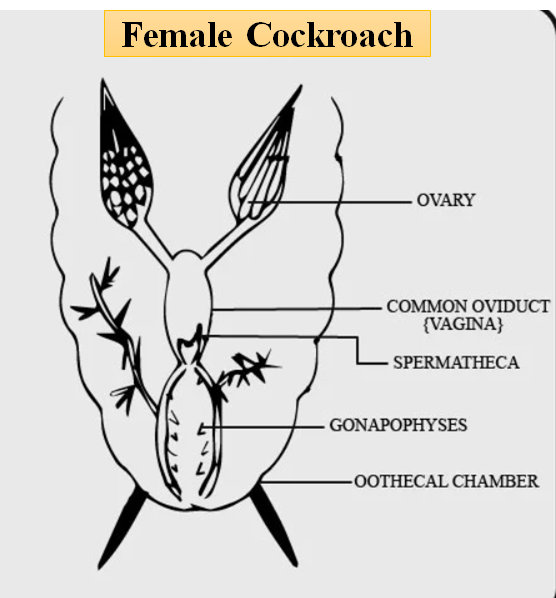
The female reproductive system of cockroaches consists of two large ovaries, lying laterally in the 2-6 abdominal segments. A group of eight ovarian tubules or ovarioles, containing a chain of developing ova formed in both of the ovaries. Oviducts of both ovaries attach into a single median oviduct, also called vagina which opens into the genital chamber. In most cases, females produce 9-10 ootheca and each containing 14-16 eggs. The ootheca is a dark blackish brown capsule, about 8 mm long.
Additional Information:
In the case of the male reproductive system, it consists of a pair of testes, vasa deferentia, an ejaculatory duct, utricular gland, phallic gland and the external genitalia. There is a pair of three-lobed testes, one lying on each at the lateral side in the 4th-6th abdominal segments being embedded in the fat body.. From each testis arises a thin vas deferens, which opens into the ejaculatory duct through seminal vesicles. Male gonopore situated ventral to the anus and the ejaculatory duct opens into it. A characteristic mushroom-shaped gland is present in the sixth and seventh abdominal segments which function as an accessory reproductive gland. The external genitalia is represented by male gonapophysis. All sperms are stored in the seminal vesicles and are discharged during copulation. Sperms are transferred through spermatophores. The fertilized eggs are encased in a capsule called ootheca.
Note:
-The female cockroaches can reproduce for years without needing a mate, and it produces a dozens of generations of all-female descendants.
-Cockroach secretes pheromones which is a chemical factor that triggers a social response in members of the same species.
Complete answer:
The female reproductive system of cockroaches consists of two large ovaries, lying laterally in the 2-6 abdominal segments. A group of eight ovarian tubules or ovarioles, containing a chain of developing ova formed in both of the ovaries. Oviducts of both ovaries attach into a single median oviduct, also called vagina which opens into the genital chamber. In most cases, females produce 9-10 ootheca and each containing 14-16 eggs. The ootheca is a dark blackish brown capsule, about 8 mm long.
Additional Information:
In the case of the male reproductive system, it consists of a pair of testes, vasa deferentia, an ejaculatory duct, utricular gland, phallic gland and the external genitalia. There is a pair of three-lobed testes, one lying on each at the lateral side in the 4th-6th abdominal segments being embedded in the fat body.. From each testis arises a thin vas deferens, which opens into the ejaculatory duct through seminal vesicles. Male gonopore situated ventral to the anus and the ejaculatory duct opens into it. A characteristic mushroom-shaped gland is present in the sixth and seventh abdominal segments which function as an accessory reproductive gland. The external genitalia is represented by male gonapophysis. All sperms are stored in the seminal vesicles and are discharged during copulation. Sperms are transferred through spermatophores. The fertilized eggs are encased in a capsule called ootheca.
Fig. The female reproductive system in cockroach
Note:
-The female cockroaches can reproduce for years without needing a mate, and it produces a dozens of generations of all-female descendants.
-Cockroach secretes pheromones which is a chemical factor that triggers a social response in members of the same species.
Recently Updated Pages
Master Class 11 Computer Science: Engaging Questions & Answers for Success

Master Class 11 Business Studies: Engaging Questions & Answers for Success
Master Class 11 Economics: Engaging Questions & Answers for Success
Master Class 11 English: Engaging Questions & Answers for Success
Master Class 11 Maths: Engaging Questions & Answers for Success
Master Class 11 Biology: Engaging Questions & Answers for Success
Trending doubts
One Metric ton is equal to kg A 10000 B 1000 C 100 class 11 physics CBSE
There are 720 permutations of the digits 1 2 3 4 5 class 11 maths CBSE
Discuss the various forms of bacteria class 11 biology CBSE
Draw a diagram of a plant cell and label at least eight class 11 biology CBSE
State the laws of reflection of light
Explain zero factorial class 11 maths CBSE