




Positive charge $Q$ is distributed uniformly over a circular ring of radius $R$. A particle having mass $m$ and a negative charge $q$ is placed on its axis at a distance $x$ from the centre. Find the force on the particle. Assuming $x << R$, find the time period of oscillation of the particle if it is released from there.
Answer
 Verified
573.6k+ views
Hint: We know that the electric force is force experience due multiple charges, and is given by Coulomb's force. It states that the electric force depends on the charge q and inversely proportional to the square of the distance between them. We can use the above to solve the given problem..
Formula: $F=k\dfrac{q_{1}q_{2}}{r^{2}}$
Complete answer:
We know that the electric force is the force experienced due to a pair charges is given by Coulomb's force. Clearly, the electrical force between the charges, depends on the individual charge q and is inversely proportional to the square of the distance between them.
We know that, the electrical force $F$ between two charges $q_{1}$ and $q_{2}$ which is separated at a distance $r$ is given as $F=k\dfrac{q_{1}q_{2}}{r^{2}}$, where $k=\dfrac{1}{4\pi\epsilon_{0}}$ which is constant with a value $9\times 10^{9}$.
Similarly, an electric field E is defined as the electric force F per unit positive charge q, which is infinitesimally small and at rest, and is given as $E=\dfrac{F}{q}$. Then $E=\dfrac{kq}{r^{2}}$.
Here, given that the $-q$ is kept at a point, say, P at the axial point, at a distance $x$ from the ring.
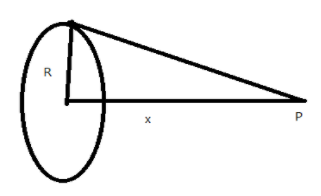
We know that the electric field due to a circular ring, of radius $R$ and charge $Q$ i is given as $E=\dfrac{kQx}{(R^{2}+x^{2})^{\dfrac{3}{2}}}$
$\implies E=\dfrac{kQx}{R^{3}}$
Then the force at P is given as, $F=qE=\dfrac{kQqx}{R^{3}}$
Let the amplitude of the electric field be $x$, then the time period of the electric field is given as
$T=2\pi\sqrt{\dfrac{x}{\dfrac{kQqx}{mR^{3}}}}$
$\implies T=2\pi\sqrt{\dfrac{mR^{3}x}{kQqx}}$
$\implies T=2\pi\sqrt{\dfrac{4\pi\epsilon_{0}mR^{3}}{Qq}}$
$\therefore T=\sqrt{\dfrac{16\pi^{2}\epsilon_{0}mR^{3}}{Qq}}$ is the time period of the electric field.
Note:
We know that the electric force due to a pair of charges is given by Coulomb's law. This force can be attractive or repelling depending on the nature of the charges. Electric field is in the direction of the force. However, the electric field also depends on the symmetry of the charge carrying conductor.
Formula: $F=k\dfrac{q_{1}q_{2}}{r^{2}}$
Complete answer:
We know that the electric force is the force experienced due to a pair charges is given by Coulomb's force. Clearly, the electrical force between the charges, depends on the individual charge q and is inversely proportional to the square of the distance between them.
We know that, the electrical force $F$ between two charges $q_{1}$ and $q_{2}$ which is separated at a distance $r$ is given as $F=k\dfrac{q_{1}q_{2}}{r^{2}}$, where $k=\dfrac{1}{4\pi\epsilon_{0}}$ which is constant with a value $9\times 10^{9}$.
Similarly, an electric field E is defined as the electric force F per unit positive charge q, which is infinitesimally small and at rest, and is given as $E=\dfrac{F}{q}$. Then $E=\dfrac{kq}{r^{2}}$.
Here, given that the $-q$ is kept at a point, say, P at the axial point, at a distance $x$ from the ring.
We know that the electric field due to a circular ring, of radius $R$ and charge $Q$ i is given as $E=\dfrac{kQx}{(R^{2}+x^{2})^{\dfrac{3}{2}}}$
$\implies E=\dfrac{kQx}{R^{3}}$
Then the force at P is given as, $F=qE=\dfrac{kQqx}{R^{3}}$
Let the amplitude of the electric field be $x$, then the time period of the electric field is given as
$T=2\pi\sqrt{\dfrac{x}{\dfrac{kQqx}{mR^{3}}}}$
$\implies T=2\pi\sqrt{\dfrac{mR^{3}x}{kQqx}}$
$\implies T=2\pi\sqrt{\dfrac{4\pi\epsilon_{0}mR^{3}}{Qq}}$
$\therefore T=\sqrt{\dfrac{16\pi^{2}\epsilon_{0}mR^{3}}{Qq}}$ is the time period of the electric field.
Note:
We know that the electric force due to a pair of charges is given by Coulomb's law. This force can be attractive or repelling depending on the nature of the charges. Electric field is in the direction of the force. However, the electric field also depends on the symmetry of the charge carrying conductor.
Recently Updated Pages
Master Class 12 Economics: Engaging Questions & Answers for Success

Master Class 12 Physics: Engaging Questions & Answers for Success
Master Class 12 English: Engaging Questions & Answers for Success
Master Class 12 Social Science: Engaging Questions & Answers for Success
Master Class 12 Maths: Engaging Questions & Answers for Success
Master Class 12 Business Studies: Engaging Questions & Answers for Success
Trending doubts
Which are the Top 10 Largest Countries of the World?
What are the major means of transport Explain each class 12 social science CBSE
Draw a labelled sketch of the human eye class 12 physics CBSE
Why cannot DNA pass through cell membranes class 12 biology CBSE
Differentiate between insitu conservation and exsitu class 12 biology CBSE
Draw a neat and well labeled diagram of TS of ovary class 12 biology CBSE