




Prove that the points, \[A( - 3, - 2),B(5, - 2),C(9,3),D(1,3)\] are the vertices of a parallelogram.
Answer
 Verified
587.1k+ views
Hint: Here we are given 4 points. To prove that it is a parallelogram, we need to calculate the length of the sides, we use the distance formula for it. And then check if opposite sides are equal.
Complete step-by-step answer:
We know that the distance between the two points \[\left( {{x_1},{y_1}} \right)\] and \[\left( {{x_2},{y_2}} \right)\] is,
\[d = \sqrt {{{\left( {{x_{2}} - {x_1}} \right)}^2} + {{\left( {{y_2} - {y_1}} \right)}^2}} \;\]
Let the given vertices be \[A = \left( { - 3, - 2} \right),\;B = \left( {5, - 2} \right),\;C = (9,3)\] and \[D = \left( {1,3} \right)\]
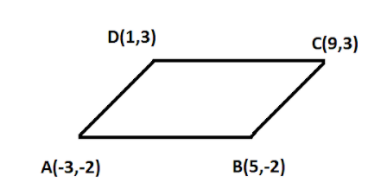
We first find the distance between \[A = \left( { - 3, - 2} \right)\;\]and \[B = \left( {5, - 2} \right)\;\;\]as follows:
\[AB = \sqrt {{{\left( {{x_{2}} - {x_1}} \right)}^2} + {{\left( {{y_2} - {y_1}} \right)}^2}} \;\]
On substituting the values of \[A = \left( { - 3, - 2} \right)\;\]and \[B = \left( {5, - 2} \right)\;\;\], we get,
\[ = \sqrt {{{\left( {5 - ( - 3)} \right)}^2} + {{\left( {( - 2) - ( - 2)} \right)}^2}} \;\]
On simplifying we get,
\[ = \sqrt {{{\left( {8} \right)}^2} + {{\left( {0} \right)}^2}} \;\]
\[ = \sqrt {64} \]
On taking positive root we get,
\[ = 8\]units
Similarly, the distance between \[B = \left( {5, - 2} \right)\;\]and \[C = \left( {9,3} \right)\;\] is:
\[BC = \sqrt {{{\left( {{x_{2}} - {x_1}} \right)}^2} + {{\left( {{y_2} - {y_1}} \right)}^2}} \;\]
On substituting the values of \[B = \left( {5, - 2} \right)\;\]and \[C = \left( {9,3} \right)\;\], we get,
\[ = \sqrt {{{\left( {9 - 5} \right)}^2} + {{\left( {3 - ( - 2)} \right)}^2}} \;\]
On simplifying we get,
\[ = \sqrt {{{\left( 4 \right)}^2} + {{\left( {5} \right)}^2}} \;\]
\[ = \sqrt {16 + 25} \;\]
\[ = \sqrt {41} \;\]units
Now, the distance between \[C = \left( {9,3} \right)\;\] and \[D = (1,3)\;\]is:
\[CD = \sqrt {{{\left( {{x_{2}} - {x_1}} \right)}^2} + {{\left( {{y_2} - {y_1}} \right)}^2}} \;\]
On substituting the value of \[C = \left( {9,3} \right)\;\] and \[D = (1,3)\;\], we get,
\[ = \sqrt {{{\left( {1 - 9} \right)}^2} + {{\left( {3 - 3} \right)}^2}} \;\]
On further simplification we get,
\[ = \sqrt {{{\left( { - 8} \right)}^2} + {{\left( 0 \right)}^2}} \;\]
\[ = \sqrt {64} \;\]
On taking positive square root we get,
\[ = 8\]units
Now, the distance between \[D = \left( {1,3} \right)\;\]and \[A = \left( { - 3, - 2} \right)\;\] is:
\[DA = \sqrt {{{\left( {{x_{2}} - {x_1}} \right)}^2} + {{\left( {{y_2} - {y_1}} \right)}^2}} \;\]
On substituting the values of \[D = \left( {1,3} \right)\;\]and \[A = \left( { - 3, - 2} \right)\;\], we get,
\[ = \sqrt {{{\left( { - 3 - 1} \right)}^2} + {{\left( { - 2 - 3} \right)}^2}} \;\]
On simplifying further we get,
\[ = \sqrt {{{\left( { - 4} \right)}^2} + {{\left( { - 5} \right)}^2}} \;\]
\[ = \sqrt {16 + 25} \;\]
\[ = \sqrt {41} \]units
We also know that if the opposite sides have equal side lengths, then ABCD is a parallelogram.
Here, since the lengths of the opposite sides are equal that is:
\[AB = CD = 8\]units and \[BC = DA = \sqrt {41} \]units.
Hence, the given vertices are the vertices of a parallelogram.
Note: There are also other important properties of parallelograms to know:
1.Opposite sides are congruent \[\left( {AB{\text{ }} = {\text{ }}DC} \right).\]
2.Opposite angles are congruent \[\left( {D{\text{ }} = {\text{ }}B} \right).\]
3.Consecutive angles are supplementary \[\left( {A{\text{ }} + {\text{ }}D{\text{ }} = {\text{ }}180^\circ } \right).\]
4.If one angle is right, then all angles are right.
5.The diagonals of a parallelogram bisect each other.
6.Each diagonal of a parallelogram separates it into two congruent triangles.
Complete step-by-step answer:
We know that the distance between the two points \[\left( {{x_1},{y_1}} \right)\] and \[\left( {{x_2},{y_2}} \right)\] is,
\[d = \sqrt {{{\left( {{x_{2}} - {x_1}} \right)}^2} + {{\left( {{y_2} - {y_1}} \right)}^2}} \;\]
Let the given vertices be \[A = \left( { - 3, - 2} \right),\;B = \left( {5, - 2} \right),\;C = (9,3)\] and \[D = \left( {1,3} \right)\]
We first find the distance between \[A = \left( { - 3, - 2} \right)\;\]and \[B = \left( {5, - 2} \right)\;\;\]as follows:
\[AB = \sqrt {{{\left( {{x_{2}} - {x_1}} \right)}^2} + {{\left( {{y_2} - {y_1}} \right)}^2}} \;\]
On substituting the values of \[A = \left( { - 3, - 2} \right)\;\]and \[B = \left( {5, - 2} \right)\;\;\], we get,
\[ = \sqrt {{{\left( {5 - ( - 3)} \right)}^2} + {{\left( {( - 2) - ( - 2)} \right)}^2}} \;\]
On simplifying we get,
\[ = \sqrt {{{\left( {8} \right)}^2} + {{\left( {0} \right)}^2}} \;\]
\[ = \sqrt {64} \]
On taking positive root we get,
\[ = 8\]units
Similarly, the distance between \[B = \left( {5, - 2} \right)\;\]and \[C = \left( {9,3} \right)\;\] is:
\[BC = \sqrt {{{\left( {{x_{2}} - {x_1}} \right)}^2} + {{\left( {{y_2} - {y_1}} \right)}^2}} \;\]
On substituting the values of \[B = \left( {5, - 2} \right)\;\]and \[C = \left( {9,3} \right)\;\], we get,
\[ = \sqrt {{{\left( {9 - 5} \right)}^2} + {{\left( {3 - ( - 2)} \right)}^2}} \;\]
On simplifying we get,
\[ = \sqrt {{{\left( 4 \right)}^2} + {{\left( {5} \right)}^2}} \;\]
\[ = \sqrt {16 + 25} \;\]
\[ = \sqrt {41} \;\]units
Now, the distance between \[C = \left( {9,3} \right)\;\] and \[D = (1,3)\;\]is:
\[CD = \sqrt {{{\left( {{x_{2}} - {x_1}} \right)}^2} + {{\left( {{y_2} - {y_1}} \right)}^2}} \;\]
On substituting the value of \[C = \left( {9,3} \right)\;\] and \[D = (1,3)\;\], we get,
\[ = \sqrt {{{\left( {1 - 9} \right)}^2} + {{\left( {3 - 3} \right)}^2}} \;\]
On further simplification we get,
\[ = \sqrt {{{\left( { - 8} \right)}^2} + {{\left( 0 \right)}^2}} \;\]
\[ = \sqrt {64} \;\]
On taking positive square root we get,
\[ = 8\]units
Now, the distance between \[D = \left( {1,3} \right)\;\]and \[A = \left( { - 3, - 2} \right)\;\] is:
\[DA = \sqrt {{{\left( {{x_{2}} - {x_1}} \right)}^2} + {{\left( {{y_2} - {y_1}} \right)}^2}} \;\]
On substituting the values of \[D = \left( {1,3} \right)\;\]and \[A = \left( { - 3, - 2} \right)\;\], we get,
\[ = \sqrt {{{\left( { - 3 - 1} \right)}^2} + {{\left( { - 2 - 3} \right)}^2}} \;\]
On simplifying further we get,
\[ = \sqrt {{{\left( { - 4} \right)}^2} + {{\left( { - 5} \right)}^2}} \;\]
\[ = \sqrt {16 + 25} \;\]
\[ = \sqrt {41} \]units
We also know that if the opposite sides have equal side lengths, then ABCD is a parallelogram.
Here, since the lengths of the opposite sides are equal that is:
\[AB = CD = 8\]units and \[BC = DA = \sqrt {41} \]units.
Hence, the given vertices are the vertices of a parallelogram.
Note: There are also other important properties of parallelograms to know:
1.Opposite sides are congruent \[\left( {AB{\text{ }} = {\text{ }}DC} \right).\]
2.Opposite angles are congruent \[\left( {D{\text{ }} = {\text{ }}B} \right).\]
3.Consecutive angles are supplementary \[\left( {A{\text{ }} + {\text{ }}D{\text{ }} = {\text{ }}180^\circ } \right).\]
4.If one angle is right, then all angles are right.
5.The diagonals of a parallelogram bisect each other.
6.Each diagonal of a parallelogram separates it into two congruent triangles.
Recently Updated Pages
Master Class 11 Computer Science: Engaging Questions & Answers for Success

Master Class 11 Business Studies: Engaging Questions & Answers for Success
Master Class 11 Economics: Engaging Questions & Answers for Success
Master Class 11 English: Engaging Questions & Answers for Success
Master Class 11 Maths: Engaging Questions & Answers for Success
Master Class 11 Biology: Engaging Questions & Answers for Success
Trending doubts
There are 720 permutations of the digits 1 2 3 4 5 class 11 maths CBSE
Discuss the various forms of bacteria class 11 biology CBSE
Explain zero factorial class 11 maths CBSE
What organs are located on the left side of your body class 11 biology CBSE
Draw a labelled diagram of the human heart and label class 11 biology CBSE
What is 1s 2s 2p 3s 3p class 11 chemistry CBSE