




Ringing/Girdling experiment was first performed by?
(a)Malpighi
(b)Strasburger
(c)Godlewski
(d)Bose
Answer
 Verified
589.8k+ views
Hint: He is an Italian botanist and referred to as the "Founder of microscopic anatomy, histology, and the Father of embryology and physiology".
Complete answer:
The Girdling/Ringing experiment was performed by 'Malpighi' in 1672, 'Stephen Hales' in 1727, and ‘Hartig' in 1837.
-The Girdling/ Ringing experiment involves the removal of all the tissue outside to vascular cambium (bark, cortex, and phloem) in woody stems except for xylem. Xylem is the only remaining tissue in the girdled area which connects the upper and lower part of the plant. This setup is placed in a beaker of water. After some time, it is observed that swelling on the upper part of the ring appears as a result of the accumulation of food material. In subsequent days, the roots die first. The roots cannot synthesize their food by photosynthesis and so they die first as their food supply is lost due to cutting of phloem.
-Eduard Adolf Strasburger (1844- 1912) was a Polish-German professor and one of the most famous botanists of the 19th century. He studied angiosperms in detail.
-Jagadish Chandra Bose (1858-1937) an Indian scientist made huge contributions to many areas of science. He is widely known for inventing the crescograph.
So, the correct answer is ‘Malpighi'.
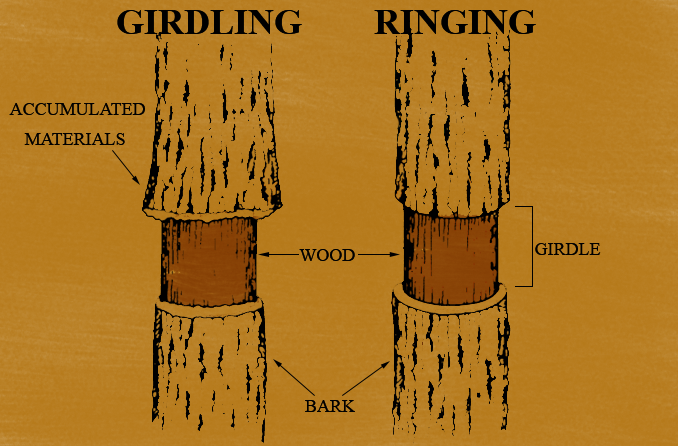
Note: -The girdling experiment proved that the Phloem is responsible for the conduction of food in plants.
-The passage of absorbed water along with the dissolved minerals through xylem (tracheid and vessel) is known as the Ascent of sap. It takes place at a rate of 10-75 cm/sec.
-After girdling, gradually the whole plant dies as the supply of food stops.
Complete answer:
The Girdling/Ringing experiment was performed by 'Malpighi' in 1672, 'Stephen Hales' in 1727, and ‘Hartig' in 1837.
-The Girdling/ Ringing experiment involves the removal of all the tissue outside to vascular cambium (bark, cortex, and phloem) in woody stems except for xylem. Xylem is the only remaining tissue in the girdled area which connects the upper and lower part of the plant. This setup is placed in a beaker of water. After some time, it is observed that swelling on the upper part of the ring appears as a result of the accumulation of food material. In subsequent days, the roots die first. The roots cannot synthesize their food by photosynthesis and so they die first as their food supply is lost due to cutting of phloem.
-Eduard Adolf Strasburger (1844- 1912) was a Polish-German professor and one of the most famous botanists of the 19th century. He studied angiosperms in detail.
-Jagadish Chandra Bose (1858-1937) an Indian scientist made huge contributions to many areas of science. He is widely known for inventing the crescograph.
So, the correct answer is ‘Malpighi'.
Note: -The girdling experiment proved that the Phloem is responsible for the conduction of food in plants.
-The passage of absorbed water along with the dissolved minerals through xylem (tracheid and vessel) is known as the Ascent of sap. It takes place at a rate of 10-75 cm/sec.
-After girdling, gradually the whole plant dies as the supply of food stops.
Recently Updated Pages
Master Class 11 Computer Science: Engaging Questions & Answers for Success

Master Class 11 Business Studies: Engaging Questions & Answers for Success
Master Class 11 Economics: Engaging Questions & Answers for Success
Master Class 11 English: Engaging Questions & Answers for Success
Master Class 11 Maths: Engaging Questions & Answers for Success
Master Class 11 Biology: Engaging Questions & Answers for Success
Trending doubts
One Metric ton is equal to kg A 10000 B 1000 C 100 class 11 physics CBSE
There are 720 permutations of the digits 1 2 3 4 5 class 11 maths CBSE
Discuss the various forms of bacteria class 11 biology CBSE
Draw a diagram of a plant cell and label at least eight class 11 biology CBSE
State the laws of reflection of light
Explain zero factorial class 11 maths CBSE