




Sea squirt is a common name for
(a) Balanoglossus
(b) Herdmania
(c) Amphioxus
(d) None of the above
Answer
 Verified
570k+ views
Hint: The body has a flat shape like a purse with a length of 6-13 cms and 4-7 cms in width. It's brownish in color. By way of foot, the animal is pretty buried in the sand. There are two projections of the body proper: atrial and branchial syphons.
Complete answer:
Herdmania is commonly known as sea squirt. It is an organism that is completely aquatic. They are located in water that is shallow. These are solitary and sedentary species clinging to the bottom of a rocky sea. The sandy floor is rooted in them. It's both a cilliatory feeder and an animal microphagous. It is hermaphrodite and there is external fertilization and indirect growth.
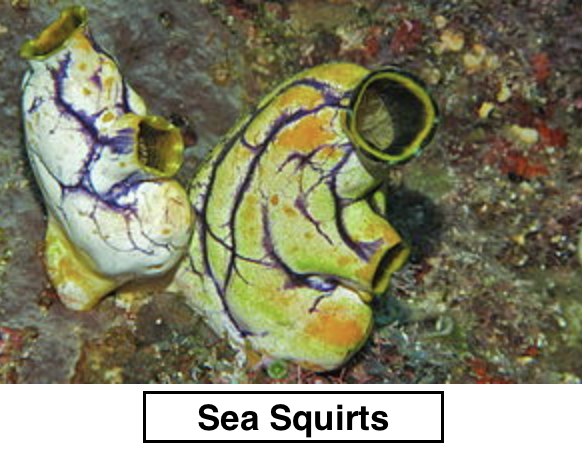
Herdmania releases a jet of water from both of its apertures when irritated. It is a hermaphrodite breed. Cross-fertilization, which is external, happens. To become an adult, the larval phase or tadpole undergoes a retrogressive metamorphosis.
Additional information:
Balanoglossus is a genus of ocean-dwelling acorn worm of great zoological interest because it is a "evolutionary link" between invertebrates and vertebrates, being a Hemichordate. Balanoglossus is a deuterostome, similar to Ascidians or sea squirts since it has branch openings or "gill slits."
Some of the members of the invertebrate subphylum Cephalochordata of the phylum Chordata are amphioxus, plural amphioxi, or amphioxus, also known as lancelets. Amphioxi are small marine species widely found in the warmer parts of the world's coastal waters and less often in temperate waters.
So, the correct answer is ‘(b) Herdmania’.
Note: This type of metamorphosis is called retrogressive metamorphosis, where the highly advanced larval form ends in a lowly structured adult. Larva fixation: The larva swims without feeding for some time. With the support of the adhesive papillas, it is fixed to a substratum.
Complete answer:
Herdmania is commonly known as sea squirt. It is an organism that is completely aquatic. They are located in water that is shallow. These are solitary and sedentary species clinging to the bottom of a rocky sea. The sandy floor is rooted in them. It's both a cilliatory feeder and an animal microphagous. It is hermaphrodite and there is external fertilization and indirect growth.
Herdmania releases a jet of water from both of its apertures when irritated. It is a hermaphrodite breed. Cross-fertilization, which is external, happens. To become an adult, the larval phase or tadpole undergoes a retrogressive metamorphosis.
Additional information:
Balanoglossus is a genus of ocean-dwelling acorn worm of great zoological interest because it is a "evolutionary link" between invertebrates and vertebrates, being a Hemichordate. Balanoglossus is a deuterostome, similar to Ascidians or sea squirts since it has branch openings or "gill slits."
Some of the members of the invertebrate subphylum Cephalochordata of the phylum Chordata are amphioxus, plural amphioxi, or amphioxus, also known as lancelets. Amphioxi are small marine species widely found in the warmer parts of the world's coastal waters and less often in temperate waters.
So, the correct answer is ‘(b) Herdmania’.
Note: This type of metamorphosis is called retrogressive metamorphosis, where the highly advanced larval form ends in a lowly structured adult. Larva fixation: The larva swims without feeding for some time. With the support of the adhesive papillas, it is fixed to a substratum.
Recently Updated Pages
Master Class 11 Computer Science: Engaging Questions & Answers for Success

Master Class 11 Business Studies: Engaging Questions & Answers for Success
Master Class 11 Economics: Engaging Questions & Answers for Success
Master Class 11 English: Engaging Questions & Answers for Success
Master Class 11 Maths: Engaging Questions & Answers for Success
Master Class 11 Biology: Engaging Questions & Answers for Success
Trending doubts
One Metric ton is equal to kg A 10000 B 1000 C 100 class 11 physics CBSE
There are 720 permutations of the digits 1 2 3 4 5 class 11 maths CBSE
Discuss the various forms of bacteria class 11 biology CBSE
Draw a diagram of a plant cell and label at least eight class 11 biology CBSE
State the laws of reflection of light
Explain zero factorial class 11 maths CBSE