




Select the true statement for an isobilateral leaf.
(a) The stomata are present on both the surfaces
(b) Mesophyll is differentiated into palisade and spongy
(c) Cuticle is always absent on both surface
(d) Vascular bundles are open and conjoint
Answer
 Verified
535.8k+ views
Hint: In this kind of leaves the veins strike parallel to each other in the direction of sunlight. Grasses and grasslike plants, lilies, irises, and amaryllises, all are parallel-veined leaves.
Complete answer:
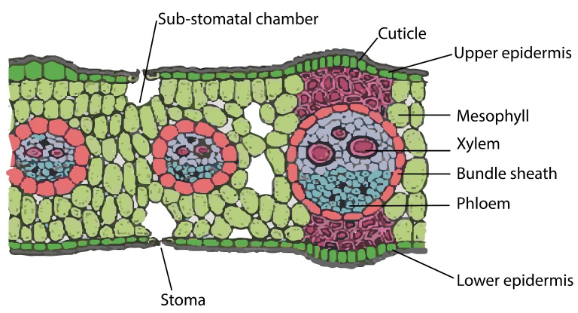
Isobilateral leaves are also known as monocot leaves as both the sides of monocot leaves are more or less alike. Isobilateral leaves arrange themselves parallel to the main axis and parallel toward the beam of sunlight. The epidermis is one layered, situated on both of the surfaces, and possesses cuticles (cuticularized) and stomata on both of the surfaces (amphistomatic). They are made up of tightly arranged oval or barrel-shaped thin-walled parenchymatous cells. The mesophyll is the ground tissue that is situated between the two layers of the epidermal. Vascular bundles are of two kinds which are small bundles and large bundles. Where small bundles are abundant and larger bundles are present in between them.
Additional information:
Historically, plants are divided into two categories based on the number of cotyledons or embryonic leaves present. Thus, the term “monocot” is known to the flowering plants that include only one cotyledon. Similarly, the term “dicot” is known to flowering plants possessing two cotyledons. Apart from the number of cotyledons, these two plant classifications show vastly distinct features from each other as for other parts of the plant like the roots, leaves, and stem. In monocot leaves, the mesophyll layer is not differentiated into spongy and palisade parenchyma. Vascular bundles are identical in size, only the bundles near the midvein are long and bulliform cells are found.
So, the correct option is 'the stomata are present on both the surfaces'.
Note:
Monocot plants have leaves that are characteristically longer and slender. Stomata in monocot leaves are dumb-bell shaped. Monocot leaves are amphistomatic – which suggests the stomata are present on the lower and also because of the upper surface. Monocot leaves have comparatively tighter intracellular space because of the compact arrangement of mesophyll cells.
Complete answer:
Isobilateral leaves are also known as monocot leaves as both the sides of monocot leaves are more or less alike. Isobilateral leaves arrange themselves parallel to the main axis and parallel toward the beam of sunlight. The epidermis is one layered, situated on both of the surfaces, and possesses cuticles (cuticularized) and stomata on both of the surfaces (amphistomatic). They are made up of tightly arranged oval or barrel-shaped thin-walled parenchymatous cells. The mesophyll is the ground tissue that is situated between the two layers of the epidermal. Vascular bundles are of two kinds which are small bundles and large bundles. Where small bundles are abundant and larger bundles are present in between them.
Additional information:
Historically, plants are divided into two categories based on the number of cotyledons or embryonic leaves present. Thus, the term “monocot” is known to the flowering plants that include only one cotyledon. Similarly, the term “dicot” is known to flowering plants possessing two cotyledons. Apart from the number of cotyledons, these two plant classifications show vastly distinct features from each other as for other parts of the plant like the roots, leaves, and stem. In monocot leaves, the mesophyll layer is not differentiated into spongy and palisade parenchyma. Vascular bundles are identical in size, only the bundles near the midvein are long and bulliform cells are found.
So, the correct option is 'the stomata are present on both the surfaces'.
Note:
Monocot plants have leaves that are characteristically longer and slender. Stomata in monocot leaves are dumb-bell shaped. Monocot leaves are amphistomatic – which suggests the stomata are present on the lower and also because of the upper surface. Monocot leaves have comparatively tighter intracellular space because of the compact arrangement of mesophyll cells.
Recently Updated Pages
Master Class 11 Computer Science: Engaging Questions & Answers for Success

Master Class 11 Business Studies: Engaging Questions & Answers for Success
Master Class 11 Economics: Engaging Questions & Answers for Success
Master Class 11 English: Engaging Questions & Answers for Success
Master Class 11 Maths: Engaging Questions & Answers for Success
Master Class 11 Biology: Engaging Questions & Answers for Success
Trending doubts
One Metric ton is equal to kg A 10000 B 1000 C 100 class 11 physics CBSE
There are 720 permutations of the digits 1 2 3 4 5 class 11 maths CBSE
Discuss the various forms of bacteria class 11 biology CBSE
Draw a diagram of a plant cell and label at least eight class 11 biology CBSE
State the laws of reflection of light
Explain zero factorial class 11 maths CBSE