




Sink is related to
(A) Phytochrome
(B) Enzymes
(C) Stomata
(D) Transport of minerals
Answer
 Verified
574.8k+ views
Hint: Sink is related to that part of the plants which help in the storage of food. Once the food is prepared by photosynthesis, it is stored in parts like rhizome of plant or roots of some plants and get transported to plants when needed.
Complete answer:
Sink is related to the Transport of minerals. When plants require minerals and nutrients, they get transferred from storage parts of the plant to various parts. The part which makes food is defined as a source, whereas the part which stores minerals, specifically food is referred to as sink. The xylem cells of the stem, roots, and leaves are interconnected forming a conducting channel reaching all plant parts. Thus, there's a nonstop water movement into the xylem.
Additional Information: Roots, especially those with attached tubers, or other underground parts like rhizomes or bulbs which are technically a modified stem, are one of the most common places where plants store food. The storage structures are mostly underground because of the reason that due to this the plant gets protection from animals that might eat that nutrient-rich structure, exactly like a carrot or potato, but some plants have modified storage structures above ground also.
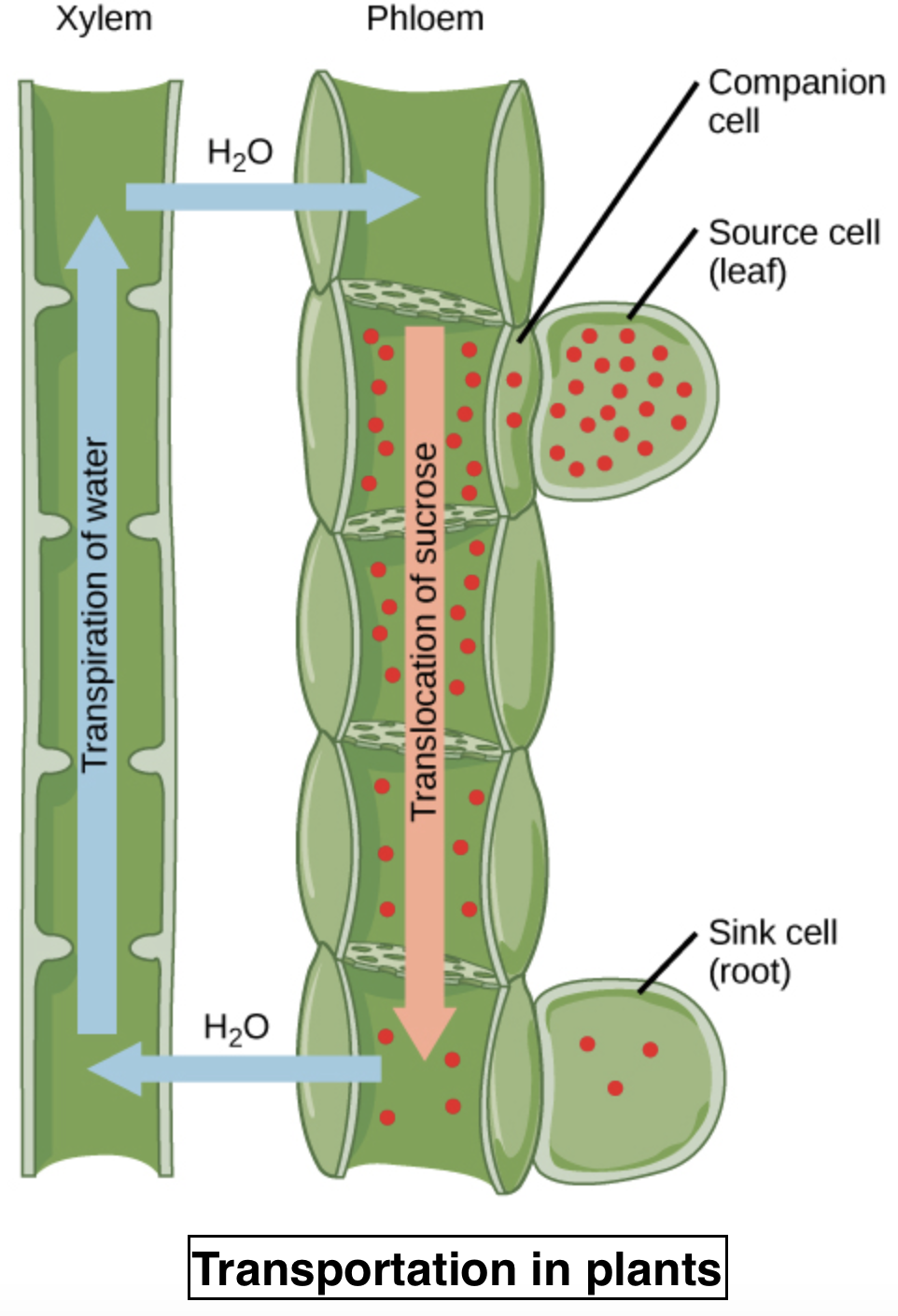
Usually, it is seen that the wild plants store some amount of energy and nutrients in their stems, and some in leaves. Even the plants also store significant food in seeds, which act as food for the next generation of plants. The cotyledons are stored food that the young plant will use while it's growing.
So, the correct answer is ‘Transport of minerals’.
Note: It is very interesting to note that some organs act like both a source and a sink. Leaves are sinks when growing and sources when performing photosynthesis. Rhizomes are sinks when growing but become sources in the spring season when they provide energy for the new growth.
Complete answer:
Sink is related to the Transport of minerals. When plants require minerals and nutrients, they get transferred from storage parts of the plant to various parts. The part which makes food is defined as a source, whereas the part which stores minerals, specifically food is referred to as sink. The xylem cells of the stem, roots, and leaves are interconnected forming a conducting channel reaching all plant parts. Thus, there's a nonstop water movement into the xylem.
Additional Information: Roots, especially those with attached tubers, or other underground parts like rhizomes or bulbs which are technically a modified stem, are one of the most common places where plants store food. The storage structures are mostly underground because of the reason that due to this the plant gets protection from animals that might eat that nutrient-rich structure, exactly like a carrot or potato, but some plants have modified storage structures above ground also.
Usually, it is seen that the wild plants store some amount of energy and nutrients in their stems, and some in leaves. Even the plants also store significant food in seeds, which act as food for the next generation of plants. The cotyledons are stored food that the young plant will use while it's growing.
So, the correct answer is ‘Transport of minerals’.
Note: It is very interesting to note that some organs act like both a source and a sink. Leaves are sinks when growing and sources when performing photosynthesis. Rhizomes are sinks when growing but become sources in the spring season when they provide energy for the new growth.
Recently Updated Pages
Master Class 11 Computer Science: Engaging Questions & Answers for Success

Master Class 11 Business Studies: Engaging Questions & Answers for Success
Master Class 11 Economics: Engaging Questions & Answers for Success
Master Class 11 English: Engaging Questions & Answers for Success
Master Class 11 Maths: Engaging Questions & Answers for Success
Master Class 11 Biology: Engaging Questions & Answers for Success
Trending doubts
One Metric ton is equal to kg A 10000 B 1000 C 100 class 11 physics CBSE
There are 720 permutations of the digits 1 2 3 4 5 class 11 maths CBSE
Discuss the various forms of bacteria class 11 biology CBSE
Draw a diagram of a plant cell and label at least eight class 11 biology CBSE
State the laws of reflection of light
Explain zero factorial class 11 maths CBSE