




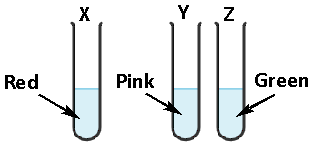
Smita carried out some experiments with china rose petals. She placed china rose petals in a beaker and added some hot water. She divided this solution into three test tubes and added acid to one, base to another and left the third one as such. But she forgot to label these test tubes. Identify the correct match for the solution in each test tube.
A) X-Base, Y-Indicator, Z-Acid
B) X-Indicator, Y-Acid, Z-Base
C) X-Acid, Y-Base, Z-Indicator
D) X-Acid, Y-Indicator, Z-Base
Answer
 Verified
564.9k+ views
Hint:To solve this we must know that china rose is an indicator. Substances that change their colours in the presence of an acid or a base are known as indicators. In a neutral solution, indicators do not show any colour change.
Complete answer:We know that china rose is a natural indicator. Indicators are obtained from nature and are known as natural indicators.
-China rose is a natural indicator. Originally, the china rose indicator is pink in colour. China rose solution turns dark pink (red) when dipped in acid and turns green when dipped in the base.
We are told that Smita carried out some experiments with china rose petals. She placed china rose petals in a beaker and added some hot water. This is the china rose extract.
Later Smita divided this solution into three test tubes and added acid to one, base to another and left the third one as such.
-We know that china rose solution turns dark pink (red) in colour when dipped in an acid. Thus, the test tube containing red coloured solution contains an acid. Thus, X-Acid.
We know that originally the china rose solution is pink in colour. Thus, the test tube containing pink coloured solution contains only the indicator. Thus, Y-Indicator.
We know that china rose solution turns green in colour when dipped in a base. Thus, the test tube containing green coloured solution contains a base. Thus, Z-Base.
Thus, the correct match for the solution in each test tube is X-Acid, Y-Indicator, Z-Base.
Thus, the correct option is (D) X-Acid, Y-Indicator, Z-Base.
Note: Substances that change their colors in the presence of an acid or a base are known as indicators. In a neutral solution, indicators do not show any color change. A few examples of natural indicators are litmus, turmeric etc.
Complete answer:We know that china rose is a natural indicator. Indicators are obtained from nature and are known as natural indicators.
-China rose is a natural indicator. Originally, the china rose indicator is pink in colour. China rose solution turns dark pink (red) when dipped in acid and turns green when dipped in the base.
We are told that Smita carried out some experiments with china rose petals. She placed china rose petals in a beaker and added some hot water. This is the china rose extract.
Later Smita divided this solution into three test tubes and added acid to one, base to another and left the third one as such.
-We know that china rose solution turns dark pink (red) in colour when dipped in an acid. Thus, the test tube containing red coloured solution contains an acid. Thus, X-Acid.
We know that originally the china rose solution is pink in colour. Thus, the test tube containing pink coloured solution contains only the indicator. Thus, Y-Indicator.
We know that china rose solution turns green in colour when dipped in a base. Thus, the test tube containing green coloured solution contains a base. Thus, Z-Base.
Thus, the correct match for the solution in each test tube is X-Acid, Y-Indicator, Z-Base.
Thus, the correct option is (D) X-Acid, Y-Indicator, Z-Base.
Note: Substances that change their colors in the presence of an acid or a base are known as indicators. In a neutral solution, indicators do not show any color change. A few examples of natural indicators are litmus, turmeric etc.
Recently Updated Pages
Master Class 10 Computer Science: Engaging Questions & Answers for Success

Master Class 10 General Knowledge: Engaging Questions & Answers for Success
Master Class 10 English: Engaging Questions & Answers for Success
Master Class 10 Social Science: Engaging Questions & Answers for Success
Master Class 10 Maths: Engaging Questions & Answers for Success
Master Class 10 Science: Engaging Questions & Answers for Success
Trending doubts
What is the median of the first 10 natural numbers class 10 maths CBSE
Which women's tennis player has 24 Grand Slam singles titles?
Who is the Brand Ambassador of Incredible India?
Why is there a time difference of about 5 hours between class 10 social science CBSE
Write a letter to the principal requesting him to grant class 10 english CBSE
A moving boat is observed from the top of a 150 m high class 10 maths CBSE