




How many spherical lead shots each $4.2cm$ in diameter can be obtained from a rectangular solid of lead with dimensions $66cm,42cm,21cm$ (Use $\pi = \dfrac{{22}}{7}$)
Answer
 Verified
489.3k+ views
Hint: Here we are given a rectangular lead solid(cuboid) and the lead solid is changed into spherical lead shots, and then we need to find the number of shots that can be made. To find the required answer, we need the formula to find the volume of the cuboid and the volume of the sphere. Also, we need to equate both volumes to obtain the desired answer.
Complete step by step solution:
Here the rectangular lead piece will be in a cuboidal shape.
Hence, the length of the cuboid is $66cm$, the breadth of the cuboid is $42cm$ and the height of the cuboid is $21cm$ .
Also, it is given that the diameter of the sphere is $4.2cm$.
We all know that the radius is half the diameter. Therefore, the required radius of the sphere is $r = \dfrac{{4.2}}{2} = 2.1cm$.
Now, we shall find the volume of the cuboid.
We need to apply the formula Volume of cuboid $ = $ length $ \times $ breadth $ \times $ height
Thus, the volume of the cuboid \[ = 66 \times 42 \times 21c{m^3}\]
Now, we shall find the volume of the sphere.
We shall apply the formula Volume of the sphere \[ = \dfrac{4}{3}\pi {r^3}\]
Thus Volume of the sphere \[ = \dfrac{4}{3} \times \dfrac{{22}}{7} \times {\left( {2.1} \right)^3}\]
$ \Rightarrow \dfrac{4}{3} \times \dfrac{{22}}{7} \times \dfrac{{4.2}}{2} \times \dfrac{{4.2}}{2} \times \dfrac{{4.2}}{2}v$
\[ \Rightarrow 22 \times 0.1 \times 4.2 \times 4.2c{m^3}\]
We are asked to find the number of shots that can be made when the lead solid is changed into lead shots.
Let $n$ be the number of lead shots.
Hence we need to multiply the number of shots with the volume of the sphere and need to compare it with the volume of the cuboid.
That is Volume of $n$ spherical lead shots $ = $ Volume of the cuboid
$ \Rightarrow n \times 22 \times 0.1 \times 4.2 \times 4.2 = 66 \times 42 \times 21$
\[ \Rightarrow n = \dfrac{{66 \times 42 \times 21}}{{22 \times 0.1 \times 4.2 \times 4.2}}\]
\[ \Rightarrow n = \dfrac{6}{{0.2 \times 0.2 \times 0.1}}\]
\[ \Rightarrow n = \dfrac{{6 \times 1000}}{{2 \times 2}}\]
\[ \Rightarrow n = 1.5 \times 1000\]
$ \therefore n = 1500$
Therefore, $1500$ shots can be made.
Note:
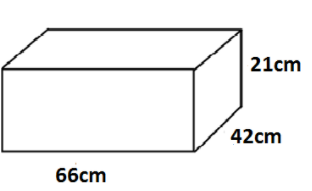
Here, we are given a rectangular lead piece and it is nothing but a cuboid. The dimensions of the cuboid are $66cm,42cm,21cm$. We may get confused to choose the length, breadth, and height from the given $66cm,42cm,21cm$. When we analyze the figure of the cuboid, we are able to note that the length is the largest dimension and height is the smallest dimension.
Complete step by step solution:
Here the rectangular lead piece will be in a cuboidal shape.
Hence, the length of the cuboid is $66cm$, the breadth of the cuboid is $42cm$ and the height of the cuboid is $21cm$ .
Also, it is given that the diameter of the sphere is $4.2cm$.
We all know that the radius is half the diameter. Therefore, the required radius of the sphere is $r = \dfrac{{4.2}}{2} = 2.1cm$.
Now, we shall find the volume of the cuboid.
We need to apply the formula Volume of cuboid $ = $ length $ \times $ breadth $ \times $ height
Thus, the volume of the cuboid \[ = 66 \times 42 \times 21c{m^3}\]
Now, we shall find the volume of the sphere.
We shall apply the formula Volume of the sphere \[ = \dfrac{4}{3}\pi {r^3}\]
Thus Volume of the sphere \[ = \dfrac{4}{3} \times \dfrac{{22}}{7} \times {\left( {2.1} \right)^3}\]
$ \Rightarrow \dfrac{4}{3} \times \dfrac{{22}}{7} \times \dfrac{{4.2}}{2} \times \dfrac{{4.2}}{2} \times \dfrac{{4.2}}{2}v$
\[ \Rightarrow 22 \times 0.1 \times 4.2 \times 4.2c{m^3}\]
We are asked to find the number of shots that can be made when the lead solid is changed into lead shots.
Let $n$ be the number of lead shots.
Hence we need to multiply the number of shots with the volume of the sphere and need to compare it with the volume of the cuboid.
That is Volume of $n$ spherical lead shots $ = $ Volume of the cuboid
$ \Rightarrow n \times 22 \times 0.1 \times 4.2 \times 4.2 = 66 \times 42 \times 21$
\[ \Rightarrow n = \dfrac{{66 \times 42 \times 21}}{{22 \times 0.1 \times 4.2 \times 4.2}}\]
\[ \Rightarrow n = \dfrac{6}{{0.2 \times 0.2 \times 0.1}}\]
\[ \Rightarrow n = \dfrac{{6 \times 1000}}{{2 \times 2}}\]
\[ \Rightarrow n = 1.5 \times 1000\]
$ \therefore n = 1500$
Therefore, $1500$ shots can be made.
Note:
Here, we are given a rectangular lead piece and it is nothing but a cuboid. The dimensions of the cuboid are $66cm,42cm,21cm$. We may get confused to choose the length, breadth, and height from the given $66cm,42cm,21cm$. When we analyze the figure of the cuboid, we are able to note that the length is the largest dimension and height is the smallest dimension.
Recently Updated Pages
Master Class 10 Computer Science: Engaging Questions & Answers for Success

Master Class 10 General Knowledge: Engaging Questions & Answers for Success
Master Class 10 English: Engaging Questions & Answers for Success
Master Class 10 Social Science: Engaging Questions & Answers for Success
Master Class 10 Maths: Engaging Questions & Answers for Success
Master Class 10 Science: Engaging Questions & Answers for Success
Trending doubts
What is the median of the first 10 natural numbers class 10 maths CBSE
Which women's tennis player has 24 Grand Slam singles titles?
Who is the Brand Ambassador of Incredible India?
Why is there a time difference of about 5 hours between class 10 social science CBSE
Write a letter to the principal requesting him to grant class 10 english CBSE
State and prove converse of BPT Basic Proportionality class 10 maths CBSE