




Suppose in an exceedingly circular motion of a particle , the tangential acceleration of the particle is given by \[at\Rightarrow 9m/{{s}^{2}}\]. The radius of the circle is 4m. The particle was initially at rest . Find the time after which acceleration of the particle makes an angle of \[{{45}^{\circ }}\] with the radial accelerations is –
A. \[\dfrac{1}{3}s\]
B. \[\dfrac{2}{3}s\]
C. \[\dfrac{4}{3}s\]
D. \[1s\]
Answer
 Verified
518.4k+ views
Hint: We know that the radial acceleration is equal to the rate of change in velocity . The change which generates in speed during the non uniform circular motion known as tangential acceleration.
Complete step-by-step solution:
let's draw a diagram of this question to solve this question-
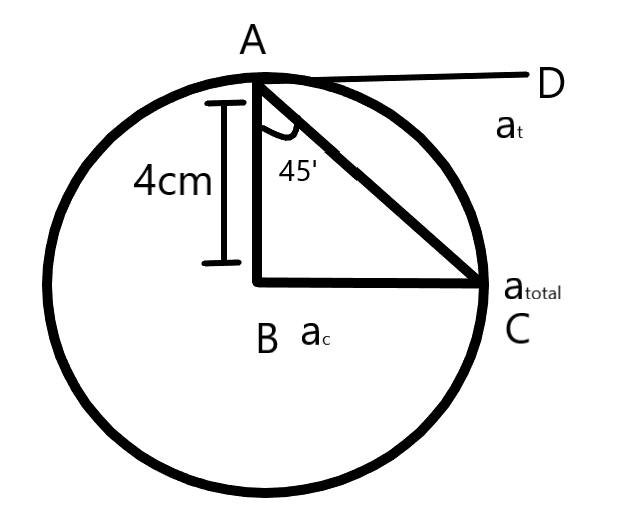
here in this problem , tangential acceleration = \[9m/{{s}^{2}}\]
Radius =\[4m\]
from the fig we get triangle ABC ,
\[\begin{align}
& \tan {{45}^{\circ }}\Rightarrow \dfrac{at}{ac} \\
& or,1\Rightarrow \dfrac{9}{ac} \\
& or,ac\Rightarrow 9m/{{s}^{2}} \\
\end{align}\]
Now , we know that tangential acceleration is
\[at\Rightarrow \dfrac{dv}{dt}\]
\[or,dv\Rightarrow at.dt\]
\[or,\int_{0}^{v}{dv\Rightarrow \int\limits_{0}^{t}{9dt}}\]
\[or,v\Rightarrow 9t\] \[m/s\]
Again , we know that centripetal acceleration \[\left( ac \right)=\dfrac{{{v}^{2}}}{r}\]
Now , using \[(ac)=(at)\] we get
\[\dfrac{{{v}^{2}}}{r}\Rightarrow \dfrac{dv}{dt}\]
\[or,\dfrac{{{(9t)}^{2}}}{4}\Rightarrow 9\]
\[or,\dfrac{81t}{4}\Rightarrow 9\]
\[or,{{1}^{2}}\Rightarrow \dfrac{4}{9}\]
\[or,t\Rightarrow \dfrac{2}{3}\sec \]
Therefore, the correct option is B) \[\dfrac{2}{3}s\].
Note: During circular motion the speed vector changes its direction at each point on the circle . This suggests that the tangential component of acceleration is always non-zero.
Complete step-by-step solution:
let's draw a diagram of this question to solve this question-
here in this problem , tangential acceleration = \[9m/{{s}^{2}}\]
Radius =\[4m\]
from the fig we get triangle ABC ,
\[\begin{align}
& \tan {{45}^{\circ }}\Rightarrow \dfrac{at}{ac} \\
& or,1\Rightarrow \dfrac{9}{ac} \\
& or,ac\Rightarrow 9m/{{s}^{2}} \\
\end{align}\]
Now , we know that tangential acceleration is
\[at\Rightarrow \dfrac{dv}{dt}\]
\[or,dv\Rightarrow at.dt\]
\[or,\int_{0}^{v}{dv\Rightarrow \int\limits_{0}^{t}{9dt}}\]
\[or,v\Rightarrow 9t\] \[m/s\]
Again , we know that centripetal acceleration \[\left( ac \right)=\dfrac{{{v}^{2}}}{r}\]
Now , using \[(ac)=(at)\] we get
\[\dfrac{{{v}^{2}}}{r}\Rightarrow \dfrac{dv}{dt}\]
\[or,\dfrac{{{(9t)}^{2}}}{4}\Rightarrow 9\]
\[or,\dfrac{81t}{4}\Rightarrow 9\]
\[or,{{1}^{2}}\Rightarrow \dfrac{4}{9}\]
\[or,t\Rightarrow \dfrac{2}{3}\sec \]
Therefore, the correct option is B) \[\dfrac{2}{3}s\].
Note: During circular motion the speed vector changes its direction at each point on the circle . This suggests that the tangential component of acceleration is always non-zero.
Recently Updated Pages
Master Class 11 Computer Science: Engaging Questions & Answers for Success

Master Class 11 Business Studies: Engaging Questions & Answers for Success
Master Class 11 Economics: Engaging Questions & Answers for Success
Master Class 11 English: Engaging Questions & Answers for Success
Master Class 11 Maths: Engaging Questions & Answers for Success
Master Class 11 Biology: Engaging Questions & Answers for Success
Trending doubts
One Metric ton is equal to kg A 10000 B 1000 C 100 class 11 physics CBSE
There are 720 permutations of the digits 1 2 3 4 5 class 11 maths CBSE
Discuss the various forms of bacteria class 11 biology CBSE
Draw a diagram of a plant cell and label at least eight class 11 biology CBSE
State the laws of reflection of light
Explain zero factorial class 11 maths CBSE