




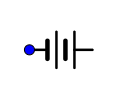
What is the symbol for a battery?
A.)
B.)

C.)

D.)

Answer
 Verified
593.4k+ views
Hint: A battery consists of one or more electrochemical cells. In a battery one terminal is positively charged and one terminal negatively charged. When a circuit is closed the electrons will flow from negative terminal to positive terminal which will create current inside the circuit.
Complete step by step answer:
The symbol for battery is
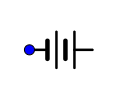
 Represents an open switch and
 represents a closed switch.
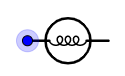 This represents a bulb.
Hence, the correct answer is option A.
Additional Information
Circuit Diagram: It is a diagram which shows how the different components of a circuit are connected together. The different circuit components are cell,battery(combination of cells).switch(open) and switch(closed), bulb, resistance, rheostat, ammeter, voltmeter, galvanometer. Different circuit symbols of a circuit are given below table
(I)Ammeter: It is an electronic device used to measure the amount of current flow in terms of $Ampere$ a mili-Ampere. An ammeter always connected in series with the circuit.
(II)Voltmeter: It is an electronic device used to measure the potential difference between two points in terms of $Volt$. Voltmeter always connected parallel with the circuit.
(III)Galvanometer: It measures a very small potential difference between two points.
Note:
In a circuit the direction of current is from positive end to negative end (opposite to direction of charge flow). The longer end of the battery is positive and the shorter end is negative. The positive end of the ammeter is always connected to the positive end of the battery and negative end of the ammeter connected to the negative end of the battery. Ammeter is connected in series whereas voltmeter and galvanometer were always connected in parallel with the circuit.
Complete step by step answer:
The symbol for battery is
Hence, the correct answer is option A.
Additional Information
Circuit Diagram: It is a diagram which shows how the different components of a circuit are connected together. The different circuit components are cell,battery(combination of cells).switch(open) and switch(closed), bulb, resistance, rheostat, ammeter, voltmeter, galvanometer. Different circuit symbols of a circuit are given below table
| Cell | 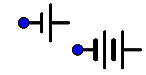
|
| battery | 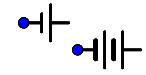
|
| Switch(open) | 
|
| Switch(closed) | 
|
| resistance | 
|
| bulb | 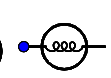
|
| voltmeter | 
|
| ammeter | 
|
(I)Ammeter: It is an electronic device used to measure the amount of current flow in terms of $Ampere$ a mili-Ampere. An ammeter always connected in series with the circuit.
(II)Voltmeter: It is an electronic device used to measure the potential difference between two points in terms of $Volt$. Voltmeter always connected parallel with the circuit.
(III)Galvanometer: It measures a very small potential difference between two points.
Note:
In a circuit the direction of current is from positive end to negative end (opposite to direction of charge flow). The longer end of the battery is positive and the shorter end is negative. The positive end of the ammeter is always connected to the positive end of the battery and negative end of the ammeter connected to the negative end of the battery. Ammeter is connected in series whereas voltmeter and galvanometer were always connected in parallel with the circuit.
Recently Updated Pages
Master Class 10 Computer Science: Engaging Questions & Answers for Success

Master Class 10 General Knowledge: Engaging Questions & Answers for Success
Master Class 10 English: Engaging Questions & Answers for Success
Master Class 10 Social Science: Engaging Questions & Answers for Success
Master Class 10 Maths: Engaging Questions & Answers for Success
Master Class 10 Science: Engaging Questions & Answers for Success
Trending doubts
What is the median of the first 10 natural numbers class 10 maths CBSE
Which women's tennis player has 24 Grand Slam singles titles?
Who is the Brand Ambassador of Incredible India?
Why is there a time difference of about 5 hours between class 10 social science CBSE
Write a letter to the principal requesting him to grant class 10 english CBSE
A moving boat is observed from the top of a 150 m high class 10 maths CBSE