




Tension is measured in units of
(A) Momentum
(B) Force
(C) Length
(D) None
Answer
 Verified
590.4k+ views
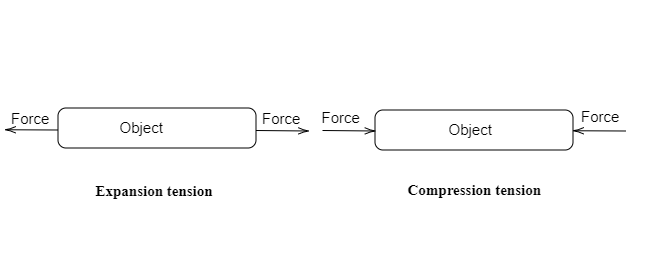
Hint: Tension is described as the pulling force transmitted axially by the means of a string, chain, cable, or similar object. Tension is also described as the action-reaction pair of forces acting at each end of an element. Tension can be the opposite of the compression force.
Complete step by step solution:
At the atomic level when the atoms or molecules are pulled apart from each other and gain potential energy with a restoring force still existing, the restoring force may create tension. Each end of the string or rod under such tension could pull on the object it is attached to, in order to restore the string or rod to its relaxed length.
The tension can be easily explained in the case of bodies hung from chain, cable, string etc. It is represented by $T$ (It is also denoted as $Ft$).
If such a hung body moves vertically with an acceleration $a$,
Then the formula for tension force is,
$T = W\left( \pm \right)ma$
If the body is moving upwards then, $T = W + ma$
If the body is moving downwards then, $T = W - ma$
If the body is just suspended (not moving), $T = W$
Here,
$m$ is the mass of the body
$W$ is the weight of the body
$a$ is the acceleration of the body.
So, tension is also a kind of force that is why it is expressed in Newton which is denoted as $N$.
$\therefore$ The tension is measured in the units of force. Hence the option (A) is correct.
Note:
The force that is transmitted through a string, rope, cable, or wire when it is pulled tight by forces acting from opposite ends is known as tension force. The tension force is acting along the length of the wire/rope and pulls equally on the objects on the opposite ends of the wire/rope.
Complete step by step solution:
At the atomic level when the atoms or molecules are pulled apart from each other and gain potential energy with a restoring force still existing, the restoring force may create tension. Each end of the string or rod under such tension could pull on the object it is attached to, in order to restore the string or rod to its relaxed length.
The tension can be easily explained in the case of bodies hung from chain, cable, string etc. It is represented by $T$ (It is also denoted as $Ft$).
If such a hung body moves vertically with an acceleration $a$,
Then the formula for tension force is,
$T = W\left( \pm \right)ma$
If the body is moving upwards then, $T = W + ma$
If the body is moving downwards then, $T = W - ma$
If the body is just suspended (not moving), $T = W$
Here,
$m$ is the mass of the body
$W$ is the weight of the body
$a$ is the acceleration of the body.
So, tension is also a kind of force that is why it is expressed in Newton which is denoted as $N$.
$\therefore$ The tension is measured in the units of force. Hence the option (A) is correct.
Note:
The force that is transmitted through a string, rope, cable, or wire when it is pulled tight by forces acting from opposite ends is known as tension force. The tension force is acting along the length of the wire/rope and pulls equally on the objects on the opposite ends of the wire/rope.
Recently Updated Pages
Master Class 11 Computer Science: Engaging Questions & Answers for Success

Master Class 11 Business Studies: Engaging Questions & Answers for Success
Master Class 11 Economics: Engaging Questions & Answers for Success
Master Class 11 English: Engaging Questions & Answers for Success
Master Class 11 Maths: Engaging Questions & Answers for Success
Master Class 11 Biology: Engaging Questions & Answers for Success
Trending doubts
One Metric ton is equal to kg A 10000 B 1000 C 100 class 11 physics CBSE
There are 720 permutations of the digits 1 2 3 4 5 class 11 maths CBSE
Discuss the various forms of bacteria class 11 biology CBSE
Draw a diagram of a plant cell and label at least eight class 11 biology CBSE
State the laws of reflection of light
Explain zero factorial class 11 maths CBSE