




What will be the angle between $\left( A+B \right)$ and $\left( A\times B \right)$? State the reason also.
Answer
 Verified
582.9k+ views
Hint: First of all find the sum of two vectors and then figure out the position of the resultant vector with respect to the vectors given. Similarly find out the cross product of the vectors and also find out the angle between the vectors and the resultant. Compare both these facts and reach at the answer. This information will help you to solve this question.
Complete answer:
Let us assume that the two vectors we are discussing are given as $A$ and $B$. Let their sum can be written as,
$A+B=sum$
Their sum will be lying in the same plane where the vectors $A$ and $B$ are lying. As they are also found to be non -parallel therefore they can describe a plane and also the cross product between them will be not zero. The cross product of the two vectors can be shown as,
$A\times B=\left| A \right|\left| B \right|\sin \alpha n$
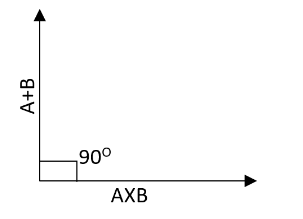
Here $\alpha $ be the angle between $A$ and $B$. The unit vector which is perpendicular to the plane containing $A$ and $B$ is mentioned as $n$. Here the resultant will be perpendicular to the two vectors. Hence we can say that the angle between the $A\times B$ and $A+B$ will be $90{}^\circ $.
Note:
The cross product also known as the vector product is basically the binary operation of two vectors in the three-dimensional space. Cross product can be applicable only in the case of vectors. It has been given two linearly independent vectors $A$and $B$, then their cross product, $A\times B$ will be also a vector which is perpendicular to both the vectors. This will be normal to the plane containing the vectors.
Complete answer:
Let us assume that the two vectors we are discussing are given as $A$ and $B$. Let their sum can be written as,
$A+B=sum$
Their sum will be lying in the same plane where the vectors $A$ and $B$ are lying. As they are also found to be non -parallel therefore they can describe a plane and also the cross product between them will be not zero. The cross product of the two vectors can be shown as,
$A\times B=\left| A \right|\left| B \right|\sin \alpha n$
Here $\alpha $ be the angle between $A$ and $B$. The unit vector which is perpendicular to the plane containing $A$ and $B$ is mentioned as $n$. Here the resultant will be perpendicular to the two vectors. Hence we can say that the angle between the $A\times B$ and $A+B$ will be $90{}^\circ $.
Note:
The cross product also known as the vector product is basically the binary operation of two vectors in the three-dimensional space. Cross product can be applicable only in the case of vectors. It has been given two linearly independent vectors $A$and $B$, then their cross product, $A\times B$ will be also a vector which is perpendicular to both the vectors. This will be normal to the plane containing the vectors.
Recently Updated Pages
Master Class 11 Computer Science: Engaging Questions & Answers for Success

Master Class 11 Business Studies: Engaging Questions & Answers for Success
Master Class 11 Economics: Engaging Questions & Answers for Success
Master Class 11 English: Engaging Questions & Answers for Success
Master Class 11 Maths: Engaging Questions & Answers for Success
Master Class 11 Biology: Engaging Questions & Answers for Success
Trending doubts
One Metric ton is equal to kg A 10000 B 1000 C 100 class 11 physics CBSE
There are 720 permutations of the digits 1 2 3 4 5 class 11 maths CBSE
Discuss the various forms of bacteria class 11 biology CBSE
Draw a diagram of a plant cell and label at least eight class 11 biology CBSE
State the laws of reflection of light
Explain zero factorial class 11 maths CBSE