




The angles of depression of the top and bottom of an 8m tall building from the top of a multi-storeyed building are 30 and 45 respectively. Find the height of the multi-storeyed building and the distance between the two buildings.
Answer
 Verified
618.3k+ views
Hint: This question can be solved by drawing a figure of the given problem giving it suitable variables and expressions and using the theory of trigonometric ratios in which tan of the angle is represented by dividing perpendicular to the base.
Complete step-by-step answer:
To solve this question, we will first try to draw the figure of the question.
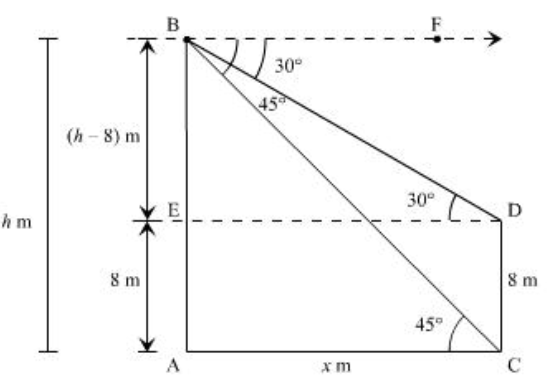
Let AB and CD be the multi-storeyed building and the building respectively. Let the height of the multi-storeyed building= h m and the distance between the two buildings = x m.
Representing all the above theory we have the figure as:
Given,
\[\begin{array}{*{35}{l}}
\begin{align}
& AE\text{ }=\text{ }CD\text{ }=\text{ }8\text{ }m \\
& \\
\end{align} \\
BE\text{ }=\text{ }AB\text{ }\text{ }AE\text{ }=\text{ }\left( h~\text{ }8 \right)\text{ }m~ \\
\end{array}\]
and \[AC\text{ }=\text{ }DE\text{ }=~x~\text{ }\]
Also, as BF, ED and AC are all parallel to each other
\[\Rightarrow \]\[\angle FBD\text{ }=\angle BDE\text{ }=\text{ }30{}^\circ \] (Corresponding angles)
And \[\angle FBC\text{ }=\angle BCA\text{ }=\text{ }45{}^\circ \] (Corresponding angles)
Now in Δ ACB, applying tan on \[\angle ACB\] and using formula as given we get,
\[\begin{align}
& \tan \theta =\dfrac{perpendicular}{base} \\
& \\
& \Rightarrow \tan 45=\dfrac{AB}{AC} \\
& \\
& \Rightarrow 1=\dfrac{h}{x} \\
\end{align}\]
\[\Rightarrow \]\[x=h\]……..(i)
Now in Δ BDE, applying tan on\[\angle EDB\] and using formula as given we get,
\[\begin{align}
& \tan \theta =\dfrac{perpendicular}{base} \\
& \\
& \Rightarrow \tan 30=\dfrac{BE}{ED} \\
& \\
& \Rightarrow \dfrac{1}{\sqrt{3}}=\dfrac{h-8}{x} \\
\end{align}\]
\[\Rightarrow \]\[x=\sqrt{3}(h-8)\]……….(ii)
From (i) and (ii), we get,
\[\begin{align}
& h=\sqrt{3}h-8\sqrt{3} \\
& \\
& \Rightarrow \sqrt{3}h-h=8\sqrt{3} \\
& \\
& \Rightarrow h(\sqrt{3}-1)=8\sqrt{3} \\
& \\
& \Rightarrow h=\dfrac{8\sqrt{3}}{(\sqrt{3}-1)} \\
\end{align}\]
Rationalising the obtained term, we get
\[\begin{align}
& h=\dfrac{8\sqrt{3}}{(\sqrt{3}-1)}\left( \dfrac{\sqrt{3}+1}{\sqrt{3}+1} \right) \\
& \\
& \Rightarrow h=\dfrac{8\sqrt{3}}{2}(\sqrt{3}+1) \\
& \\
& \Rightarrow h=4\sqrt{3}(\sqrt{3}+1) \\
& \\
& \Rightarrow h=4(3+\sqrt{3}) \\
\end{align}\]
Hence, we obtain h that is the distance between the two buildings as \[4(3+\sqrt{3})\]m
Note: The possibility of error in this question is missing the fact that angle of depression is given rather than angle of elevation, which gives the angle to be drawn from the top to bottom and not from the bottom to top.
Complete step-by-step answer:
To solve this question, we will first try to draw the figure of the question.
Let AB and CD be the multi-storeyed building and the building respectively. Let the height of the multi-storeyed building= h m and the distance between the two buildings = x m.
Representing all the above theory we have the figure as:
Given,
\[\begin{array}{*{35}{l}}
\begin{align}
& AE\text{ }=\text{ }CD\text{ }=\text{ }8\text{ }m \\
& \\
\end{align} \\
BE\text{ }=\text{ }AB\text{ }\text{ }AE\text{ }=\text{ }\left( h~\text{ }8 \right)\text{ }m~ \\
\end{array}\]
and \[AC\text{ }=\text{ }DE\text{ }=~x~\text{ }\]
Also, as BF, ED and AC are all parallel to each other
\[\Rightarrow \]\[\angle FBD\text{ }=\angle BDE\text{ }=\text{ }30{}^\circ \] (Corresponding angles)
And \[\angle FBC\text{ }=\angle BCA\text{ }=\text{ }45{}^\circ \] (Corresponding angles)
Now in Δ ACB, applying tan on \[\angle ACB\] and using formula as given we get,
\[\begin{align}
& \tan \theta =\dfrac{perpendicular}{base} \\
& \\
& \Rightarrow \tan 45=\dfrac{AB}{AC} \\
& \\
& \Rightarrow 1=\dfrac{h}{x} \\
\end{align}\]
\[\Rightarrow \]\[x=h\]……..(i)
Now in Δ BDE, applying tan on\[\angle EDB\] and using formula as given we get,
\[\begin{align}
& \tan \theta =\dfrac{perpendicular}{base} \\
& \\
& \Rightarrow \tan 30=\dfrac{BE}{ED} \\
& \\
& \Rightarrow \dfrac{1}{\sqrt{3}}=\dfrac{h-8}{x} \\
\end{align}\]
\[\Rightarrow \]\[x=\sqrt{3}(h-8)\]……….(ii)
From (i) and (ii), we get,
\[\begin{align}
& h=\sqrt{3}h-8\sqrt{3} \\
& \\
& \Rightarrow \sqrt{3}h-h=8\sqrt{3} \\
& \\
& \Rightarrow h(\sqrt{3}-1)=8\sqrt{3} \\
& \\
& \Rightarrow h=\dfrac{8\sqrt{3}}{(\sqrt{3}-1)} \\
\end{align}\]
Rationalising the obtained term, we get
\[\begin{align}
& h=\dfrac{8\sqrt{3}}{(\sqrt{3}-1)}\left( \dfrac{\sqrt{3}+1}{\sqrt{3}+1} \right) \\
& \\
& \Rightarrow h=\dfrac{8\sqrt{3}}{2}(\sqrt{3}+1) \\
& \\
& \Rightarrow h=4\sqrt{3}(\sqrt{3}+1) \\
& \\
& \Rightarrow h=4(3+\sqrt{3}) \\
\end{align}\]
Hence, we obtain h that is the distance between the two buildings as \[4(3+\sqrt{3})\]m
Note: The possibility of error in this question is missing the fact that angle of depression is given rather than angle of elevation, which gives the angle to be drawn from the top to bottom and not from the bottom to top.
Recently Updated Pages
Master Class 10 Computer Science: Engaging Questions & Answers for Success

Master Class 10 General Knowledge: Engaging Questions & Answers for Success
Master Class 10 English: Engaging Questions & Answers for Success
Master Class 10 Social Science: Engaging Questions & Answers for Success
Master Class 10 Maths: Engaging Questions & Answers for Success
Master Class 10 Science: Engaging Questions & Answers for Success
Trending doubts
What is the median of the first 10 natural numbers class 10 maths CBSE
Which women's tennis player has 24 Grand Slam singles titles?
Who is the Brand Ambassador of Incredible India?
Why is there a time difference of about 5 hours between class 10 social science CBSE
Write a letter to the principal requesting him to grant class 10 english CBSE
A moving boat is observed from the top of a 150 m high class 10 maths CBSE