




The area (in sq. units) of the region described by \[\left\{ \left( x,y \right){{y}^{2}}\le 2x\text{ and }y\ge 4x-1 \right\}\] is:
\[\left( a \right)\dfrac{7}{32}\]
\[\left( b \right)\dfrac{5}{64}\]
\[\left( c \right)\dfrac{15}{64}\]
\[\left( d \right)\dfrac{9}{32}\]
Answer
 Verified
569.7k+ views
Hint: Draw the graph of the parabola and consider the part inside of it. Now, draw the graph of the line y = 4x – 1 and consider the left side part. Shade the area common between the two graphs. Find the point of intersection of these curves by solving the given equations. Now, apply the formula \[\text{Area}=\int\limits_{a}^{b}{\left[ f\left( y \right)-g\left( y \right) \right]}dy\] to find the required area. Here, f(y) and g(y) are the equations of the line and parabola respectively and a and b are the lower limit, upper limit respectively up to which area is to be found.
Complete step by step answer:
Here, we have to find the area between the parabola \[{{y}^{2}}\le 2x\] and the line \[y\ge 4x-1.\] Now \[{{y}^{2}}\le 2x\] will give the inside part of the parabola and \[y\ge 4x-1\] will give the left side part of the line in the graph. Here, we need to find the points of intersection of the curves to determine the value of the limits required for integration. So, let us solve the given equations by considering the equality sign. Substituting y = 4x – 1 in \[{{y}^{2}}=2x,\] we get,
\[\Rightarrow {{\left( 4x-1 \right)}^{2}}=2x\]
\[\Rightarrow 16{{x}^{2}}+1-8x=2x\]
\[\Rightarrow 16{{x}^{2}}-10x+1=0\]
Now, using the discriminant method, we get,
\[\Rightarrow x=\dfrac{-\left( -10 \right)\pm \sqrt{{{\left( -10 \right)}^{2}}-4\times 1\times 16}}{2\times 16}\]
\[\Rightarrow x=\dfrac{10\pm \sqrt{100-64}}{32}\]
\[\Rightarrow x=\dfrac{10\pm 6}{32}\]
\[\Rightarrow x=\dfrac{16}{32};x=\dfrac{4}{32}\]
\[\Rightarrow x=\dfrac{1}{2};x=\dfrac{1}{8}\]
(i) When \[x=\dfrac{1}{2}\]
\[\Rightarrow y=4\times \dfrac{1}{2}-1\]
\[\Rightarrow y=2-1\]
\[\Rightarrow y=1\]
(ii) When \[x=\dfrac{1}{8}\]
\[\Rightarrow y=4\times \dfrac{1}{8}-1\]
\[\Rightarrow y=\dfrac{1}{2}-1\]
\[\Rightarrow y=\dfrac{-1}{2}\]
Hence, the coordinates of points of intersection can be given as \[A\left( \dfrac{1}{2},1 \right)\] and \[B\left( \dfrac{1}{8},\dfrac{-1}{2} \right).\] Let us not plot the graph of the given situation. So, the required graph will look like:
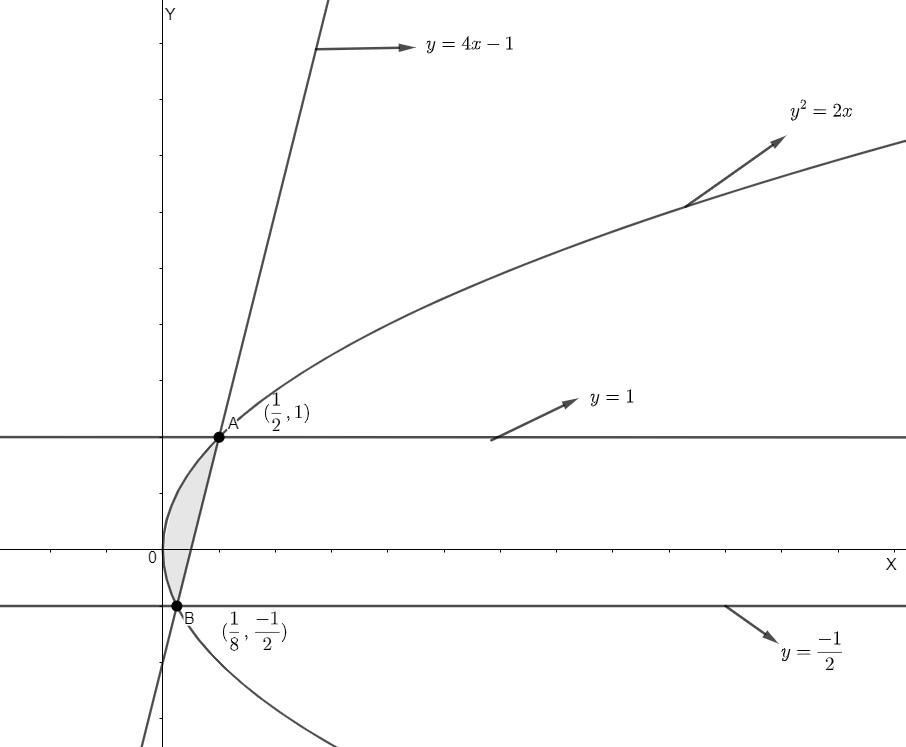
Clearly, we can see that the area of the region bounded by the curves is shown by the shaded part. Therefore, using integration, we have,
\[\Rightarrow \text{Area}=\int\limits_{a}^{b}{\left[ f\left( y \right)-g\left( y \right) \right]}dy\]
Here, f(y) is the equation of the line in terms of y.
\[=\left( \dfrac{y+1}{4} \right)\]
And, g(y) is the equation of the parabola in terms of y.
\[=\dfrac{{{y}^{2}}}{2}\]
Here, ‘a’ and ‘b’ are the limits up to which the area between the graph is to be determined.
\[\Rightarrow \left( a,b \right)=\left( \dfrac{-1}{2},1 \right)\]
\[\Rightarrow \text{Area}=\int\limits_{\dfrac{-1}{2}}^{1}{\left[ \left( \dfrac{y+1}{4} \right)-\dfrac{{{y}^{2}}}{2} \right]}dy\]
\[\Rightarrow \text{Area}=\left[ \dfrac{1}{4}\left( \dfrac{{{y}^{2}}}{2}+y \right)-\dfrac{{{y}^{3}}}{2\times 3} \right]_{\dfrac{-1}{2}}^{1}\]
Substituting the limits and simplifying, we get,
\[\Rightarrow \text{Area}=\left[ \left( \dfrac{3}{8}-\dfrac{1}{6} \right)-\left( \dfrac{-3}{32}+\dfrac{1}{48} \right) \right]\]
\[\Rightarrow \text{Area}=\dfrac{10}{48}+\dfrac{3}{32}-\dfrac{1}{48}\]
\[\Rightarrow \text{Area}=\dfrac{9}{32}\]
Hence, option (d) is the right answer.
Note:
One may note that plotting the graph is very important because then only we can visualize the points which are taken as limits. The important points should be marked in the graph. Also, note that we have used the formula for the area \[=\int{f\left( y \right)dy}\] because it is easier for us to calculate the area on y-axis than on x – axis. If we will calculate the area on the x – axis then we have to consider two parts, one above and the other below the x – axis and therefore the calculations will be difficult.
Complete step by step answer:
Here, we have to find the area between the parabola \[{{y}^{2}}\le 2x\] and the line \[y\ge 4x-1.\] Now \[{{y}^{2}}\le 2x\] will give the inside part of the parabola and \[y\ge 4x-1\] will give the left side part of the line in the graph. Here, we need to find the points of intersection of the curves to determine the value of the limits required for integration. So, let us solve the given equations by considering the equality sign. Substituting y = 4x – 1 in \[{{y}^{2}}=2x,\] we get,
\[\Rightarrow {{\left( 4x-1 \right)}^{2}}=2x\]
\[\Rightarrow 16{{x}^{2}}+1-8x=2x\]
\[\Rightarrow 16{{x}^{2}}-10x+1=0\]
Now, using the discriminant method, we get,
\[\Rightarrow x=\dfrac{-\left( -10 \right)\pm \sqrt{{{\left( -10 \right)}^{2}}-4\times 1\times 16}}{2\times 16}\]
\[\Rightarrow x=\dfrac{10\pm \sqrt{100-64}}{32}\]
\[\Rightarrow x=\dfrac{10\pm 6}{32}\]
\[\Rightarrow x=\dfrac{16}{32};x=\dfrac{4}{32}\]
\[\Rightarrow x=\dfrac{1}{2};x=\dfrac{1}{8}\]
(i) When \[x=\dfrac{1}{2}\]
\[\Rightarrow y=4\times \dfrac{1}{2}-1\]
\[\Rightarrow y=2-1\]
\[\Rightarrow y=1\]
(ii) When \[x=\dfrac{1}{8}\]
\[\Rightarrow y=4\times \dfrac{1}{8}-1\]
\[\Rightarrow y=\dfrac{1}{2}-1\]
\[\Rightarrow y=\dfrac{-1}{2}\]
Hence, the coordinates of points of intersection can be given as \[A\left( \dfrac{1}{2},1 \right)\] and \[B\left( \dfrac{1}{8},\dfrac{-1}{2} \right).\] Let us not plot the graph of the given situation. So, the required graph will look like:
Clearly, we can see that the area of the region bounded by the curves is shown by the shaded part. Therefore, using integration, we have,
\[\Rightarrow \text{Area}=\int\limits_{a}^{b}{\left[ f\left( y \right)-g\left( y \right) \right]}dy\]
Here, f(y) is the equation of the line in terms of y.
\[=\left( \dfrac{y+1}{4} \right)\]
And, g(y) is the equation of the parabola in terms of y.
\[=\dfrac{{{y}^{2}}}{2}\]
Here, ‘a’ and ‘b’ are the limits up to which the area between the graph is to be determined.
\[\Rightarrow \left( a,b \right)=\left( \dfrac{-1}{2},1 \right)\]
\[\Rightarrow \text{Area}=\int\limits_{\dfrac{-1}{2}}^{1}{\left[ \left( \dfrac{y+1}{4} \right)-\dfrac{{{y}^{2}}}{2} \right]}dy\]
\[\Rightarrow \text{Area}=\left[ \dfrac{1}{4}\left( \dfrac{{{y}^{2}}}{2}+y \right)-\dfrac{{{y}^{3}}}{2\times 3} \right]_{\dfrac{-1}{2}}^{1}\]
Substituting the limits and simplifying, we get,
\[\Rightarrow \text{Area}=\left[ \left( \dfrac{3}{8}-\dfrac{1}{6} \right)-\left( \dfrac{-3}{32}+\dfrac{1}{48} \right) \right]\]
\[\Rightarrow \text{Area}=\dfrac{10}{48}+\dfrac{3}{32}-\dfrac{1}{48}\]
\[\Rightarrow \text{Area}=\dfrac{9}{32}\]
Hence, option (d) is the right answer.
Note:
One may note that plotting the graph is very important because then only we can visualize the points which are taken as limits. The important points should be marked in the graph. Also, note that we have used the formula for the area \[=\int{f\left( y \right)dy}\] because it is easier for us to calculate the area on y-axis than on x – axis. If we will calculate the area on the x – axis then we have to consider two parts, one above and the other below the x – axis and therefore the calculations will be difficult.
Recently Updated Pages
Master Class 10 Computer Science: Engaging Questions & Answers for Success

Master Class 10 General Knowledge: Engaging Questions & Answers for Success
Master Class 10 English: Engaging Questions & Answers for Success
Master Class 10 Social Science: Engaging Questions & Answers for Success
Master Class 10 Maths: Engaging Questions & Answers for Success
Master Class 10 Science: Engaging Questions & Answers for Success
Trending doubts
What is the median of the first 10 natural numbers class 10 maths CBSE
Which women's tennis player has 24 Grand Slam singles titles?
Who is the Brand Ambassador of Incredible India?
Why is there a time difference of about 5 hours between class 10 social science CBSE
Write a letter to the principal requesting him to grant class 10 english CBSE
A moving boat is observed from the top of a 150 m high class 10 maths CBSE