




The area of the equilateral triangle whose side is $8{\text{cm}}$, is:
A. $64{\text{c}}{{\text{m}}^2}$
B. ${\text{16}}\sqrt 3 {\text{c}}{{\text{m}}^2}$
C. ${\text{21}}{\text{.3c}}{{\text{m}}^2}$
D. $4\sqrt 3 {\text{c}}{{\text{m}}^2}$
Answer
 Verified
572.7k+ views
Hint: Here we are given the side of the equilateral triangle. Equilateral triangle is the triangle with all sides equal which is given to be $8{\text{cm}}$. So we will use the formula of the area of the equilateral triangle which is:
${\text{Area(A)}} = \dfrac{{\sqrt 3 }}{4}{a^2}$
Here $a$ is the length of each side and ${\text{A}}$ is the area.
Complete step-by-step answer:
Here we are given the side of the equilateral triangle and we need to find the area of it. Here we must have the knowledge of what an equilateral triangle is. It is the triangle in which all the three sides are equal in length which is given here as $8{\text{cm}}$
Here we have the equilateral triangle with the side $8{\text{cm}}$
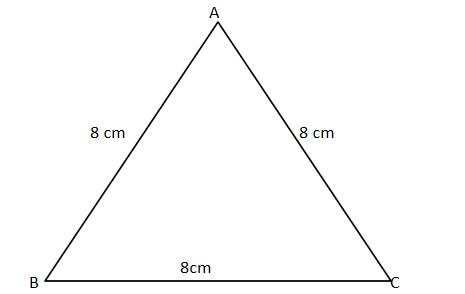
Here we have all three sides equal to $8{\text{cm}}$ and we must know what the formula to calculate the area of the equilateral triangle is.
${\text{Area(A)}} = \dfrac{{\sqrt 3 }}{4}{a^2}$
Here $a$ is the length of each side and ${\text{A}}$ is the area.
So we can say here that $a = 8{\text{cm}}$
Bow substituting the value of $a = 8$ in the given formula of the area of the equilateral triangle we get that:
$\Rightarrow$ ${\text{Area(A)}} = \dfrac{{\sqrt 3 }}{4}{a^2}$
$\Rightarrow$ ${\text{A}} = \dfrac{{\sqrt 3 }}{4}{(8)^2}$
$\Rightarrow$ ${\text{A}} = \dfrac{{\sqrt 3 }}{4} \times 64 = 16\sqrt 3 $
So here we get the value of the area as $16\sqrt 3 $ and its units according to the formula will be:
We have taken the square of the side in the formula, so we will have the unit of area as the square of the unit of the side which is given as ${\text{centimetre}} = {\text{cm}}$
So we have area of the triangle as ${\text{A}} = \dfrac{{\sqrt 3 }}{4} \times 64 = 16\sqrt 3 {\text{c}}{{\text{m}}^2}$
So option B is correct.
Note: Here we must know that this formula of area is only valid when all the three sides of the triangle are equal which means that it is only valid for the equilateral triangle. If we have the triangle whose all sides are unequal then we can use Heron’s formula which is given as
${\text{A}} = \sqrt {s(s - a)(s - b)(s - c)} $
Here $s$ represents the semi-perimeter of the triangle which means half of the total perimeter and $a,b,c$ are the three sides of the triangle.
So $s = \dfrac{{a + b + c}}{2}$
${\text{Area(A)}} = \dfrac{{\sqrt 3 }}{4}{a^2}$
Here $a$ is the length of each side and ${\text{A}}$ is the area.
Complete step-by-step answer:
Here we are given the side of the equilateral triangle and we need to find the area of it. Here we must have the knowledge of what an equilateral triangle is. It is the triangle in which all the three sides are equal in length which is given here as $8{\text{cm}}$
Here we have the equilateral triangle with the side $8{\text{cm}}$
Here we have all three sides equal to $8{\text{cm}}$ and we must know what the formula to calculate the area of the equilateral triangle is.
${\text{Area(A)}} = \dfrac{{\sqrt 3 }}{4}{a^2}$
Here $a$ is the length of each side and ${\text{A}}$ is the area.
So we can say here that $a = 8{\text{cm}}$
Bow substituting the value of $a = 8$ in the given formula of the area of the equilateral triangle we get that:
$\Rightarrow$ ${\text{Area(A)}} = \dfrac{{\sqrt 3 }}{4}{a^2}$
$\Rightarrow$ ${\text{A}} = \dfrac{{\sqrt 3 }}{4}{(8)^2}$
$\Rightarrow$ ${\text{A}} = \dfrac{{\sqrt 3 }}{4} \times 64 = 16\sqrt 3 $
So here we get the value of the area as $16\sqrt 3 $ and its units according to the formula will be:
We have taken the square of the side in the formula, so we will have the unit of area as the square of the unit of the side which is given as ${\text{centimetre}} = {\text{cm}}$
So we have area of the triangle as ${\text{A}} = \dfrac{{\sqrt 3 }}{4} \times 64 = 16\sqrt 3 {\text{c}}{{\text{m}}^2}$
So option B is correct.
Note: Here we must know that this formula of area is only valid when all the three sides of the triangle are equal which means that it is only valid for the equilateral triangle. If we have the triangle whose all sides are unequal then we can use Heron’s formula which is given as
${\text{A}} = \sqrt {s(s - a)(s - b)(s - c)} $
Here $s$ represents the semi-perimeter of the triangle which means half of the total perimeter and $a,b,c$ are the three sides of the triangle.
So $s = \dfrac{{a + b + c}}{2}$

Recently Updated Pages
Master Class 8 Social Science: Engaging Questions & Answers for Success

Master Class 8 English: Engaging Questions & Answers for Success
Class 8 Question and Answer - Your Ultimate Solutions Guide
Master Class 8 Maths: Engaging Questions & Answers for Success
Master Class 8 Science: Engaging Questions & Answers for Success
Master Class 9 General Knowledge: Engaging Questions & Answers for Success
Trending doubts
What is BLO What is the full form of BLO class 8 social science CBSE
Citizens of India can vote at the age of A 18 years class 8 social science CBSE
Full form of STD, ISD and PCO
Advantages and disadvantages of science
Right to vote is a AFundamental Right BFundamental class 8 social science CBSE
What are the 12 elements of nature class 8 chemistry CBSE