




The arrow in the following diagram shows the direction a sailing ship moves. What happens if a strong wind blows from the same direction?
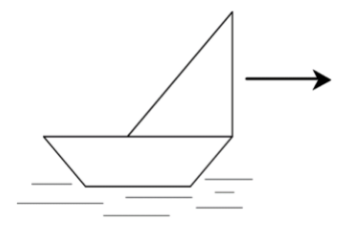
A. The sailing ship moves faster
B. The sailing ship moves slower
C. The sailing ship comes to rest
D. Nothing happens
Answer
 Verified
516.3k+ views
Hint: Sailing ships work by utilizing the true wind and apparent wind. The sail creates a low pressure zone and high pressure zone. Low pressure zone is created in front of the sail and a high pressure zone is created behind the sail. The sailing ship moves into the low pressure zone and it is pushed forward.
Complete answer:
True wind: When the sailing ship is stationary that is standing still and when the wind blows that wind is said to be true wind.
Apparent wind: When the sailing ship is in motion and when the wind blows that wind is said to be apparent wind. One force pulls the sailboat whereas another force pushes and creates the motion of the sailboat.
True wind always pushes the sailing ship. Suppose a boat sails perpendicular to the true wind, hence the sail is flat to the wind and the sailing ship is pushed from behind. Apparent wind pulls the sailing ship; here apparent wind is less compared to the true wind. If the sailing ship travels at some angle to the true wind, then apparent wind creates a force and makes the boat move faster than the wind.
Therefore, the correct option A.
Note: In the sailing ship, the wind blows against the sailing ship at an angle to the sail. And it forms similar fail shapes which in turn create a pressure difference. This pressure difference pushes the sail perpendicular to the wind direction.
Complete answer:
True wind: When the sailing ship is stationary that is standing still and when the wind blows that wind is said to be true wind.
Apparent wind: When the sailing ship is in motion and when the wind blows that wind is said to be apparent wind. One force pulls the sailboat whereas another force pushes and creates the motion of the sailboat.
True wind always pushes the sailing ship. Suppose a boat sails perpendicular to the true wind, hence the sail is flat to the wind and the sailing ship is pushed from behind. Apparent wind pulls the sailing ship; here apparent wind is less compared to the true wind. If the sailing ship travels at some angle to the true wind, then apparent wind creates a force and makes the boat move faster than the wind.
Therefore, the correct option A.
Note: In the sailing ship, the wind blows against the sailing ship at an angle to the sail. And it forms similar fail shapes which in turn create a pressure difference. This pressure difference pushes the sail perpendicular to the wind direction.
Recently Updated Pages
Master Class 11 Computer Science: Engaging Questions & Answers for Success

Master Class 11 Business Studies: Engaging Questions & Answers for Success
Master Class 11 Economics: Engaging Questions & Answers for Success
Master Class 11 English: Engaging Questions & Answers for Success
Master Class 11 Maths: Engaging Questions & Answers for Success
Master Class 11 Biology: Engaging Questions & Answers for Success
Trending doubts
One Metric ton is equal to kg A 10000 B 1000 C 100 class 11 physics CBSE
There are 720 permutations of the digits 1 2 3 4 5 class 11 maths CBSE
Discuss the various forms of bacteria class 11 biology CBSE
Draw a diagram of a plant cell and label at least eight class 11 biology CBSE
State the laws of reflection of light
Explain zero factorial class 11 maths CBSE