




The biggest among $\left( {\sin 1 + \cos 1} \right),\left( {\sqrt {\sin 1} + \sqrt {\cos 1} } \right),\left( {\sin 1 - \cos 1} \right):$
A) $\left( {\sin 1 + \cos 1} \right)$
B) $\left( {\sqrt {\sin 1} + \sqrt {\cos 1} } \right)$
C) $\left( {\sin 1 - \cos 1} \right)$
D) None of these.
Answer
 Verified
591.9k+ views
Hint: In trigonometric function, $\tan \theta $,
As angle approaches to zero ( $\theta \to 0$) , tangent of angle approached to infinity ($\tan \theta \to \infty $).
$ \Rightarrow \tan 1$must be a larger value (atleast greater than 1); use this fact to find inequality between $\sin 1{\text{ }}\& {\text{ }}\cos 1$.
The Square of numbers for greater than 0 and less than 1, is smaller than the number.
For example: Square of 0.6
i.e. \[\mathop {\left( {0.6} \right)}\nolimits^2 = 0.36\]
0.36 < 0.6
The range is a set of all output values of function as independent variables varies thoughout the domain.
The domain is a set of all possible values on which function is defined.
For trigonometric function \[y = \sin x\] , independent variable is x.
The domain is the set of all real numbers.
Range of trigonometric function $\sin x = \left[ { - 1,1} \right]{\text{ and }}\cos x = \left[ { - 1,1} \right]$
\[
\Rightarrow \mathop {\left( {\sin x} \right)}\nolimits^2 < \sin x \\
{\text{and }}\mathop {\left( {\cos x} \right)}\nolimits^2 < \cos x \\
\]
Use above mention property to find the inequality between $\sqrt {\sin 1} {\text{ }}\& {\text{ }}\sin 1$.
Complete step by step solution:
Step 1: Drawing a graph of the tangent function.
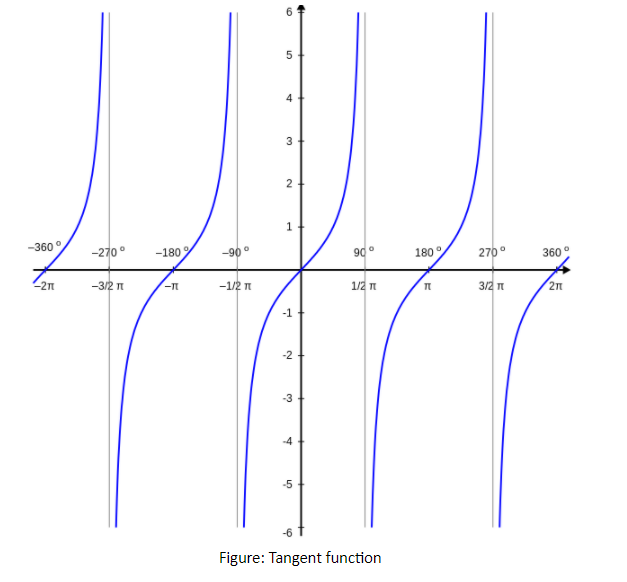
We know that $\tan 1 > 1$
It is known, $\tan 1 = \dfrac{{\sin 1}}{{\cos 1}}$
$ \Rightarrow \dfrac{{\sin 1}}{{\cos 1}} > 1$
$ \Rightarrow \sin 1 > \cos 1$ …… (1)
when smaller number is substracting form larger number, then result is real positive number.
$ \Rightarrow \sin 1 - \cos 1 > 0$ (from (1))
Hence, $\sin 1$is positive (or greater than 0) and $\cos 1$is also positive (or greater than 0).
$ \Rightarrow \sin 1 > 0;{\text{ cos1 > 0}}$
The Sum of two positive numbers is greater than their difference.
$ \Rightarrow \left( {\sin 1 + \cos 1} \right) > \left( {\sin 1 - \cos 1} \right)$ …… (2)
Step 2: Draw graph of the sine function
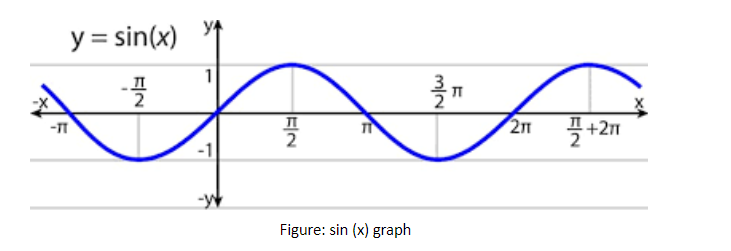
Range of sine function: $\sin x = \left[ { - 1,1} \right]{\text{ }}$
$ \Rightarrow \sin 1 < 1$
$\sqrt {\sin 1} > \sin 1$
Hence, for values less than ‘1’, higher power gives lower values
Example: For $\left( {0 < x < 1} \right)$
$x > \mathop x\nolimits^2 > \mathop x\nolimits^3 > \mathop x\nolimits^4 > \mathop x\nolimits^5 .....$
Similarly, $\sin 1 > {\sin ^2}1$
$
\Rightarrow \sin 1 < \sqrt {\sin 1} \\
\& \;{\text{ }}\cos 1 < \sqrt {\cos 1} \\
$
Thus, $\left( {\sqrt {\sin 1} - \sin 1} \right)$ and $\left( {\sqrt {\cos 1} - \cos 1} \right)$ are real positive number.
Then, $\left( {\sqrt {\sin 1} - \sin 1} \right) + \left( {\sqrt {\cos 1} - \cos 1} \right) > 0$
$ \Rightarrow \left( {\sqrt {\sin 1} + \sqrt {\cos 1} - \sin 1 - \cos 1} \right) > 0$
On transferring number to the other side of the inequality, a sign of the number changes.
$ \Rightarrow - \left( { + \sin 1 + \cos 1} \right) > - \left( {\sqrt {\sin 1} + \sqrt {\cos 1} } \right)$
Multiplying by a minus sign on both sides. The inequality reverses.
$ \Rightarrow \left( {\sin 1 + \cos 1} \right) < \left( {\sqrt {\sin 1} + \sqrt {\cos 1} } \right)$ …… (3)
From (2) and (3)
$\left( {\sin 1 - \cos 1} \right) < \left( {\sin 1 + \cos 1} \right) < \left( {\sqrt {\sin 1} + \sqrt {\cos 1} } \right)$
Final answer: Among $\left( {\sin 1 + \cos 1} \right),\left( {\sqrt {\sin 1} + \sqrt {\cos 1} } \right),\left( {\sin 1 - \cos 1} \right)$; $\left( {\sqrt {\sin 1} + \sqrt {\cos 1} } \right)$is the biggest.
$\therefore $ The correct option is (B).
Note:
The range of a function is defined as the set of all values of the function defined on its domain.
Range and domain of some trigonometric functions are given below:
As angle approaches to zero ( $\theta \to 0$) , tangent of angle approached to infinity ($\tan \theta \to \infty $).
$ \Rightarrow \tan 1$must be a larger value (atleast greater than 1); use this fact to find inequality between $\sin 1{\text{ }}\& {\text{ }}\cos 1$.
The Square of numbers for greater than 0 and less than 1, is smaller than the number.
For example: Square of 0.6
i.e. \[\mathop {\left( {0.6} \right)}\nolimits^2 = 0.36\]
0.36 < 0.6
The range is a set of all output values of function as independent variables varies thoughout the domain.
The domain is a set of all possible values on which function is defined.
For trigonometric function \[y = \sin x\] , independent variable is x.
The domain is the set of all real numbers.
Range of trigonometric function $\sin x = \left[ { - 1,1} \right]{\text{ and }}\cos x = \left[ { - 1,1} \right]$
\[
\Rightarrow \mathop {\left( {\sin x} \right)}\nolimits^2 < \sin x \\
{\text{and }}\mathop {\left( {\cos x} \right)}\nolimits^2 < \cos x \\
\]
Use above mention property to find the inequality between $\sqrt {\sin 1} {\text{ }}\& {\text{ }}\sin 1$.
Complete step by step solution:
Step 1: Drawing a graph of the tangent function.
We know that $\tan 1 > 1$
It is known, $\tan 1 = \dfrac{{\sin 1}}{{\cos 1}}$
$ \Rightarrow \dfrac{{\sin 1}}{{\cos 1}} > 1$
$ \Rightarrow \sin 1 > \cos 1$ …… (1)
when smaller number is substracting form larger number, then result is real positive number.
$ \Rightarrow \sin 1 - \cos 1 > 0$ (from (1))
Hence, $\sin 1$is positive (or greater than 0) and $\cos 1$is also positive (or greater than 0).
$ \Rightarrow \sin 1 > 0;{\text{ cos1 > 0}}$
The Sum of two positive numbers is greater than their difference.
$ \Rightarrow \left( {\sin 1 + \cos 1} \right) > \left( {\sin 1 - \cos 1} \right)$ …… (2)
Step 2: Draw graph of the sine function
Range of sine function: $\sin x = \left[ { - 1,1} \right]{\text{ }}$
$ \Rightarrow \sin 1 < 1$
$\sqrt {\sin 1} > \sin 1$
Hence, for values less than ‘1’, higher power gives lower values
Example: For $\left( {0 < x < 1} \right)$
$x > \mathop x\nolimits^2 > \mathop x\nolimits^3 > \mathop x\nolimits^4 > \mathop x\nolimits^5 .....$
Similarly, $\sin 1 > {\sin ^2}1$
$
\Rightarrow \sin 1 < \sqrt {\sin 1} \\
\& \;{\text{ }}\cos 1 < \sqrt {\cos 1} \\
$
Thus, $\left( {\sqrt {\sin 1} - \sin 1} \right)$ and $\left( {\sqrt {\cos 1} - \cos 1} \right)$ are real positive number.
Then, $\left( {\sqrt {\sin 1} - \sin 1} \right) + \left( {\sqrt {\cos 1} - \cos 1} \right) > 0$
$ \Rightarrow \left( {\sqrt {\sin 1} + \sqrt {\cos 1} - \sin 1 - \cos 1} \right) > 0$
On transferring number to the other side of the inequality, a sign of the number changes.
$ \Rightarrow - \left( { + \sin 1 + \cos 1} \right) > - \left( {\sqrt {\sin 1} + \sqrt {\cos 1} } \right)$
Multiplying by a minus sign on both sides. The inequality reverses.
$ \Rightarrow \left( {\sin 1 + \cos 1} \right) < \left( {\sqrt {\sin 1} + \sqrt {\cos 1} } \right)$ …… (3)
From (2) and (3)
$\left( {\sin 1 - \cos 1} \right) < \left( {\sin 1 + \cos 1} \right) < \left( {\sqrt {\sin 1} + \sqrt {\cos 1} } \right)$
Final answer: Among $\left( {\sin 1 + \cos 1} \right),\left( {\sqrt {\sin 1} + \sqrt {\cos 1} } \right),\left( {\sin 1 - \cos 1} \right)$; $\left( {\sqrt {\sin 1} + \sqrt {\cos 1} } \right)$is the biggest.
$\therefore $ The correct option is (B).
Note:
The range of a function is defined as the set of all values of the function defined on its domain.
Range and domain of some trigonometric functions are given below:
| Trigonometric function | Domain | Range |
| Sine | $\left( { - \infty , + \infty } \right)$ | [-1,1] |
| Cosine | $\left( { - \infty , + \infty } \right)$ | [-1,1] |
| Tangent | All real numbers except $\dfrac{\pi }{2} + n\pi $ | $\left( { - \infty , + \infty } \right)$ |
| Cosecant | All real numbers except $n\pi $ | \[\left( { - \infty , - 1} \right] \cup \left[ {1, + \infty } \right)\] |
| Secant | All real numbers except $\dfrac{\pi }{2} + n\pi $ | \[\left( { - \infty , - 1} \right] \cup \left[ {1, + \infty } \right)\] |
| Cotangent | All real numbers except $n\pi $ | $\left( { - \infty , + \infty } \right)$ |
Recently Updated Pages
Master Class 11 Computer Science: Engaging Questions & Answers for Success

Master Class 11 Business Studies: Engaging Questions & Answers for Success
Master Class 11 Economics: Engaging Questions & Answers for Success
Master Class 11 English: Engaging Questions & Answers for Success
Master Class 11 Maths: Engaging Questions & Answers for Success
Master Class 11 Biology: Engaging Questions & Answers for Success
Trending doubts
One Metric ton is equal to kg A 10000 B 1000 C 100 class 11 physics CBSE
There are 720 permutations of the digits 1 2 3 4 5 class 11 maths CBSE
Discuss the various forms of bacteria class 11 biology CBSE
Draw a diagram of a plant cell and label at least eight class 11 biology CBSE
State the laws of reflection of light
Explain zero factorial class 11 maths CBSE