




The capacity of an RD bottle is $100cc$ and its mass is $45g.$ Find the mass of the bottle when it is filled with a liquid of density $600kg/{m^3}.$
Answer
 Verified
584.1k+ views
Hint: The density of a body or material is given by the ratio of mass of that body or material with volume of body or material. The mass of bottle after adding liquid will increase by the mass of liquid added in it
Complete step by step answer:
Let the mass and volume of the bottle are ${M_b}$and ${V_b}$respectively, then it is given that
\[\left. {M_b} = 45g \\ {V_b} = \ ,100c{m^3} \\\right].........\left( i \right)\]
Now, the bottle is filled with a liquid of density \[600kg/{m^3}.\] The above data [equation] are given in gram(g) and cc\[\left[ {c{m^3}} \right]\], so we convert the density of liquid in gram per centimeter cube $\left[ {g/c{m^3}} \right]$.
As we know,
$1kg\, = \,1000g$and $1metre\, = \,100cm$
So, the density of liquid is given by gram per cc, let the density is denoted by symbol ${\rho _L}$so
$
{\rho _L} = 600kg/{m^3} \\
= 600 \times \dfrac{{1000gram}}{{100cm \times 100cm \times 100cm}} \\
$
$
= \dfrac{6}{{10}}g/c{m^3} \\
{\rho _L} = 0.6g/c{m^3} \\
= 0.6g/cc \\
$
Now the mass of the liquid say ${M_\ell }$is given by ${M_\ell } = {\rho _L}\,{V_L}\,..........\left( {ii} \right)$
Because the bottle is filled full with liquid of same volume,
so, \[{V_L} = {V_b} = 100c{m^3}\left[ {given} \right]\]
From the equation (ii) mass of the liquid, $
{M_\ell } = 0.6 \times 100 \\
{M_\ell } = 60gram \\
$
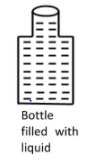
Now, the bottle was already weighing $40g$before filling it with liquid.
So, after filling by the liquid into the bottle now,
Total mass of Bottle $ = $mass of bottle when empty $ + $mass of liquid when filled
$ = 40g + 60g$
$ = 100g.$
Note:
The density of a body is a liquid is given by product of mass and volume of that body or liquid in which the liquid is carried. Let's consider the density of the body and “V” then mass “M” of the body is given by $M = \rho \times V$.The mass of liquid will be the volume of bottle × density of liquid because the volume occupied by liquid in a bottle is the volume of bottle.
Complete step by step answer:
Let the mass and volume of the bottle are ${M_b}$and ${V_b}$respectively, then it is given that
\[\left. {M_b} = 45g \\ {V_b} = \ ,100c{m^3} \\\right].........\left( i \right)\]
Now, the bottle is filled with a liquid of density \[600kg/{m^3}.\] The above data [equation] are given in gram(g) and cc\[\left[ {c{m^3}} \right]\], so we convert the density of liquid in gram per centimeter cube $\left[ {g/c{m^3}} \right]$.
As we know,
$1kg\, = \,1000g$and $1metre\, = \,100cm$
So, the density of liquid is given by gram per cc, let the density is denoted by symbol ${\rho _L}$so
$
{\rho _L} = 600kg/{m^3} \\
= 600 \times \dfrac{{1000gram}}{{100cm \times 100cm \times 100cm}} \\
$
$
= \dfrac{6}{{10}}g/c{m^3} \\
{\rho _L} = 0.6g/c{m^3} \\
= 0.6g/cc \\
$
Now the mass of the liquid say ${M_\ell }$is given by ${M_\ell } = {\rho _L}\,{V_L}\,..........\left( {ii} \right)$
Because the bottle is filled full with liquid of same volume,
so, \[{V_L} = {V_b} = 100c{m^3}\left[ {given} \right]\]
From the equation (ii) mass of the liquid, $
{M_\ell } = 0.6 \times 100 \\
{M_\ell } = 60gram \\
$
Now, the bottle was already weighing $40g$before filling it with liquid.
So, after filling by the liquid into the bottle now,
Total mass of Bottle $ = $mass of bottle when empty $ + $mass of liquid when filled
$ = 40g + 60g$
$ = 100g.$
Note:
The density of a body is a liquid is given by product of mass and volume of that body or liquid in which the liquid is carried. Let's consider the density of the body and “V” then mass “M” of the body is given by $M = \rho \times V$.The mass of liquid will be the volume of bottle × density of liquid because the volume occupied by liquid in a bottle is the volume of bottle.
Recently Updated Pages
Master Class 11 Computer Science: Engaging Questions & Answers for Success

Master Class 11 Business Studies: Engaging Questions & Answers for Success
Master Class 11 Economics: Engaging Questions & Answers for Success
Master Class 11 English: Engaging Questions & Answers for Success
Master Class 11 Maths: Engaging Questions & Answers for Success
Master Class 11 Biology: Engaging Questions & Answers for Success
Trending doubts
There are 720 permutations of the digits 1 2 3 4 5 class 11 maths CBSE
Discuss the various forms of bacteria class 11 biology CBSE
Draw a diagram of a plant cell and label at least eight class 11 biology CBSE
Explain zero factorial class 11 maths CBSE
What organs are located on the left side of your body class 11 biology CBSE
Draw a diagram of nephron and explain its structur class 11 biology CBSE