



The cost of papering the walls of a room 15m long at the rate of Rs. 0.95 per${m^2}$ is Rs. 212.80 and the cost of matting the floor at the rate of Rs. 0.50 per ${m^2}$ is Rs. 97.50. Find the height of the room.
A. 12 m
B. 8 m
C. 6 m
D. 4 m
Answer
 Verified
578.4k+ views
Hint: We will begin by finding curved surface area by dividing the total cost of papering by the rate of papering ${m^2}$. Similarly, find the area of the floor and then find the breadth of the room. Substitute the values of length and breadth in the formula of curved surface area to find the height of the room.
Complete step-by-step answer:
When the walls are papered, then the area covered is curved surface area.
Here, the cost of papering walls is Rs. 212.80 at the rate of Rs. 0.95 per${m^2}$.
To find the curved surface area of the wall, we will divide the total cost of papering by the rate of papering ${m^2}$.
$\dfrac{{212.80}}{{0.95}} = 224$
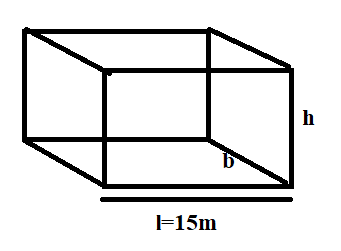
The curved surface area of a cuboid is given by $2\left( {l + b} \right)h$, where $l$ is the length of the room, $b$ is the breadth of the room and $h$ is the breadth of the space.
Then, $2\left( {l + b} \right)h = 224$ eqn. (1)
We are also given that the cost of matting the floor at the rate of Rs. 0.50 per ${m^2}$ is Rs. 97.50
We can calculate the area of the floor by dividing the total cost of matting by the rate of matting per ${m^2}$
$\dfrac{{97.50}}{{0.50}} = 195$
Area of the floor is given by $lb$, where $l$ is the length of the room, $b$ is the breadth of the room.
Therefore, $lb = 195$
The length of the room is given as 15 m
$
\Rightarrow \left( {15} \right)b = 195 \\
\Rightarrow b = 13 \\
$
Hence, length of room in 15 m and breadth is 13 m
On substituting the values in equation (1), we will get,
$
\Rightarrow 2\left( {15 + 13} \right)h = 224 \\
\Rightarrow 2\left( {28} \right)h = 224 \\
\Rightarrow 56h = 224 \\
$
Divide both sides by 56
$\Rightarrow$ $h = 4$
Therefore, the height of the room is 4 m.
Hence, option D is correct.
Note: The area of the wall that is papered is the sum of all four walls and hence, we have taken it equal to the curved surface area. Whereas the total surface of cuboid includes all the faces of a cuboid. One should know the difference between curved surface area and total surface area to do this question correctly.
Complete step-by-step answer:
When the walls are papered, then the area covered is curved surface area.
Here, the cost of papering walls is Rs. 212.80 at the rate of Rs. 0.95 per${m^2}$.
To find the curved surface area of the wall, we will divide the total cost of papering by the rate of papering ${m^2}$.
$\dfrac{{212.80}}{{0.95}} = 224$
The curved surface area of a cuboid is given by $2\left( {l + b} \right)h$, where $l$ is the length of the room, $b$ is the breadth of the room and $h$ is the breadth of the space.
Then, $2\left( {l + b} \right)h = 224$ eqn. (1)
We are also given that the cost of matting the floor at the rate of Rs. 0.50 per ${m^2}$ is Rs. 97.50
We can calculate the area of the floor by dividing the total cost of matting by the rate of matting per ${m^2}$
$\dfrac{{97.50}}{{0.50}} = 195$
Area of the floor is given by $lb$, where $l$ is the length of the room, $b$ is the breadth of the room.
Therefore, $lb = 195$
The length of the room is given as 15 m
$
\Rightarrow \left( {15} \right)b = 195 \\
\Rightarrow b = 13 \\
$
Hence, length of room in 15 m and breadth is 13 m
On substituting the values in equation (1), we will get,
$
\Rightarrow 2\left( {15 + 13} \right)h = 224 \\
\Rightarrow 2\left( {28} \right)h = 224 \\
\Rightarrow 56h = 224 \\
$
Divide both sides by 56
$\Rightarrow$ $h = 4$
Therefore, the height of the room is 4 m.
Hence, option D is correct.
Note: The area of the wall that is papered is the sum of all four walls and hence, we have taken it equal to the curved surface area. Whereas the total surface of cuboid includes all the faces of a cuboid. One should know the difference between curved surface area and total surface area to do this question correctly.

Recently Updated Pages
Master Class 8 Social Science: Engaging Questions & Answers for Success

Master Class 8 English: Engaging Questions & Answers for Success
Class 8 Question and Answer - Your Ultimate Solutions Guide
Master Class 8 Maths: Engaging Questions & Answers for Success
Master Class 8 Science: Engaging Questions & Answers for Success
Master Class 9 General Knowledge: Engaging Questions & Answers for Success
Trending doubts
What is BLO What is the full form of BLO class 8 social science CBSE
Citizens of India can vote at the age of A 18 years class 8 social science CBSE
Full form of STD, ISD and PCO
Advantages and disadvantages of science
Right to vote is a AFundamental Right BFundamental class 8 social science CBSE
What are the 12 elements of nature class 8 chemistry CBSE