




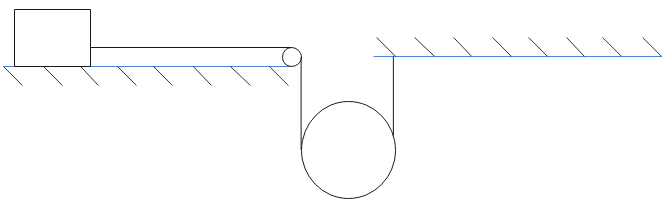
The descending pulley shown in figure has a radius 20 cm and moment of inertia $0.20kg - {m^2}$. The fixed pulley is light and the horizontal plane frictionless. Find the acceleration of the block if its mass is 1.0 kg.
Answer
 Verified
569.1k+ views
Hint: The block is connected to one string. The pulley is connected to two strings. The pulley is having some weight. So it will have both linear acceleration and angular acceleration. The tensions in both strings connecting two pulleys will be different and we will find out using the torque equation.
Formula used:
$\tau = I\alpha $
Complete answer:
Since t5wo strings are connected to pulley and only one string is connected to the block, their acceleration will be different but interdependent.
If pulley moves ‘x’ distance down, then the block moves ‘2x’ distance right. So if acceleration of the block is ‘a’ then acceleration of the pulley will be ‘a/2’. If we refer the diagram below we have
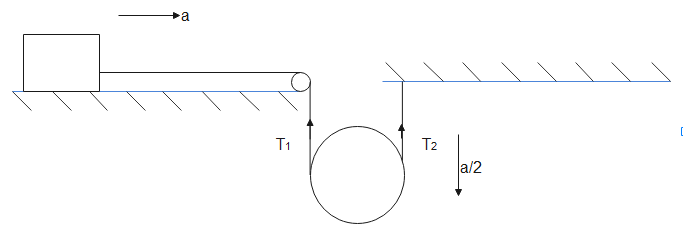
Tension of string connecting block is ${T_1}$. Let the mass of the block is ‘m’ and pulley is ‘M’. For block we have
$\eqalign{
& {T_1} = ma \cr
& \Rightarrow {T_1} = \left( 1 \right)a \cr
& \therefore {T_1} = a \cr} $
Acceleration of pulley be ${a_p}$ which is equal to a/2.
We have
$\eqalign{
& {a_p} = r\alpha \cr
& \tau = I\alpha \cr} $
Where $\alpha $ is the angular acceleration of pulley and ‘I’ is moment of inertia of pulley and ‘r’ is the radius of pulley and $\tau $ is the torque acting on pulley.
$\eqalign{
& \tau = \left( {{T_2} - {T_1}} \right)r \cr
& \Rightarrow r = 20cm = 0.2m \cr
& \Rightarrow \left( {{T_2} - {T_1}} \right)r = I\alpha \cr
& \Rightarrow \left( {{T_2} - {T_1}} \right)\left( {0.2} \right) = \left( {0.2} \right)\alpha \cr
& \Rightarrow \left( {{T_2} - {T_1}} \right) = \alpha \cr
& \Rightarrow {a_p} = r\alpha \cr
& \Rightarrow {a_p} = 0.2\alpha \cr
& \Rightarrow \dfrac{a}{2} = 0.2\alpha \cr
& \Rightarrow \alpha = 2.5a \cr
& \therefore \left( {{T_1} - {T_2}} \right) = - 2.5a \cr} $
We have got angular acceleration in terms of ‘a’ and difference in tensions in terms of ‘a’. Now we will apply Newton's second law for the pulley.
$\eqalign{
& I = \dfrac{{M{r^2}}}{2} \cr
& \Rightarrow M = \dfrac{{2 \times 0.2}}{{{{\left( {0.2} \right)}^2}}} \cr
& \Rightarrow M = 10kg \cr
& \Rightarrow Mg - \left( {{T_1} + {T_2}} \right) = M{a_p} = M\dfrac{a}{2} \cr
& \Rightarrow {T_1} - {T_2} = - 2.5a \cr
& \Rightarrow {T_1} = a \cr
& \Rightarrow 9.5a = Mg \cr
& \therefore a = \dfrac{{10 \times 9.8}}{{9.5}} = 10.315m/{s^2} \cr} $
Hence acceleration of pulley will be 10.315 meter per second square.
Note:
If pulley is massless, then the moment of inertia of pulley will be zero. When it is zero then the difference in two tensions of strings will be zero and that means tension will be the same in two strings connecting the pulley. If pulley is having friction then the case would be different and methodology would be different.
Formula used:
$\tau = I\alpha $
Complete answer:
Since t5wo strings are connected to pulley and only one string is connected to the block, their acceleration will be different but interdependent.
If pulley moves ‘x’ distance down, then the block moves ‘2x’ distance right. So if acceleration of the block is ‘a’ then acceleration of the pulley will be ‘a/2’. If we refer the diagram below we have
Tension of string connecting block is ${T_1}$. Let the mass of the block is ‘m’ and pulley is ‘M’. For block we have
$\eqalign{
& {T_1} = ma \cr
& \Rightarrow {T_1} = \left( 1 \right)a \cr
& \therefore {T_1} = a \cr} $
Acceleration of pulley be ${a_p}$ which is equal to a/2.
We have
$\eqalign{
& {a_p} = r\alpha \cr
& \tau = I\alpha \cr} $
Where $\alpha $ is the angular acceleration of pulley and ‘I’ is moment of inertia of pulley and ‘r’ is the radius of pulley and $\tau $ is the torque acting on pulley.
$\eqalign{
& \tau = \left( {{T_2} - {T_1}} \right)r \cr
& \Rightarrow r = 20cm = 0.2m \cr
& \Rightarrow \left( {{T_2} - {T_1}} \right)r = I\alpha \cr
& \Rightarrow \left( {{T_2} - {T_1}} \right)\left( {0.2} \right) = \left( {0.2} \right)\alpha \cr
& \Rightarrow \left( {{T_2} - {T_1}} \right) = \alpha \cr
& \Rightarrow {a_p} = r\alpha \cr
& \Rightarrow {a_p} = 0.2\alpha \cr
& \Rightarrow \dfrac{a}{2} = 0.2\alpha \cr
& \Rightarrow \alpha = 2.5a \cr
& \therefore \left( {{T_1} - {T_2}} \right) = - 2.5a \cr} $
We have got angular acceleration in terms of ‘a’ and difference in tensions in terms of ‘a’. Now we will apply Newton's second law for the pulley.
$\eqalign{
& I = \dfrac{{M{r^2}}}{2} \cr
& \Rightarrow M = \dfrac{{2 \times 0.2}}{{{{\left( {0.2} \right)}^2}}} \cr
& \Rightarrow M = 10kg \cr
& \Rightarrow Mg - \left( {{T_1} + {T_2}} \right) = M{a_p} = M\dfrac{a}{2} \cr
& \Rightarrow {T_1} - {T_2} = - 2.5a \cr
& \Rightarrow {T_1} = a \cr
& \Rightarrow 9.5a = Mg \cr
& \therefore a = \dfrac{{10 \times 9.8}}{{9.5}} = 10.315m/{s^2} \cr} $
Hence acceleration of pulley will be 10.315 meter per second square.
Note:
If pulley is massless, then the moment of inertia of pulley will be zero. When it is zero then the difference in two tensions of strings will be zero and that means tension will be the same in two strings connecting the pulley. If pulley is having friction then the case would be different and methodology would be different.
Recently Updated Pages
Master Class 11 Computer Science: Engaging Questions & Answers for Success

Master Class 11 Business Studies: Engaging Questions & Answers for Success
Master Class 11 Economics: Engaging Questions & Answers for Success
Master Class 11 English: Engaging Questions & Answers for Success
Master Class 11 Maths: Engaging Questions & Answers for Success
Master Class 11 Biology: Engaging Questions & Answers for Success
Trending doubts
One Metric ton is equal to kg A 10000 B 1000 C 100 class 11 physics CBSE
There are 720 permutations of the digits 1 2 3 4 5 class 11 maths CBSE
Discuss the various forms of bacteria class 11 biology CBSE
Draw a diagram of a plant cell and label at least eight class 11 biology CBSE
State the laws of reflection of light
Explain zero factorial class 11 maths CBSE