




The d-orbital involved in \[s{p^3}d\] hybridization is:
A. \[{d_{{x^2} - {y^2}}}\]
B. \[{d_{xy}}\]
C. \[{d_{{z^2}}}\]
D. \[{d_{zz}}\]
Answer
 Verified
582k+ views
Hint: To determine the hybridization of any compound, we must know the structure of that compound. Hybridization is defined as a concept of mixing two atomic orbitals having the same energy levels to give new degenerate orbitals.
Complete step by step answer:
The formula to calculate the hybridization of the central atom of the molecule is, \[H = \dfrac{1}{2}\left[ {V + X - C + A} \right]\] . where V is the number of valence electrons of the central atom, X is the number of monovalent atoms attached to the central atom, C is the total cationic charge and A is the total anionic charge, H is the hybridization.
For, \[s{p^3}d\] hybridization, the hybridization number (H) should be 5. These five orbitals are degenerate, that is their energies are the same but configurations are different.
In this \[s{p^3}d\] hybridization there are a total of 5 orbitals which are, s, \[{P_x}\] , \[{P_y}\] , and \[{P_z}\] . In the case of d subshell, the \[{d_{{z^2}}}\] orbital takes part in this hybridization.
So, the correct answer is C.
Additional information:
For, \[\;S{F_4}\] the hybridization is,
\[
H = \dfrac{1}{2}\left[ {V + X - C + A} \right] \\
\Rightarrow H = \dfrac{1}{2}\left[ {6 + 4 - 0 + 0} \right] \\
\Rightarrow H = \dfrac{1}{2}\left[ {10} \right] \\
\Rightarrow H = 5 \\
\]
For \[H = 5\] , the hybridization would be \[s{p^3}d\] , so the geometry of \[\;S{F_4}\] is Trigonal bipyramidal. In this case, the central atom chlorine has 4 bond pairs and 1 lone pair, therefore, the shape is a see-saw. Due to this shape, it has a permanent dipole moment. The structure is shown below,
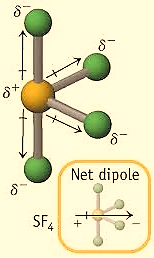
Remember that when a lone pair is present, then the molecular geometry will be the three-dimensional arrangement of the atoms without the lone pair. If there is no lone pair only bond pairs then the number of bond pairs can be equal to the hybridization number.
Note:In the case of \[s{p^3}{d^2}\] hybridization there are a total of 6 orbitals which are, s, \[{P_x}\] , \[{P_y}\] , and \[{P_z}\] . In the case of d subshell, the \[{d_{{z^2}}}\] and \[{d_{{x^2} - {y^2}}}\] orbitals take part in this hybridization. In the case of \[s{p^3}{d^3}\] hybridization there is a total of 7 orbitals which are, s, \[{P_x}\] , \[{P_y}\] , and \[{P_z}\] . In the case of d subshell, the \[{d_{{z^2}}}\] , \[{d_{xy}}\] and \[{d_{{x^2} - {y^2}}}\] orbitals take part in this hybridization.
Complete step by step answer:
The formula to calculate the hybridization of the central atom of the molecule is, \[H = \dfrac{1}{2}\left[ {V + X - C + A} \right]\] . where V is the number of valence electrons of the central atom, X is the number of monovalent atoms attached to the central atom, C is the total cationic charge and A is the total anionic charge, H is the hybridization.
| Hybridization number(H) | Hybridization | geometry |
| 2 | Sp | linear |
| 3 | \[s{p^2}\] | Trigonal planar |
| 4 | \[s{p^3}\] | tetrahedral |
| 5 | \[s{p^3}d\] | Trigonal bipyramidal |
| 6 | \[s{p^3}{d^2}\] | octahedral |
| 7 | \[s{p^3}{d^3}\] | Pentagonal bipyramidal |
For, \[s{p^3}d\] hybridization, the hybridization number (H) should be 5. These five orbitals are degenerate, that is their energies are the same but configurations are different.
In this \[s{p^3}d\] hybridization there are a total of 5 orbitals which are, s, \[{P_x}\] , \[{P_y}\] , and \[{P_z}\] . In the case of d subshell, the \[{d_{{z^2}}}\] orbital takes part in this hybridization.
So, the correct answer is C.
Additional information:
For, \[\;S{F_4}\] the hybridization is,
\[
H = \dfrac{1}{2}\left[ {V + X - C + A} \right] \\
\Rightarrow H = \dfrac{1}{2}\left[ {6 + 4 - 0 + 0} \right] \\
\Rightarrow H = \dfrac{1}{2}\left[ {10} \right] \\
\Rightarrow H = 5 \\
\]
For \[H = 5\] , the hybridization would be \[s{p^3}d\] , so the geometry of \[\;S{F_4}\] is Trigonal bipyramidal. In this case, the central atom chlorine has 4 bond pairs and 1 lone pair, therefore, the shape is a see-saw. Due to this shape, it has a permanent dipole moment. The structure is shown below,
Remember that when a lone pair is present, then the molecular geometry will be the three-dimensional arrangement of the atoms without the lone pair. If there is no lone pair only bond pairs then the number of bond pairs can be equal to the hybridization number.
Note:In the case of \[s{p^3}{d^2}\] hybridization there are a total of 6 orbitals which are, s, \[{P_x}\] , \[{P_y}\] , and \[{P_z}\] . In the case of d subshell, the \[{d_{{z^2}}}\] and \[{d_{{x^2} - {y^2}}}\] orbitals take part in this hybridization. In the case of \[s{p^3}{d^3}\] hybridization there is a total of 7 orbitals which are, s, \[{P_x}\] , \[{P_y}\] , and \[{P_z}\] . In the case of d subshell, the \[{d_{{z^2}}}\] , \[{d_{xy}}\] and \[{d_{{x^2} - {y^2}}}\] orbitals take part in this hybridization.
Recently Updated Pages
Master Class 11 Computer Science: Engaging Questions & Answers for Success

Master Class 11 Business Studies: Engaging Questions & Answers for Success
Master Class 11 Economics: Engaging Questions & Answers for Success
Master Class 11 English: Engaging Questions & Answers for Success
Master Class 11 Maths: Engaging Questions & Answers for Success
Master Class 11 Biology: Engaging Questions & Answers for Success
Trending doubts
One Metric ton is equal to kg A 10000 B 1000 C 100 class 11 physics CBSE
There are 720 permutations of the digits 1 2 3 4 5 class 11 maths CBSE
Discuss the various forms of bacteria class 11 biology CBSE
Draw a diagram of a plant cell and label at least eight class 11 biology CBSE
State the laws of reflection of light
Explain zero factorial class 11 maths CBSE