




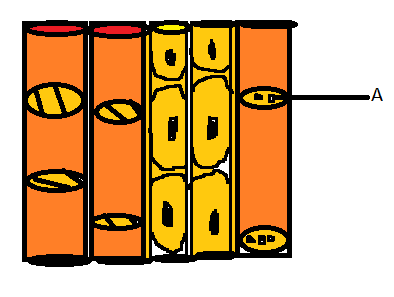
The figure of the longitudinal section of a plant tissue is given below. Name the part labelled as 'A' and mention its function. Name the other components of this tissue.
Answer
 Verified
552.3k+ views
Hint: Longitudinal section can be defined as a long axis along with a section of plant structure. It represents Xylem and phloem. These are the vascular tissue responsible for conduction of water and minerals in the plants.
Complete answer:
The part labelled as 'A' in the figure is called a sieve plate. It contains sieve elements that run throughout the stem of plant Sieve tube is present in the higher plants. It connects sieve elements in the phloem of the plants. The sieve tube elements are the elongated living cells and do not have nuclei. The transverse walls have pores which look like sieves. They are responsible for conducting food. These are the major conducting cells of the phloem.
Phloem acts as a living tissue in plants that helps in the process of photosynthesis and transport food and nutrients to the whole plant. The other components that are visible in this picture are: Companion cells, phloem fibre, phloem parenchyma and sieve tube. The companion cells regulate the activity of the sieve tube cells. They also have structural function in plants.
Note: The Phloem is located outside the xylem. They are living at maturity. They transport food in the form of carbohydrates and amino acids. It is a complex permanent tissue and conducts food from leaves to different parts of the plant.
Complete answer:
The part labelled as 'A' in the figure is called a sieve plate. It contains sieve elements that run throughout the stem of plant Sieve tube is present in the higher plants. It connects sieve elements in the phloem of the plants. The sieve tube elements are the elongated living cells and do not have nuclei. The transverse walls have pores which look like sieves. They are responsible for conducting food. These are the major conducting cells of the phloem.
Phloem acts as a living tissue in plants that helps in the process of photosynthesis and transport food and nutrients to the whole plant. The other components that are visible in this picture are: Companion cells, phloem fibre, phloem parenchyma and sieve tube. The companion cells regulate the activity of the sieve tube cells. They also have structural function in plants.
Note: The Phloem is located outside the xylem. They are living at maturity. They transport food in the form of carbohydrates and amino acids. It is a complex permanent tissue and conducts food from leaves to different parts of the plant.
Recently Updated Pages
Master Class 11 Computer Science: Engaging Questions & Answers for Success

Master Class 11 Business Studies: Engaging Questions & Answers for Success
Master Class 11 Economics: Engaging Questions & Answers for Success
Master Class 11 English: Engaging Questions & Answers for Success
Master Class 11 Maths: Engaging Questions & Answers for Success
Master Class 11 Biology: Engaging Questions & Answers for Success
Trending doubts
One Metric ton is equal to kg A 10000 B 1000 C 100 class 11 physics CBSE
There are 720 permutations of the digits 1 2 3 4 5 class 11 maths CBSE
Discuss the various forms of bacteria class 11 biology CBSE
Draw a diagram of a plant cell and label at least eight class 11 biology CBSE
State the laws of reflection of light
10 examples of friction in our daily life