




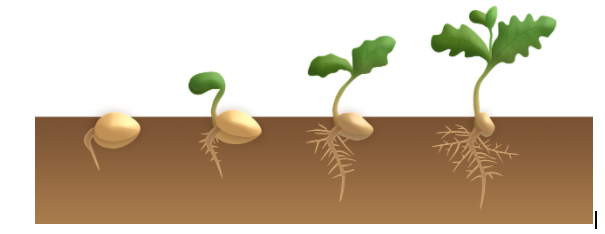
The given diagram shows different stages of seed germination. Identify A, B, C and D and select the correct option.
A. A-Plumule, B-Cotyledons,C-Epicotyl,D-Hypocotyls
B. A-Radicle, B-Cotyledons, C-Epicotyl, D- Hypocotyls
C. A- Mesocotyl, B- Cotyledon, C-Epicotyl, D- Hypocotyls
D. A-Root hair, B- Cotyledons, C-Hypocotyl, D-Epicotyl
Answer
 Verified
575.7k+ views
Hint: Seed germination is the process of germination of plants from seed. Seed germination takes place mainly in five steps. Firstly seed develops into radicle to absorb nutrition from the soil. Radicle develops into root while plumule develops into stem. Cotyledons appear as first leaves from germinating seed formed during embryogenesis, along with root and shoot meristem. Epicotyl present at the upper part of cotyledon while hypocotyls present at the lower end.
Complete answer:
Embryonic plants present inside the seed which results in the germination of seed. Seeds germinate when they get a proper environment like temperature, water and nutrition.
Development of seed starts from the radicle which develops into the primary root. It allows the seeding to absorb nutrients from soil. After water absorption by the process of imbibitions seedling starts growing.
Development of shoot occurs above the ground. Shoot develops into three main parts that are cotyledons (seed leaves), the section of shoot below the cotyledons known as hypocotyls and the section of shoot above the ground is known as epicotyls. This type of development occurs in dicot seeds.
Cotyledons absorb nutrition from the parent plant & store it in embryos. It also plays an important role in the protection of embryos.
Epicotyls develop into shoots and leaves while hypocotyls connect cotyledons and radicals.
As shown in the diagram: A shows radicle, B shows cotyledons, C shows, Epicotyl and D shows, Hypocotyl.
Hence, the correct answer is option (B).
Note: Germination does not occur in all types of seed. Suitable conditions needed for the development of seed into new plants, when the seedling grows green leaves, making of food starts in it. Cotyledons dry up and seedlings develop into new plants. Development of shoots begins and grows leaves by photomorphogenesis.
Complete answer:
Embryonic plants present inside the seed which results in the germination of seed. Seeds germinate when they get a proper environment like temperature, water and nutrition.
Development of seed starts from the radicle which develops into the primary root. It allows the seeding to absorb nutrients from soil. After water absorption by the process of imbibitions seedling starts growing.
Development of shoot occurs above the ground. Shoot develops into three main parts that are cotyledons (seed leaves), the section of shoot below the cotyledons known as hypocotyls and the section of shoot above the ground is known as epicotyls. This type of development occurs in dicot seeds.
Cotyledons absorb nutrition from the parent plant & store it in embryos. It also plays an important role in the protection of embryos.
Epicotyls develop into shoots and leaves while hypocotyls connect cotyledons and radicals.
As shown in the diagram: A shows radicle, B shows cotyledons, C shows, Epicotyl and D shows, Hypocotyl.
Hence, the correct answer is option (B).
Note: Germination does not occur in all types of seed. Suitable conditions needed for the development of seed into new plants, when the seedling grows green leaves, making of food starts in it. Cotyledons dry up and seedlings develop into new plants. Development of shoots begins and grows leaves by photomorphogenesis.
Recently Updated Pages
Master Class 11 Computer Science: Engaging Questions & Answers for Success

Master Class 11 Business Studies: Engaging Questions & Answers for Success
Master Class 11 Economics: Engaging Questions & Answers for Success
Master Class 11 English: Engaging Questions & Answers for Success
Master Class 11 Maths: Engaging Questions & Answers for Success
Master Class 11 Biology: Engaging Questions & Answers for Success
Trending doubts
One Metric ton is equal to kg A 10000 B 1000 C 100 class 11 physics CBSE
There are 720 permutations of the digits 1 2 3 4 5 class 11 maths CBSE
Discuss the various forms of bacteria class 11 biology CBSE
Draw a diagram of a plant cell and label at least eight class 11 biology CBSE
State the laws of reflection of light
Explain zero factorial class 11 maths CBSE