




The given figure is a schematic break–up of the phases/stages of the cell cycle. Select the correct option regarding it.
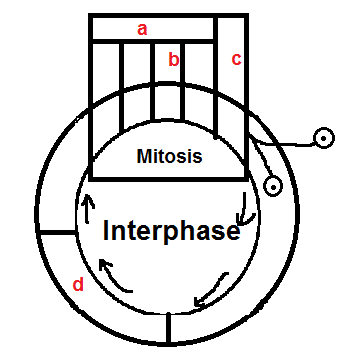
А. ‘a’ represents karyokinesis which is the division of cytoplasm.
B. ‘b’ is telophase which is just reverse of prophase.
С. ‘c’ is the best phase to count the total number of chromosomes in any species.
D. In ‘d’ stage replication of DNA takes place on the template of the existing DNA.
Answer
 Verified
585.9k+ views
Hint: In a cell cycle, there are two major phase- Interphase and Mitosis phases. Interphase takes most of the time in cell division and has three phases G1, S, and G2 phases.
Complete answer:
The schematic representation represents a cell cycle which is a process having ordered sequences of occurrences that a cell goes through so as to prepare for cell division.The cell cycle has 4 stages: G1, S, G2, and mitosis.
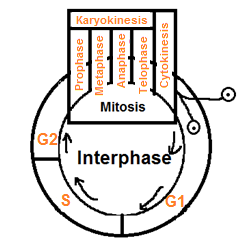
-In option A, it is mentioned that ‘a’ is karyokinesis which is the division of cytoplasm which is true. Karyokinesis also is known as mitosis is the combined name given to the 4 basic stages: prophase, metaphase, anaphase, and telophase which result in cytoplasm differentiation and 2 nucleus formation.
-In option B, it is mentioned that ‘b’ is telophase which is incorrect. Anaphase is the third stage of cell division in which the chromosomes are aligned in the middle cell.
-In option C, it is mentioned that ‘c’ is the best phase to count chromosomes. In the diagram, ‘c’ represents cytokinesis. This is the phase in which the cell divides into two finally. But, the phase to best count the chromosomes, is metaphase. So the option is incorrect.
In option D, it is mentioned that in ‘d’ stage replication of DNA occurs on a template of the existing DNA which is incorrect. It represents the S phase of the cell cycle. In this phase DNA duplication occurs.
Hence option A is correct.
Note: In the G1 phase, also known as the first gap phase, the cells grow physically larger. The duplication of organelles and the creation of the molecular building blocks required in further steps also form. In the S phase, the cell synthesizes a new copy of the DNA in its nucleus. It also duplicates a microtubule-organizing structure known as the centrosome. The centrosomes are required in separating DNA during the M phase. During the second gap phase, G2, the cell grows more, makes proteins and organelles, and initiates to reorganize its composition in preparation for mitosis. Now we know that the final step is the M phase or mitosis, in which cytoplasm division occurs and then two new cells are obtained.
Complete answer:
The schematic representation represents a cell cycle which is a process having ordered sequences of occurrences that a cell goes through so as to prepare for cell division.The cell cycle has 4 stages: G1, S, G2, and mitosis.
-In option A, it is mentioned that ‘a’ is karyokinesis which is the division of cytoplasm which is true. Karyokinesis also is known as mitosis is the combined name given to the 4 basic stages: prophase, metaphase, anaphase, and telophase which result in cytoplasm differentiation and 2 nucleus formation.
-In option B, it is mentioned that ‘b’ is telophase which is incorrect. Anaphase is the third stage of cell division in which the chromosomes are aligned in the middle cell.
-In option C, it is mentioned that ‘c’ is the best phase to count chromosomes. In the diagram, ‘c’ represents cytokinesis. This is the phase in which the cell divides into two finally. But, the phase to best count the chromosomes, is metaphase. So the option is incorrect.
In option D, it is mentioned that in ‘d’ stage replication of DNA occurs on a template of the existing DNA which is incorrect. It represents the S phase of the cell cycle. In this phase DNA duplication occurs.
Hence option A is correct.
Note: In the G1 phase, also known as the first gap phase, the cells grow physically larger. The duplication of organelles and the creation of the molecular building blocks required in further steps also form. In the S phase, the cell synthesizes a new copy of the DNA in its nucleus. It also duplicates a microtubule-organizing structure known as the centrosome. The centrosomes are required in separating DNA during the M phase. During the second gap phase, G2, the cell grows more, makes proteins and organelles, and initiates to reorganize its composition in preparation for mitosis. Now we know that the final step is the M phase or mitosis, in which cytoplasm division occurs and then two new cells are obtained.
Recently Updated Pages
Master Class 11 Computer Science: Engaging Questions & Answers for Success

Master Class 11 Business Studies: Engaging Questions & Answers for Success
Master Class 11 Economics: Engaging Questions & Answers for Success
Master Class 11 English: Engaging Questions & Answers for Success
Master Class 11 Maths: Engaging Questions & Answers for Success
Master Class 11 Biology: Engaging Questions & Answers for Success
Trending doubts
One Metric ton is equal to kg A 10000 B 1000 C 100 class 11 physics CBSE
There are 720 permutations of the digits 1 2 3 4 5 class 11 maths CBSE
Discuss the various forms of bacteria class 11 biology CBSE
Draw a diagram of a plant cell and label at least eight class 11 biology CBSE
State the laws of reflection of light
Explain zero factorial class 11 maths CBSE