




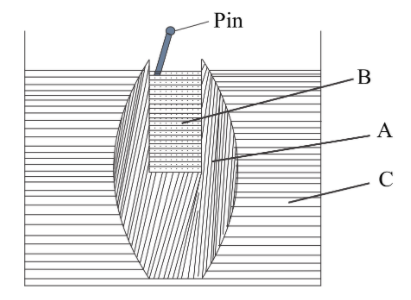
The given figure shows a set up potato osmoscope experiment. Select the option that correctly identifies the labels A, B and C.
A. A-Peeled potato, B-Water, C- Sugar solution
B. A-Peeled potato, B-Sugar solution, C- Water
C. A-Unpeeled potato, B-Sugar Solution, C-Water
D. A-Unpeeled potato, B-Water, C- Sugar solution
Answer
 Verified
586.2k+ views
Hint: Solutions are made of different concentrations. Their net movement depends on the concentration of the solutes. The equilibrium is tried to be maintained by diffusing the solutes so that there is no net movement of them at last. The isotonic solution is preferred over hypotonic and hypertonic.
Complete answer:
Omoscope experiment: The experiment performed on the potato to know the osmosis is the osmoscope process. Osmosis is the diffusion through a semipermeable membrane when the water molecules move from lower concentration to higher concentration in a solution. So it is a special diffusion in liquids.
There are solutions with different concentrations of solute and solvent- when the high solute concentrated solution is separated from the low concentrated solute solution. Then the A is hypertonic and B is hypotonic. Here the net movement will be from the hypotonic to the hypertonic solution. They will then reach an equilibrium stage where there is no net movement and the solutions will be isotonic then.
In the osmoscope experiment, the potato is peeled, one side is flattened to serve as a base. A cavity is made in the potato. It is filled with a sugar solution. A mark is made to indicate the initial level. This setup is placed in the water for the results.
Observation- we observe that the sugar solution becomes coloured and it rises that means the water solution has diffused inside.
So we can see that in the figure,
A - peeled potato
B - Sugar solution and
C - water
Hence, the correct answer is option (B).
Note: Plasmolysis is a condition when the cell is placed in the hypertonic solution, exosmosis initiates. This will take out the water from the sap to the external solution. This will cause reduction in tension in the cell thus the protoplasm will shrink due to water loss. Its turgidity will reduce. Cell becomes rounded in shape now.
Complete answer:
Omoscope experiment: The experiment performed on the potato to know the osmosis is the osmoscope process. Osmosis is the diffusion through a semipermeable membrane when the water molecules move from lower concentration to higher concentration in a solution. So it is a special diffusion in liquids.
There are solutions with different concentrations of solute and solvent- when the high solute concentrated solution is separated from the low concentrated solute solution. Then the A is hypertonic and B is hypotonic. Here the net movement will be from the hypotonic to the hypertonic solution. They will then reach an equilibrium stage where there is no net movement and the solutions will be isotonic then.
In the osmoscope experiment, the potato is peeled, one side is flattened to serve as a base. A cavity is made in the potato. It is filled with a sugar solution. A mark is made to indicate the initial level. This setup is placed in the water for the results.
Observation- we observe that the sugar solution becomes coloured and it rises that means the water solution has diffused inside.
So we can see that in the figure,
A - peeled potato
B - Sugar solution and
C - water
Hence, the correct answer is option (B).
Note: Plasmolysis is a condition when the cell is placed in the hypertonic solution, exosmosis initiates. This will take out the water from the sap to the external solution. This will cause reduction in tension in the cell thus the protoplasm will shrink due to water loss. Its turgidity will reduce. Cell becomes rounded in shape now.
Recently Updated Pages
Master Class 11 Computer Science: Engaging Questions & Answers for Success

Master Class 11 Business Studies: Engaging Questions & Answers for Success
Master Class 11 Economics: Engaging Questions & Answers for Success
Master Class 11 English: Engaging Questions & Answers for Success
Master Class 11 Maths: Engaging Questions & Answers for Success
Master Class 11 Biology: Engaging Questions & Answers for Success
Trending doubts
One Metric ton is equal to kg A 10000 B 1000 C 100 class 11 physics CBSE
There are 720 permutations of the digits 1 2 3 4 5 class 11 maths CBSE
Discuss the various forms of bacteria class 11 biology CBSE
Draw a diagram of a plant cell and label at least eight class 11 biology CBSE
State the laws of reflection of light
Explain zero factorial class 11 maths CBSE