




The graph of \[y = \sin x,\,y = \cos x,\,y = \tan x,\,and\,y = \csc x\] are drawn on the same axes from 0 to $ \dfrac{\pi }{2} $ . A vertical line is drawn through the points where the graphs of $ y = \cos x $ and $ y = \tan x $ cross, intersecting the other graphs at the points A & B. The length of the line segment AB is?
Answer
 Verified
546.3k+ views
Hint: We are given four trigonometric functions that are drawn on the same axes from 0 to $ \dfrac{\pi }{2} $ . After plotting all the given four functions, we will find the point of intersection of the cosine and tangent functions and then draw a vertical line passing through that point. We will find the length of AB by finding the length of the AC and BC and then subtracting BC from AC.
Complete step by step solution:
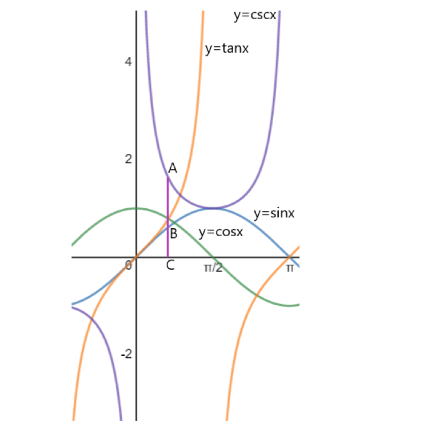
Above is the graph of the four functions on the same axes. B is the point of intersection of $ y = \cos x $ and the vertical line passing through the point of intersection of $ y = \cos x $ and $ y = \tan x $ , and A is the point of intersection of $ y = \csc x $ and the point of intersection of $ y = \cos x $ and $ y = \tan x $ .
At the point of intersection of $ y = \cos x $ and $ y = \tan x $ ,
$
\cos x = \tan x \\
\Rightarrow \cos x = \dfrac{{\sin x}}{{\cos x}} \\
\Rightarrow {\cos ^2}x = \sin x \\
\Rightarrow 1 - {\sin ^2}x = \sin x \\
\Rightarrow {\sin ^2}x + \sin x - 1 = 0 \;
$
Applying the quadratic formula in the above quadratic equation, we get –
$
\sin x = \dfrac{{ - 1 \pm \sqrt {{{(1)}^2} - 4(1)( - 1)} }}{{2(1)}} \\
\Rightarrow \sin x = \dfrac{{ - 1 \pm \sqrt 5 }}{2} \\
$
We know that $ - 1 \leqslant \sin x \leqslant 1 $ , so $ \sin x = \dfrac{{ - 1 - \sqrt 5 }}{2} $ is rejected.
So, $ \sin x = \dfrac{{ - 1 + \sqrt 5 }}{2} $
Equation of the line BC is $ y = \sin x $ or $ BC = \dfrac{{ - 1 + \sqrt 5 }}{2} $ and equation of line AC is $ y = \csc x $ or $ AC = \dfrac{1}{{\dfrac{{ - 1 + \sqrt 5 }}{2}}} = \dfrac{2}{{ - 1 + \sqrt 5 }} $
So –
$
AB = AC - BC = \dfrac{2}{{ - 1 + \sqrt 5 }} - \dfrac{{ - 1 + \sqrt 5 }}{2} \\
\Rightarrow AB = \dfrac{{4 - {{(\sqrt 5 - 1)}^2}}}{{2(\sqrt 5 - 1)}} \\
\Rightarrow AB = \dfrac{{4 - (5 + 1 - 2\sqrt 5 )}}{{2(\sqrt 5 - 1)}} \\
\Rightarrow AB = \dfrac{{4 - 6 + 2\sqrt 5 }}{{2(\sqrt 5 - 1)}} = \dfrac{{2\sqrt 5 - 2}}{{2\sqrt 5 - 2}} \\
\Rightarrow AB = 1 \;
$
Hence the length of AB is 1 unit.
So, the correct answer is “1 unit”.
Note: Trigonometric functions are the functions that tell us the relation between the sides of a right-angled triangle and one of its angles other than the right angle. Sine, cosine, tangent, cosecant, secant and cotangent are the main trigonometric functions. We find the equation of AC and BC as AC passes through cosecant function and BC passes through sine function.
Complete step by step solution:
Above is the graph of the four functions on the same axes. B is the point of intersection of $ y = \cos x $ and the vertical line passing through the point of intersection of $ y = \cos x $ and $ y = \tan x $ , and A is the point of intersection of $ y = \csc x $ and the point of intersection of $ y = \cos x $ and $ y = \tan x $ .
At the point of intersection of $ y = \cos x $ and $ y = \tan x $ ,
$
\cos x = \tan x \\
\Rightarrow \cos x = \dfrac{{\sin x}}{{\cos x}} \\
\Rightarrow {\cos ^2}x = \sin x \\
\Rightarrow 1 - {\sin ^2}x = \sin x \\
\Rightarrow {\sin ^2}x + \sin x - 1 = 0 \;
$
Applying the quadratic formula in the above quadratic equation, we get –
$
\sin x = \dfrac{{ - 1 \pm \sqrt {{{(1)}^2} - 4(1)( - 1)} }}{{2(1)}} \\
\Rightarrow \sin x = \dfrac{{ - 1 \pm \sqrt 5 }}{2} \\
$
We know that $ - 1 \leqslant \sin x \leqslant 1 $ , so $ \sin x = \dfrac{{ - 1 - \sqrt 5 }}{2} $ is rejected.
So, $ \sin x = \dfrac{{ - 1 + \sqrt 5 }}{2} $
Equation of the line BC is $ y = \sin x $ or $ BC = \dfrac{{ - 1 + \sqrt 5 }}{2} $ and equation of line AC is $ y = \csc x $ or $ AC = \dfrac{1}{{\dfrac{{ - 1 + \sqrt 5 }}{2}}} = \dfrac{2}{{ - 1 + \sqrt 5 }} $
So –
$
AB = AC - BC = \dfrac{2}{{ - 1 + \sqrt 5 }} - \dfrac{{ - 1 + \sqrt 5 }}{2} \\
\Rightarrow AB = \dfrac{{4 - {{(\sqrt 5 - 1)}^2}}}{{2(\sqrt 5 - 1)}} \\
\Rightarrow AB = \dfrac{{4 - (5 + 1 - 2\sqrt 5 )}}{{2(\sqrt 5 - 1)}} \\
\Rightarrow AB = \dfrac{{4 - 6 + 2\sqrt 5 }}{{2(\sqrt 5 - 1)}} = \dfrac{{2\sqrt 5 - 2}}{{2\sqrt 5 - 2}} \\
\Rightarrow AB = 1 \;
$
Hence the length of AB is 1 unit.
So, the correct answer is “1 unit”.
Note: Trigonometric functions are the functions that tell us the relation between the sides of a right-angled triangle and one of its angles other than the right angle. Sine, cosine, tangent, cosecant, secant and cotangent are the main trigonometric functions. We find the equation of AC and BC as AC passes through cosecant function and BC passes through sine function.
Recently Updated Pages
Master Class 11 Computer Science: Engaging Questions & Answers for Success

Master Class 11 Business Studies: Engaging Questions & Answers for Success
Master Class 11 Economics: Engaging Questions & Answers for Success
Master Class 11 English: Engaging Questions & Answers for Success
Master Class 11 Maths: Engaging Questions & Answers for Success
Master Class 11 Biology: Engaging Questions & Answers for Success
Trending doubts
One Metric ton is equal to kg A 10000 B 1000 C 100 class 11 physics CBSE
There are 720 permutations of the digits 1 2 3 4 5 class 11 maths CBSE
Discuss the various forms of bacteria class 11 biology CBSE
Draw a diagram of a plant cell and label at least eight class 11 biology CBSE
State the laws of reflection of light
10 examples of friction in our daily life