




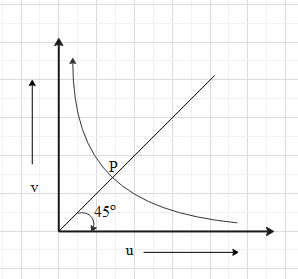
The graph shows variation of v with change in u for a mirror. Points plotted above the point P on the curve are for the values of v
A. smaller than f
B. smaller than 2f
C. larger than 2f
D. larger than f
Answer
 Verified
582.9k+ views
Hint: Use the mirror formula that gives a relation u, v and f and find an expression for v in the terms of u and f. Then find the relation between v and u at point P. Take a value of v greater than u and find the relation between v and f.
Formula used:
$\dfrac{1}{f}=\dfrac{1}{v}+\dfrac{1}{u}$
Complete answer:
Here, u is the position of the object and v is position of the image with respect to the mirror.
f is the focal length of the mirror.
The relation between u, v and f is given by $\dfrac{1}{f}=\dfrac{1}{v}+\dfrac{1}{u}$.
$\Rightarrow \dfrac{1}{v}=\dfrac{1}{f}-\dfrac{1}{u}$
$\Rightarrow \dfrac{1}{v}=\dfrac{u-f}{uf}$
$\Rightarrow v=\dfrac{uf}{u-f}$ ….. (i).
From the graph of v v/s u we can understand that as the object comes towards the mirror (as we reduce the object distance), the image distance increases. This means that v is inversely proportional to u.
Let us analyse the relation between u and v at point P. In the graph we can see that the point P also lies on a line passing through the origin and making an angle of ${{45}^{\circ }}$ with the positive x-axis.
From geometry we know that the x and y coordinates of the points on a line passing through the origin and making an angle of ${{45}^{\circ }}$ with the positive x-axis are equal.
This means that at point P, v = u.
Now, since the v is inversely proportional to u and at point P v = u, the value of v will be greater than the value of u for the points above point P.
Therefore, let v = nu, where n is a real number greater than one.
$\Rightarrow u=\dfrac{v}{n}$.
Substitute this value of u in (i).
$\Rightarrow v=\dfrac{\dfrac{v}{n}f}{\dfrac{v}{n}-f}$
$\Rightarrow \dfrac{v}{n}-f=\dfrac{f}{n}$
$\Rightarrow v-nf=f$
$\Rightarrow v=f+nf$
$\Rightarrow v=(n+1)f$.
But n >1
This means that (n+1) > 2.
This also means that (n+1)f > 2f
This finally means that v > 2f.
Therefore, the value of v is larger than 2f for the points above the point P.
So, the correct answer is “Option C”.
Note:
Other than taking the value of v as v =nu, we can just take some value of v greater than u, say v = 2u.
$\Rightarrow u=\dfrac{v}{2}$.
Substitute this value of u in (i).
$\Rightarrow v=\dfrac{\dfrac{v}{2}f}{\dfrac{v}{2}-f}$
$\Rightarrow \dfrac{v}{2}-f=\dfrac{f}{2}$
$\Rightarrow v-2f=f$
$\Rightarrow v=3f$
Substitute u = v in (i).
$\Rightarrow v=\dfrac{vf}{v-f}$
$\Rightarrow v-f=f$
$\Rightarrow v=2f$
This means that the value of v at point P is equal to 2f.
Hence, we can say that the value of v will be greater than 2f above point P.
Formula used:
$\dfrac{1}{f}=\dfrac{1}{v}+\dfrac{1}{u}$
Complete answer:
Here, u is the position of the object and v is position of the image with respect to the mirror.
f is the focal length of the mirror.
The relation between u, v and f is given by $\dfrac{1}{f}=\dfrac{1}{v}+\dfrac{1}{u}$.
$\Rightarrow \dfrac{1}{v}=\dfrac{1}{f}-\dfrac{1}{u}$
$\Rightarrow \dfrac{1}{v}=\dfrac{u-f}{uf}$
$\Rightarrow v=\dfrac{uf}{u-f}$ ….. (i).
From the graph of v v/s u we can understand that as the object comes towards the mirror (as we reduce the object distance), the image distance increases. This means that v is inversely proportional to u.
Let us analyse the relation between u and v at point P. In the graph we can see that the point P also lies on a line passing through the origin and making an angle of ${{45}^{\circ }}$ with the positive x-axis.
From geometry we know that the x and y coordinates of the points on a line passing through the origin and making an angle of ${{45}^{\circ }}$ with the positive x-axis are equal.
This means that at point P, v = u.
Now, since the v is inversely proportional to u and at point P v = u, the value of v will be greater than the value of u for the points above point P.
Therefore, let v = nu, where n is a real number greater than one.
$\Rightarrow u=\dfrac{v}{n}$.
Substitute this value of u in (i).
$\Rightarrow v=\dfrac{\dfrac{v}{n}f}{\dfrac{v}{n}-f}$
$\Rightarrow \dfrac{v}{n}-f=\dfrac{f}{n}$
$\Rightarrow v-nf=f$
$\Rightarrow v=f+nf$
$\Rightarrow v=(n+1)f$.
But n >1
This means that (n+1) > 2.
This also means that (n+1)f > 2f
This finally means that v > 2f.
Therefore, the value of v is larger than 2f for the points above the point P.
So, the correct answer is “Option C”.
Note:
Other than taking the value of v as v =nu, we can just take some value of v greater than u, say v = 2u.
$\Rightarrow u=\dfrac{v}{2}$.
Substitute this value of u in (i).
$\Rightarrow v=\dfrac{\dfrac{v}{2}f}{\dfrac{v}{2}-f}$
$\Rightarrow \dfrac{v}{2}-f=\dfrac{f}{2}$
$\Rightarrow v-2f=f$
$\Rightarrow v=3f$
Substitute u = v in (i).
$\Rightarrow v=\dfrac{vf}{v-f}$
$\Rightarrow v-f=f$
$\Rightarrow v=2f$
This means that the value of v at point P is equal to 2f.
Hence, we can say that the value of v will be greater than 2f above point P.
Recently Updated Pages
Master Class 10 Computer Science: Engaging Questions & Answers for Success

Master Class 10 General Knowledge: Engaging Questions & Answers for Success
Master Class 10 English: Engaging Questions & Answers for Success
Master Class 10 Social Science: Engaging Questions & Answers for Success
Master Class 10 Maths: Engaging Questions & Answers for Success
Master Class 10 Science: Engaging Questions & Answers for Success
Trending doubts
What is the median of the first 10 natural numbers class 10 maths CBSE
Which women's tennis player has 24 Grand Slam singles titles?
Who is the Brand Ambassador of Incredible India?
Why is there a time difference of about 5 hours between class 10 social science CBSE
Write a letter to the principal requesting him to grant class 10 english CBSE
A moving boat is observed from the top of a 150 m high class 10 maths CBSE