




The hybridisation of nitrogen in pyrrole is:
A.$s{{p}^{3}}$
B.$s{{p}^{2}}$
C.$sp$
D. cannot be predicted
Answer
 Verified
531.9k+ views
Hint: The nitrogen in pyrrole contains a lone pair of electrons which is in conjugation with the double bond of the ring, which makes the compound aromatic and similar hybridisation as the carbon atom in the benzene ring.
Complete answer:
In order to understand the question, we need to learn about hybridisation:
$\mathbf{sp}$ Hybridisation: This is the simplest type of hybridisation involving p and s orbitals. In this hybridisation one s and one p orbitals hybridise (or intermix) to produce two equivalent hybrid orbitals, known as sp hybrid orbitals. The suitable orbitals for sp hybridisation are s and ${{p}_{z}}$. if the hybrid orbitals are to lie along the z-axis. The two sp-hybrid orbitals are oriented in a straight line making an angle of 180 and therefore the molecule possesses linear geometry. Each of hybrid orbitals has 50 percent s-character and 50 percent p-character This type of hybridisation is also known as diagonal hybridisation. The two sp hybrids point in the opposite direction along the z-axis with projecting positive lobes are very small negative lobes, which provides more effective overlapping resulting in the formation of stronger bonds.
$\mathbf{s}{{\mathbf{p}}^{\mathbf{2}}}$Hybridisation: In $s{{p}^{2}}$ hybridisation one s and two p ( and p) orbitals of one atom hybridize to give three equivalent $s{{p}^{2}}$ hybrid orbitals. These three $s{{p}^{2}}$hybrid orbitals are directed towards the three corners of an equilateral triangle with an angle of ${{120}^{0}}$and give a triangular geometry to the molecule.
$\mathbf{s}{{\mathbf{p}}^{\mathbf{3}}}$Hybridisation: In this hybridisation one s and three p-orbitals intermix to form $s{{p}^{3}}$ hybrid orbitals of equivalent energy and identical shape. These four $s{{p}^{3}}$hybrid orbitals are directed towards the four corners of a tetrahedron separated by an angle of ${{109}^{0}}28'$. $s{{p}^{3}}$ hybrid orbitals have 25 percent s-character and 75 percent p character.
Let us see the structure of pyrrole:
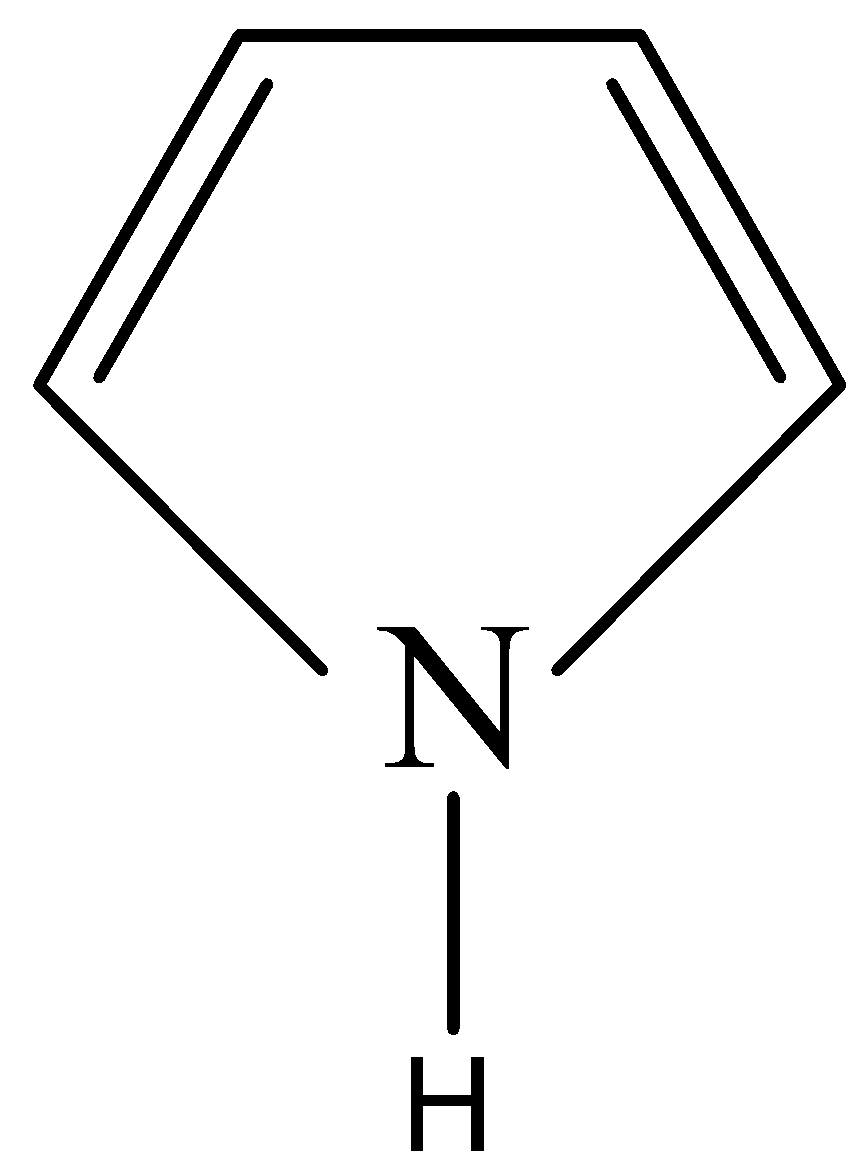
We can see that the nitrogen is $s{{p}^{2}}$ hybridised.
So, we get the correct option for the question as option B.
Note:
It is to be noted that the hybridisation is not $s{{p}^{3}}$, as there is a lone pair of electrons available in nitrogen which involve conjugation with the double bond.
Complete answer:
In order to understand the question, we need to learn about hybridisation:
$\mathbf{sp}$ Hybridisation: This is the simplest type of hybridisation involving p and s orbitals. In this hybridisation one s and one p orbitals hybridise (or intermix) to produce two equivalent hybrid orbitals, known as sp hybrid orbitals. The suitable orbitals for sp hybridisation are s and ${{p}_{z}}$. if the hybrid orbitals are to lie along the z-axis. The two sp-hybrid orbitals are oriented in a straight line making an angle of 180 and therefore the molecule possesses linear geometry. Each of hybrid orbitals has 50 percent s-character and 50 percent p-character This type of hybridisation is also known as diagonal hybridisation. The two sp hybrids point in the opposite direction along the z-axis with projecting positive lobes are very small negative lobes, which provides more effective overlapping resulting in the formation of stronger bonds.
$\mathbf{s}{{\mathbf{p}}^{\mathbf{2}}}$Hybridisation: In $s{{p}^{2}}$ hybridisation one s and two p ( and p) orbitals of one atom hybridize to give three equivalent $s{{p}^{2}}$ hybrid orbitals. These three $s{{p}^{2}}$hybrid orbitals are directed towards the three corners of an equilateral triangle with an angle of ${{120}^{0}}$and give a triangular geometry to the molecule.
$\mathbf{s}{{\mathbf{p}}^{\mathbf{3}}}$Hybridisation: In this hybridisation one s and three p-orbitals intermix to form $s{{p}^{3}}$ hybrid orbitals of equivalent energy and identical shape. These four $s{{p}^{3}}$hybrid orbitals are directed towards the four corners of a tetrahedron separated by an angle of ${{109}^{0}}28'$. $s{{p}^{3}}$ hybrid orbitals have 25 percent s-character and 75 percent p character.
Let us see the structure of pyrrole:
We can see that the nitrogen is $s{{p}^{2}}$ hybridised.
So, we get the correct option for the question as option B.
Note:
It is to be noted that the hybridisation is not $s{{p}^{3}}$, as there is a lone pair of electrons available in nitrogen which involve conjugation with the double bond.
Recently Updated Pages
Master Class 11 Computer Science: Engaging Questions & Answers for Success

Master Class 11 Business Studies: Engaging Questions & Answers for Success
Master Class 11 Economics: Engaging Questions & Answers for Success
Master Class 11 English: Engaging Questions & Answers for Success
Master Class 11 Maths: Engaging Questions & Answers for Success
Master Class 11 Biology: Engaging Questions & Answers for Success
Trending doubts
One Metric ton is equal to kg A 10000 B 1000 C 100 class 11 physics CBSE
There are 720 permutations of the digits 1 2 3 4 5 class 11 maths CBSE
Discuss the various forms of bacteria class 11 biology CBSE
Draw a diagram of a plant cell and label at least eight class 11 biology CBSE
State the laws of reflection of light
Explain zero factorial class 11 maths CBSE